Words create. Words frame what we see, what we tolerate, what we demand and what we build. Cape Town now needs new words for an old wound: land, belonging, justice and the right of ordinary people to live near the opportunities they help create.
Cape Town is at a defining moment. Two developments, arriving almost together, tell one story about our city’s future. On the one hand, property developers report that about one-third of recent Atlantic Seaboard transactions, worth billions in the Deeds Office, have been purchased by foreigners. On the other hand, the Constitutional Court has ruled that the sale of the Tafelberg site in Sea Point was unlawful and has placed the City of Cape Town and Western Cape Government under constitutional obligation to advance affordable housing in well-located areas.
These are not separate stories. They are one mirror held up to the soul of the city.
They ask a simple but uncomfortable question: if global capital can find a way into Sea Point, Green Point, Camps Bay and the Atlantic Seaboard, why can government not find a way for nurses, teachers, municipal workers, hospitality workers, young professionals, artists, security guards, cleaners, carers and working families to live closer to the city they serve?
This is not an argument against foreign buyers. Cape Town is a global city. We should welcome visitors, investors, entrepreneurs, families and dreamers who bring capital, confidence, creativity and connection into our economy. We must avoid lazy nationalism and dangerous xenophobia. The issue is not the passport of the buyer. The issue is market structure, scarce well-located land, weak public value capture and the continued exclusion of ordinary Capetonians from places where opportunity is concentrated.
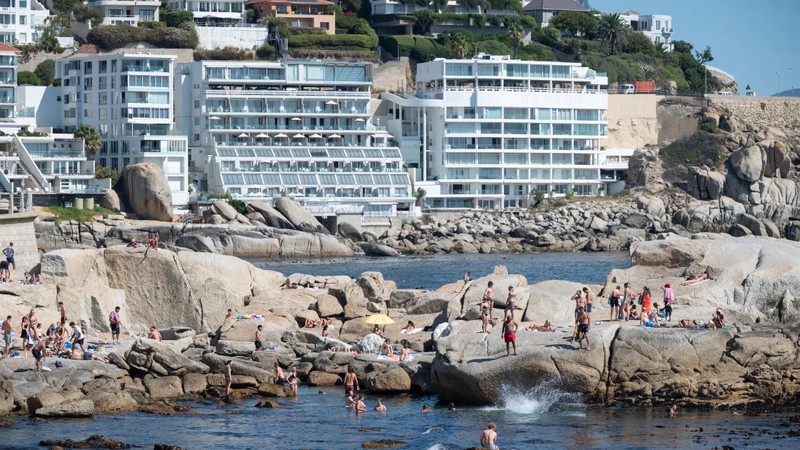
The Atlantic Seaboard is not an ordinary property market. It is a fixed-supply coastal corridor, trapped between mountain and sea, protected by beauty, scarcity and global desirability. When buyers earning in pounds, euros, dollars, dirhams and francs compete with South Africans earning in rands, prices detach from local incomes. A flat can become a currency hedge, lifestyle asset, second residence, short-term rental, wealth store and global portfolio instrument.
That is the real problem. Cape Town land is increasingly priced by global wealth, while Cape Town’s people are still paid by a local economy marked by inequality, unemployment, apartheid geography, long transport costs and inherited exclusion.
The Constitutional Court’s Tafelberg judgment therefore lands with historic force. It tells government that location matters. Housing on the urban edge, far from work, schools, hospitals, public transport, universities and social networks, cannot be the only answer. The poor and working class cannot be permanently pushed to the margins while prime public land is sold, delayed, underused or left idle.
This is a sovereignty-of-place question. Who has the right to belong in Cape Town? Who is the city being built for? Who benefits when land values rise? Who pays the price when working people are pushed further and further away? And what does government do when the market produces exclusion faster than policy produces justice?
Mayor Geordin Hill-Lewis now has an opportunity to lead with courage, not defensiveness. The Court has provided the constitutional instruction. The property market has provided the warning signal. Capetonians need an implementation blueprint, not another press statement.
The first commitment should be a public land release schedule within 90 days. The City must publish every suitable parcel of municipal land around the CBD, Sea Point, Green Point, Woodstock, Salt River, Observatory, Maitland, Paarden Eiland, Bellville, Wynberg, Athlone and transport-linked corridors, with timelines for feasibility, rezoning, funding, procurement and construction. Public land must be accounted for publicly. Land held in trust for the people must serve the people.
Second, the City must establish a Cape Town Spatial Justice and Property Observatory. We need quarterly data on foreign purchases, local purchases, company and trust ownership, vacancies, short-term rentals, bond finance, price bands, rental escalation, evictions, valuations and affordable housing delivery. Rumour must be replaced by evidence. Evidence must drive policy. Policy must produce homes.
Third, Cape Town must implement mandatory inclusionary housing. Any developer receiving extra rights, height, density, departures, public land access or planning advantage must contribute affordable units on site, nearby, or through a ring-fenced affordable housing fund. Development cannot continue as private gain with public consequences. If the city creates value through zoning, rights and approvals, the public must share in that value.
Fourth, the City should introduce a differential municipal rate for vacant investment units and high-intensity short-term rentals. If a property functions as an investment hotel without hotel obligations, it must contribute more to city social infrastructure. This is not punishment. It is balance. Homes must first be homes before they become speculative instruments.
Fifth, Mayor Hill-Lewis should formally request that National Treasury and SARS consider a non-resident buyer surcharge for high-value residential purchases in declared housing-pressure zones. The money must not disappear into the general fiscus. It must be ring-fenced for social housing, affordable rental, land acquisition and inner-city infrastructure.
Sixth, the City and Province must create a bank-backed affordable housing compact. If banks can finance luxury purchases and foreign buyers with confidence, they can also help finance mixed-income rental, social housing and worker accommodation. The banks benefit from rising property values. They should now help stabilise the social foundations of the city that creates those values.
Seventh, Tafelberg must become a demonstration project, not a legal monument. The site should be developed as a high-quality, mixed-income community that proves affordable housing can exist in Sea Point without destroying value, safety, dignity or neighbourhood quality. The best answer to fear is excellence. The best answer to resistance is a well-designed, well-managed, beautiful project that works.
Eighth, communities must be brought into co-design. Affordable housing is often opposed because people imagine badly managed, underfunded projects. The City must set non-negotiable standards for design, safety, tenant support, public space, maintenance, governance and long-term management. Social housing must be secure, dignified, integrated and beautiful.
Ninth, Cape Town needs an anti-displacement plan for areas already under pressure: Salt River, Woodstock, Observatory, Maitland, Bo-Kaap, District Six surrounds, Wynberg, Athlone and parts of the Voortrekker Road corridor. Without tenant protection, rental support, land banking, public acquisition and community benefit agreements, regeneration becomes removal by price.
Tenth, the Mayor should report to the public every quarter. Not slogans. Numbers. Sites released. Units approved. Units under construction. Units completed. Money raised. Land unlocked. Delays explained. Officials accountable. Partners named. Communities engaged. Cape Town does not need performance politics. It needs performance government.
This is the minimum.
Cape Town can still choose a better path. We can welcome responsible global capital while insisting that it contributes to a just city. We can protect property rights while also honouring constitutional rights. We can build density without destroying neighbourhoods. We can attract investment without surrendering belonging. We can become a world-class city without becoming a city only the world’s wealthy can afford.
But this requires a new compact. Residents must support well-located affordable housing, not only in principle but in their own neighbourhoods. Developers must accept that public value capture is part of responsible investment. Banks must help finance inclusive supply. Province must release land. National government must support funding and regulatory reform. The City must lead implementation. Civil society must monitor delivery. Communities must help shape solutions, not only oppose proposals.
The deeper wisdom is this: a city is not only an asset class. It is a covenant between generations. It is memory, work, prayer, school, family, sea air, taxi routes, corner shops, public parks, burial grounds and daily dignity. Cape Town’s beauty does not belong only to those who can buy a view. It belongs also to those who clean the hotels, nurse the sick, teach the children, guard the buildings, cook the meals, drive the buses, fix the roads and keep the city alive.
The Tafelberg judgment has reopened the moral imagination of Cape Town. The foreign-buyer data has exposed the market pressure. Now leadership must turn judgment into justice.
Mayor Hill-Lewis should not see this as an attack. He should see it as an invitation to make history. You have ignore me and us in the past. Lets co-create.
Cape Town does not need anti-investor politics. It needs pro-resident courage. It needs a sovereign urban operating system: truth in the data, justice in the land, discipline in implementation, compassion in design, value capture from growth and accountability in leadership. This is how we roll… This is how we be, we feel, we see and we do things..
Let the Atlantic Seaboard remain beautiful. But let it no longer be a symbol of exclusion.
Let foreign capital be welcomed, but not worshipped.
Let public land serve public purpose.
Let development create belonging, not displacement.
Let Tafelberg become the turning point.
Let every Capetonian who reads this ask not only, “What is government doing?” but also, “What must I and We do to support, defend and help build?”
Because cities are created twice: first in language, then in concrete.
Let us all together now speak Cape Town into justice and then build it.
* Faiez Jacobs is a governance adviser, former Member of Parliament, founder of The Transcendence Group, Capetonian, activist and servant of the people.
** The views expressed do not necessarily reflect the views of IOL.


