In the 1940s, a youngster sat in a mathematics class taught by Oliver Tambo, then a young teacher not much older than his pupils.
It was decades before Tambo would leave apartheid South Africa and lead the ANC from exile after the organisation was banned in 1960.
Sitting in his classroom was Joe Matthews, then a student who would go on to become a lawyer and a senior figure in the same movement.
And such was the impression Tambo made that Matthews would tell his family for years afterwards that he had never had a better mathematics teacher.
“My dad was a lawyer, but he talked about education a lot as he had been impacted by the great mathematics teaching of a young teacher at his school, OR Tambo,” said Matthews’ daughter Naledi Pandor, who would grow up to become one of the most senior women in SA government, serving in five different Cabinet portfolios before becoming the minister who took Pretoria’s case against Israel to the International Court of Justice.
When she came home and said she wanted to study English and history, her two favourite subjects, her parents encouraged her to pursue her interests.
They did, however, insist she add a teaching qualification to her degree.
Pandor, now 72, took the advice, and it set the course of the next 14 years of her life.
She taught at a comprehensive school in London, in classrooms in Gaborone and at a teacher training college in Taung before joining the University of Cape Town in 1989.
There, she lectured black students who had come through an apartheid schooling system deliberately funded at a fraction of the amount spent on white children.
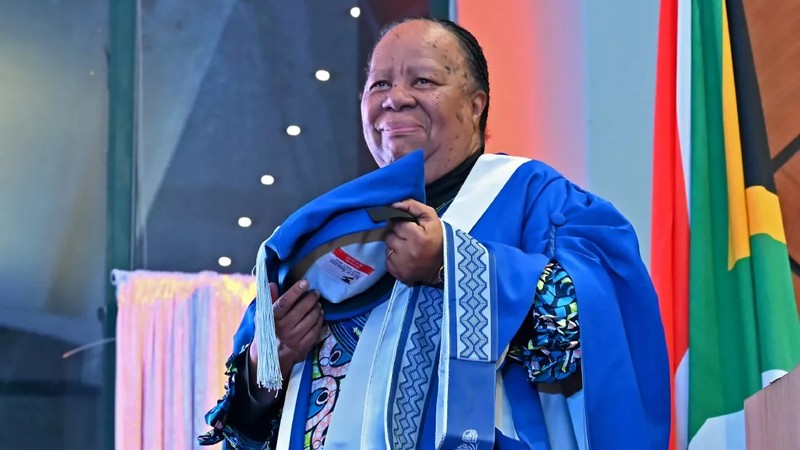
That teaching career, and the family that steered her into it, is what the University of the Western Cape was recognising on Friday night when it made her an honorary doctor at the Old Mutual Conference Centre in Kirstenbosch.
She was one of seven honoured, alongside former Irish president Mary Robinson, Advocate Adila Hassim SC, UN investigator Francesca Albanese and Professor Emeritus Loyiso Nongxa, along with two women who did not live to see it, Charlotte Maxeke and Mandisa Monakali.
It was the latest in a string of honorary doctorates for Pandor.
She received her first from the Cape Peninsula University of Technology, followed by honours from Stellenbosch University in 2013, the University of Lisbon in 2017 and University College Dublin.
A decorated servant
Pandor has been decorated by governments and institutions across three continents, and in three decades in public life she has emerged with an unblemished record, a rarity among senior figures of her generation in SA politics.
When she received the call from UWC telling her she would receive an honorary doctorate, Pandor said it gave her goosebumps.
“To be honoured by this institution in particular, with that history,” she told IOL in an interview shortly before the degrees were conferred.
“All of that just comes together in a very positive way, and gives one a feeling of goosebumps, you know, of really, wow, what a wonderful honour.”
Accepting the degree on stage a short while later, she told those gathered how she reacted when UWC first called her.
“The moment I received the call, the thought was about the historic character of the University of the Western Cape and its contribution to our struggle for freedom,” Pandor said at the ceremony.
“But also the role it has played post-apartheid and the continuing interest in building our society.
“And I thought, wow, what an honour to be associated with an institution that has all these characteristics. I feel very, very privileged, and I was so thrilled to be nominated.”
A family that teaches
Education is the family trade in the Matthews household, and has been for a century.
Pandor’s mother, Regina Thelma, was a teacher.
Her grandfather was Professor ZK Matthews, who in 1923 became the first black South African to earn a BA from a South Africa institution, and in 1930, the first to earn an LLB in the country.
ZK spent his working life lecturing at Fort Hare, where Nelson Mandela, who would become South Africa’s first democratically elected president, was among his students, along with Tambo and Seretse Khama, who later became Botswana’s first president.
It was ZK who conceptualised the Congress of the People that produced the Freedom Charter in 1955.
Her grandfather taught Tambo. Years later, Tambo taught her father, who would encourage her to become a teacher herself.
But Pandor’s own schooling was shaped by a childhood spent moving between countries. Her father’s political work forced the family into exile in 1961, when she was eight.
They went first to Lesotho, then Zambia, England and finally Botswana, where she matriculated from Gaborone Secondary School in 1972.
She earned a BA from the University of Botswana in 1977, later adding a master’s from the University of London, a master’s in linguistics from Stellenbosch University and a doctorate examining the transformation of higher education in SA since apartheid ended.
The classroom years
Her first teaching job was at Ernest Bevin School in London in 1980.
She taught in Gaborone from 1981 to 1984, then returned home to lecture at Taung College of Education, where she trained other teachers.
From 1986 to 1989, she was a senior lecturer in English at the University of Bophuthatswana.
In 1989 she joined UCT’s academic support programme, working with students who had come through the damaged schooling system created by apartheid. She stayed there until 1994.
“With respect to lecturing, key moments include the courage of largely SASCO students on a difficult still majority white UCT campus,” Pandor told IOL.
SASCO, the SA Students’ Congress, was a national student organisation formed in 1991 from the anti-apartheid student movement.
It was active on university campuses in the fight against apartheid and for a democratic, non-racial education system.
“Their resistance and determination was impressive,” she said.
“Also, the role of academics such as Jakes Gerwel, Franklin Sonn and even Stuart Saunders, who insisted higher education had a societal obligation to strive for freedom.”
Gerwel is the name that explains the goosebumps.
He was rector of UWC from 1987 to 1994, transforming an institution the apartheid government had established in 1960 as a college for coloured students into what became known as the intellectual home of the left.
He left UWC to become Mandela’s director-general in the presidency and, when Mandela established the Nelson Mandela Foundation in 1999, became its founding chairperson.
Pandor now holds that same position.
She became chairperson of the foundation in October 2024, only the third person to do so.
Three decades in Parliament
Pandor was elected to Parliament in 1994 and spent the next 30 years in public service.
She served as deputy chief whip of the ANC in the National Assembly before moving to the National Council of Provinces, Parliament’s upper house, where she was deputy chairperson and then chairperson from 1999 to 2004.
Then-president Thabo Mbeki appointed her minister of education in 2004.
Under his successor, Jacob Zuma, she served as minister of science and technology from 2009, moved to home affairs in 2012 and returned to science and technology in 2014.
Incumbent President Cyril Ramaphosa appointed her minister of higher education and training in 2018 and minister of international relations and cooperation in 2019, a position she held until leaving government in June 2024.
Four of the five ministerial portfolios Pandor held during her 20 years in government were in education, science or research.
The fifth took her into international affairs and put her on the world stage.
In December 2023, in the closing months of her term as international relations minister, SA filed its genocide case against Israel at the International Court of Justice.
Pandor was in The Hague for the hearings the following month.
Hassim, who was honoured alongside her on Friday night, was part of the legal team that argued the case.
She has remained outspoken on the issue since leaving office.
Asked about Francesca Albanese, the UN special rapporteur on the situation of human rights in the Palestinian territories occupied since 1967, who was honoured at the same ceremony, Pandor did not hesitate.
“I think she has done a sterling job in the role of special rapporteur on Palestine,” she told IOL.
“I know it has been a very challenging role for her, because of the resistance to the acknowledgement that the Palestinian people do not enjoy freedom, justice or democracy.
“But she has been very clear in presenting on the public stage the experience of Palestinian people, and recording in very clear fashion what is happening to the Palestinian people.
“And, of course, she has had terrible experiences of sanctions against her, and her family threats and intimidation.
“But even in the face of that, she has remained true to her task, reflecting in some way the University of the Western Cape.”
Albanese has been on a US sanctions blacklist since July 2025, when secretary of state Marco Rubio announced the measures and said she had tried to push the International Criminal Court into action against US and Israeli officials and companies.
She was barred from entering the US and cut off from American banks.
A Washington judge blocked the sanctions in May and the Treasury removed her from its list on May 20, but the US Court of Appeals for the District of Columbia Circuit ruled they would stay in force while her family’s legal challenge runs.
Back on campus
In April this year, Pandor returned to university life, taking up the chancellorship of Nelson Mandela University in Gqeberha on 1 April and being installed a week later.
She succeeded Dr Geraldine Fraser-Moleketi and is the university’s fourth chancellor.
She talks about the role differently from the ministerial positions she held in government.
“I feel like I’m back home somewhat and I hope that I will get to have a fuller role in Nelson Mandela University,” Pandor told IOL.
“I’m still a new chancellor, but it is a brilliant institution, and, of course, I have always loved education.
“And so to work closely with academics and students is a great pleasure.”
She is not treating it as a ceremonial post.
At her installation in April, she said the university had a duty to speak out about the pressure being placed on universities around the world, and described the near silence of the global South during the current crisis as one of the more worrying things she had observed.
UWC rector and vice-chancellor Professor Robert Balfour told Friday’s ceremony that the university confers relatively few honorary degrees and considers each recipient carefully.
“Our honorary graduates include figures closely connected to SA’s struggle for democracy,” Balfour said.
“Among them are Nelson Mandela, Oliver Tambo, Albertina Sisulu and Albie Sachs.
“An honorary degree from this university has therefore long expressed solidarity, as well as inspired admiration.
“Advocate Adila Hassim and Dr Naledi Pandor have advanced SA’s engagement with international law.
“Mary Robinson and Francesca Albanese have kept the world’s attention on human rights and accountability.”
And though Pandor is two years out of government, none of it looks much like retirement.
But of all the things she did in public life, she said what she remembered most from her years as a lecturer was the students.
“The most important moments were seeing those first time entry to higher education black families celebrate their son or daughter at graduation.”
IOL News


