Nearly a year after gender-based violence and femicide was classified as a national disaster, South Africa’s shelter sector says the response remains too slow, with many organisations supporting survivors struggling to stay afloat.
The National Shelter Movement of South Africa (NSMSA) will host its Sixth National Shelter Indaba from September 15 to 17, 2026, bringing together voices from the country’s shelter sector at a critical moment in South Africa’s response to gender-based violence and femicide (GBVF).
The movement, which supports around 100 shelters across the country, says approximately 90% of these shelters are struggling with funding and other forms of support despite providing essential frontline services to survivors.
The Indaba comes nearly a year after GBVF was classified as a national disaster, raising questions about whether the urgency reflected in that classification has translated into meaningful support for organisations working directly with survivors.
“When we talk about GBVF as a national disaster, we must understand what that means in the life of a woman trying to escape violence,” the NSMSA said.
The organisation stressed that survivors need more than temporary accommodation.
Shelters often provide a range of services, including mental-health support, legal assistance, counselling and support for children who have also been exposed to violence.
“For a woman escaping violence, the response to GBVF can mean finding somewhere safe to sleep, securing a protection order, accessing legal assistance, dealing with trauma, finding mental-health support, caring for children who have also been exposed to violence and, ultimately, finding a way to rebuild an independent life,” the organisation said.
Moving beyond the headlines
The NSMSA is calling on civil society organisations, policymakers, funders, researchers, media, community leaders and members of the public to join the Indaba online.
The event will be livestreamed across the organisation’s social media platforms.
The aim is to move conversations around GBVF beyond statistics and daily headlines and focus on the realities confronting survivors and the organisations supporting them.
The programme will examine progress made against commitments and resolutions since the first National Shelter Indaba in 2020.
Discussions will include the role of the National Council on GBVF, community responses to violence, protection orders, mental-health support for shelter workers, financial empowerment for survivors and the state of shelters across South Africa’s provinces.
The programme will also explore specialised support for boys affected by sexual violence and cross-sector collaboration in responding to GBVF.
From survival to independence
A major focus of this year’s Indaba will be the long-term support survivors need to move beyond immediate survival towards sustainable social and economic independence.
Financial empowerment will form part of the discussion, aligning with the 2026 Women’s Month theme, “Empowered Women Empower the Nation.”
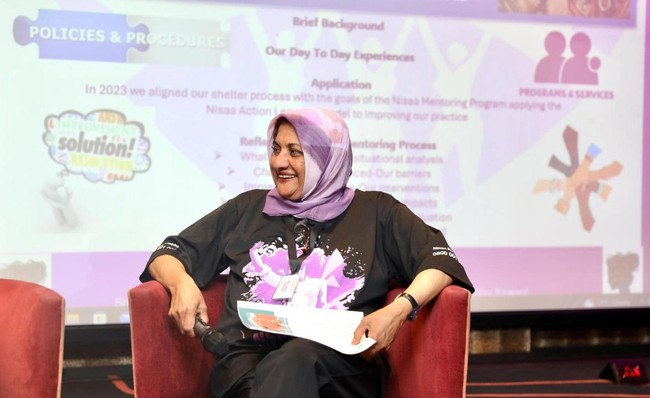
The appointment of Dr Zubeda Dangor, NSMSA’s Head of the Executive, to the National Council on GBVF is also expected to strengthen the connection between the experiences of frontline shelter workers and national policymaking.
Dr Zubeda Dangor speaking on the panel
The organisation believes the appointment creates an opportunity to examine whether national commitments are translating into practical improvements for survivors across the country.
A national disaster that still requires fundraising
One of the most pressing concerns raised by the NSMSA is the financial strain facing shelters.
According to the organisation, shelter teams are often forced to divide their time between supporting survivors and fundraising to keep their organisations operating.
“It is heartbreaking that shelter teams have to leave their essential work with survivors to focus on fundraising, which has also become an essential part of the job,” the NSMSA said.
The organisation estimates that it costs a shelter around R300 per person per day to cover living expenses and provide support services.
This includes food, toiletries, facilities, maintenance, water and electricity, as well as counselling and skills development programmes.
The NSMSA argues that fundraising cannot replace an adequately resourced national response.
As South Africa continues to confront the devastating impact of GBVF, the Sixth National Shelter Indaba is expected to ask a crucial question: If GBVF is recognised as a national disaster, what happens next for the survivors and the shelters working to keep them safe?
The Indaba will take place from September 15 to 17, 2026 and will be livestreamed on the National Shelter Movement of South Africa’s social media platforms.
For Zakithi Nene, this weekend's Diamond League final in Brussels is about more than simply making up the numbers. For the first time, the South African 400m runner will actually get to compete for the coveted Diamond League trophy after qualifying for the season-ending showpiece in previous years without being able to take his place on the starting line.“Funny enough, as much as I’ve qualified for a lot of Diamond […]