For Igshaan Amlay, the transition from schoolboy to political prisoner was not historical happenstance, but a consequence of a life steeped in activism.
By 1976, while most children his age were preoccupied with play, Amlay was already participating in solidarity protests for the Sharpeville Massacre at Klip Primary in Grassy Park.
“We went to sit outside on the sand sports field to protest,” he recalls, saying “activism was built into me from a young age.”
This early exposure defined his philosophy: that history is a lesson that cannot be killed, and that the fight for education was the only way to escape the “gutter education” designed for the oppressed.
These values would later bind him together with the other members of the Wynberg 7: Julian Stubbs, Wayne Jordaan, Nasir Masoet, Shouket Enous, Dee Dicks, and Venetia de Klerk.
Across the country, resistance movements had begun calling on communities to make South Africa “ungovernable”, and the political atmosphere in the Western Cape was tense and volatile.
On October 15,1985, Igshaan Amlay attended a mass rally at Wynberg High School.
The gathering drew students, activists, and community members, all of whom responded to the growing momentum of protest.
As veteran activist Graham Block prepared to address the crowd, the situation shifted dramatically.
“Security police gripped him and arrested him,” Amlay recalls.
The arrest ignited immediate outrage.
“That’s when all hell broke loose,” he says.
The crowd surged out of the school grounds and began marching up Park Road. But the response from the state was swift.
Security forces moved in with Casspirs and armed personnel, blocking the advancing protesters and asserting control through force.
By that stage, Amlay says he had already become involved in manufacturing petrol bombs as part of the resistance.
In the chaos of the confrontation, he remembers making a split-second decision, one he will never forget.
“I threw one at the police escort vehicle and saw the vehicle engulfed in flames.”
As the confrontation intensified, the students retreated, pursued by police vehicles and tear gas as the rally dissolved into running street battles.
The Siege of the Bedroom
Fleeing the heavy police response, Amlay and around thirty others sought refuge in the Pandy family home nearby.
Inside the house, the group crowded into a small bedroom measuring roughly three metres by three metres. In a desperate attempt to keep the police out, they barricaded the door.
“We pushed a cupboard against the door,” Amlay says, recalling the moment.
Outside, the sound of security forces closing in grew louder.
“You could hear the boots on the ground,” he says.
The room quickly filled with fear and uncertainty as the group waited, hoping the police would move past the house. But the brief sanctuary did not last.
The stand-off was broken when a police officer forced his hand and a firearm through the window.
“The pandemonium broke out,” Amlay recalls.
Within moments, the cupboard was pushed aside, the door forced open, and the students were dragged from the room.
What followed, he says, revealed a calculated legal strategy by the apartheid state.
“They waited for me to turn 18 to avoid international fallout for sending minors to prison.”
They watched the calendar until I was legally a ‘man’ so they could throw the book at us.”
In May 1987, two days after his 18th birthday, the headline read: Wynberg 7 to start prison term.
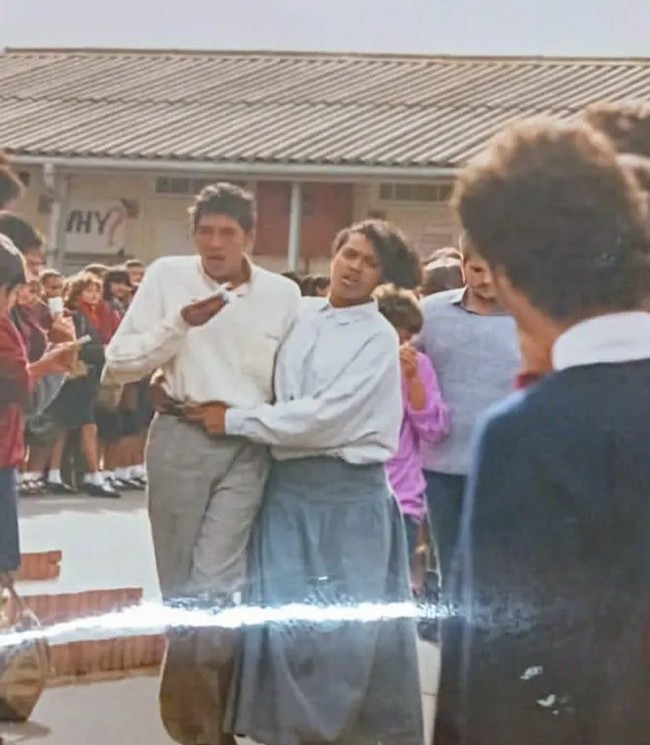
Isghaan Amlay and Dee Dicks, with Venetia de Klerk and Julian Stubbs partially hidden behind them, depart South Peninsula High School following their last assembly. This was a few days before they went to prison.
Pollsmoor: The Numbers and the Trauma
Entering Pollsmoor Maximum Security Prison as a teenager meant being placed among hardened offenders, a deliberate attempt, Amlay believes, to intimidate the young activists.
“They mixed us with common criminals,” Amlay tells IOL.
The tactic was meant to break their resolve. Instead, Amlay confronted the reality of prison life directly.
Inside Pollsmoor, the powerful Numbers prison gangs held significant influence.
Rather than avoid them, Amlay chose to address them openly, setting out the political purpose behind the group’s actions.
“I told them we were fighting to free their children, or their children’s children,” he recalls.
The response surprised him.
“Because of that, they respected us as political prisoners.”
Yet the respect of the gangs could not shield the young detainees from the psychological toll of prison life.
During his time inside, Amlay and the Wynberg 7 witnessed suicides in nearby cells, events he says left lasting scars on those who survived.
“It mentally impacted us,” he says quietly. The experience, he explains, was something many of the group carried with them long after their release.
But the deepest disappointment came later.
Amlay speaks with visible frustration about how former activists were reintegrated into society after apartheid.
The men and women who would later become known as the “Wynberg 7”, he says, were released without any meaningful support.
“There was no psychological assessment or debriefing,” he explains, as the consequences, he believes, are still being felt today.
Three members of the group are struggling to cope with the long-term effects of imprisonment.
One has been institutionalised, while others are living in difficult circumstances.
The sense of abandonment hangs heavy.
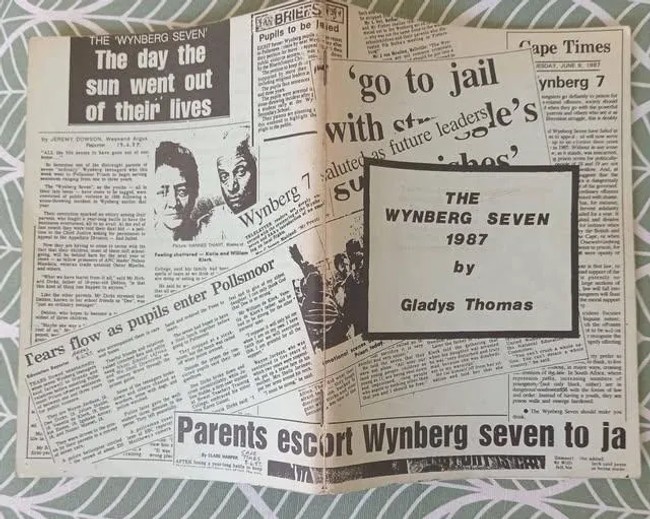
The Wynberg Seven were published across newspapers in South Africa.
Reparations Due
Amlay tells IOL how the ANC has done nothing for the Wynberg 7.
“We requested special pensions for the group, especially for those affected by our incarceration. The ANC has not provided us with assistance.”
“The Department of Defence and the Department of Military Veterans have sent us from pillar to post, while people who were not involved in our struggle have received special pensions.” Amlay claims.
The Wynberg 7 haven’t received proper acknowledgment either.
“We stood at the forefront of the Struggle as students in the Western Cape.
“This is something we have fought for all along, and we continue to fight for it.”
Amlay connects this matter to the findings of the Truth and Reconciliation Commission (TRC).
“As for the TRC, it acknowledged three members of the Wynberg 7 as victims and classified the other four as witnesses,” he explains.
“The TRC compensated three members of the Wynberg 7; it ignored the other four.
“The finding stated that the other four were classified as witnesses, while only the three received recognition as victims.”
Reflecting on the state of democracy in 2026, Amlay’s critique is sharp.
He argues that South Africa has transitioned from a system of overt racism to an insidious classism.
He considers classism “more dangerous” because it allows the wealthy of all races to coexist in a bubble of privilege while the plight of the poor remains unchanged.
“The rich stay richer, and the poor stay poorer,” he observes.
This structural inequality, he notes, is visible in the very “organogram” of Cape Town.
While the city’s top management remains largely in the hands of a white minority, it is the “coloured workforce” who are “standing with brooms to sweep”.
Amlay explains that the basic promises of the constitution – free healthcare, free university education, and free housing, all of which remain unfulfilled.
“They are written in the constitution,” he tells IOL, “but they have still not been met.”
The Warning: Divide and Rule
Amlay warns that modern political organisations are often undermined by the same “divide and rule” tactics used in the past during apartheid.
Promising leaders, he says, are frequently “monitored and offered bribes”, salaries, houses, or a car to influence their movements for personal gain.
He urges the younger generation to seek political education, as many remain unaware of the history of forced removals or the true platforms of the parties they vote for.
His final message is one of legacy and accountability.
Amlay stresses the importance of “giving a person flowers while they are still alive,” pointing out figures like Soli Philander, who are often only hailed as “legends” once they have passed.
“Unity is strength,” Amlay says.
“Upon death, you are wrapped in the same blanket and sheet in which you were born.”
During Sunday's meditation, I was guided to connect to the earth. To find a tree. I closed my eyes, and the baobab arrived before I even looked for it. Roots that go deeper than any drought can reach. Bark that has held the memory of centuries without cracking under the weight of them. I sat with that image for a long time.Then I came home, opened Migrations Beneath a Baobab, […]