The City of Cape Town is taking steps to secure its water supply, amid rising demand and lower-than-expected rainfall.
The city’s 2026 Water Outlook reports that water demand exceeded its target in 2025/26 due to below-average rainfall, an early end to the rainy season, and a longer dry summer.
Household water use also remained higher than expected through winter, declining mainly during rain.
Councillor Zahid Badroodien, the Mayoral Committee Member for Water and Sanitation, said: “We are not waiting for the next drought to start preparing. We are investing now in new water sources and better ways of managing our existing resources.”
Their goal, according to Badroodien, is to establish a water supply network that is increasingly resilient, diversified, and equipped to endure climate instability, drought, and the needs of an expanding population.
“The City encourages residents and businesses to continue using water wisely. Every reduction in unnecessary water use helps to protect Cape Town’s available resources and gives the system greater flexibility to manage future pressures,” he said.
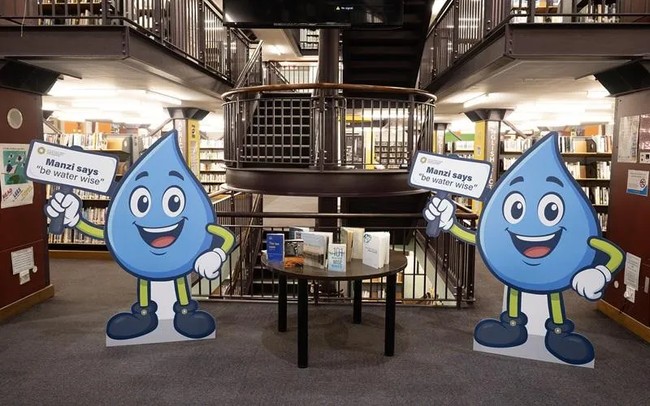
Life-size cut-outs of Manzi, the City’s Water and Sanitation Directorate mascot, are on display at 102 libraries across the metro, encouraging residents to use water wisely.
Dam levels stable, but rainfall uncertain
According to the report, early rains brought July 2026 dam levels to around 76%, keeping immediate supply risks low. However, with below-average rainfall forecast, the City is monitoring conditions for potential low-level restrictions.
Water security also depends on managing demand, infrastructure constraints, maintenance, and complex long-term projects.
The New Water Programme aims to diversify sources — using groundwater, surface water, reuse, desalination, and nature-based solutions — to add 300 million litres daily by 2036.
Some key initiatives already operational:
The Trans Caledon Tunnel Authority is implementing the Berg River-Voëlvlei Augmentation Scheme for the National Department of Water and Sanitation.
It aims to supply about 40 ML/day, with delivery delayed to 2030 due to financing and procurement issues.
Phase one of the Faure New Water Scheme targets up to 70 ML/day.
Badroodien said: “The City is navigating complex requirements for its first large municipal public-private partnership, with the Request for Qualification process expected in September 2026 and initial water targeted for 2031.”
For the planned 70 ML/day Paarden Eiland Desalination Plant, Transnet National Port Authority (TNPA) announced in November 2025 plans to update its Port Development Framework Plan (PDFP) in 2026, potentially impacting feasibility assumptions.
The City is assessing alternative options to ensure technical feasibility, affordability, and integration, pushing expected desalination delivery to 2036.
“Despite stable current supplies, demand management is crucial. The City is deploying leak detection, pressure management, infrastructure replacement, and improved metering,” Badroodien said.
Fire and emergency services are busy extinguishing a fire in the Pomeroy CBD in KwaZulu-Natal. Co-operative Governance and Traditional Affairs (COGTA) MEC Thulasizwe Buthelezi has directed the immediate deployment of emergency response teams following reports of the fire.He said municipal fire and rescue services have been dispatched to the scene to respond to and contain the fire. Buthelezi has confirmed that the uMzinyathi District Disaster and Rescue team has been fully […]