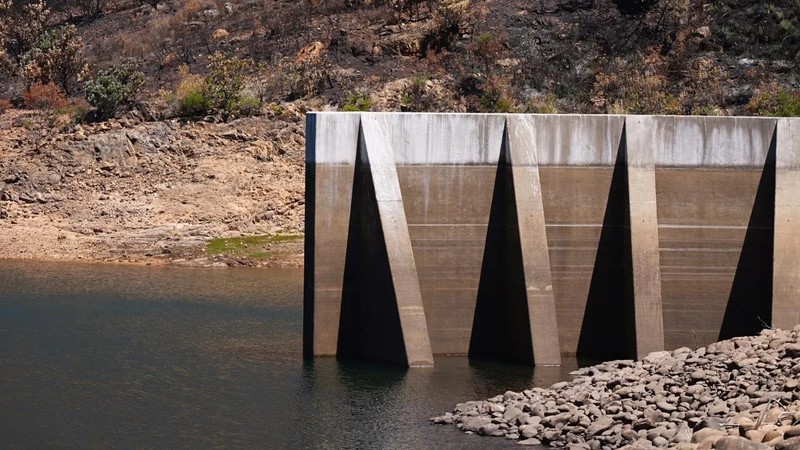
While Stellenbosch Municipality has taken steps to put Level 2 Water Restrictions in place as a precautionary measure from 1 March 2026, the City of Cape Town and its residents are not far off if they don’t start conserving water.
At a council meeting on Wednesday, the municipality addressed the need for precautionary water measures.
“Following consideration of current dam levels, weather patterns and projected supply, Council approved the implementation of Level 2 Water Restrictions in terms of the Municipality’s Water Services By-law, 2017.
“This decision is in line with advice and proposals from the provincial government, as well as similar precautionary measures already introduced by several neighbouring and nearby municipalities,” the municipality said.
“It is a proactive step aimed at safeguarding our shared water resources and ensuring long-term security of supply.
“Although dam levels and the persistently dry conditions across the region are cause for concern – particularly given the pressures being experienced elsewhere in the province – there is no need for panic.
“There is no immediate risk of taps running dry, nor is there an impending crisis. The implementation of Level 2 restrictions is a responsible and measured intervention to manage demand early and avoid more severe measures later,” they said.
Mayoral Committee Member for Water and Sanitation, Zahid Badroodien, said that at the last update, the level of the dams which service the City were sitting at 55% full, which is 19% lower than the same time last year.
He added that while there is no immediate threat to supply, the system is entering a more sensitive period ahead of winter rainfall.
“On top of that, we anticipate that the rains will begin later in the year than what we used to, and the volumes may be lower as well.
“We’ve now been very transparent with the city, to say that the next 90 days are going to be critical for us, in terms of trying to conserve as much of our surface water as possible, in order to try and keep as far back a need for restrictions, at this time,” Badroodien said.
“If our water usage behaviour doesn’t change, it may be that restrictions are introduced even earlier. The most crucial intervention for us as a city is to reduce water usage now, by making small adjustments within our own.”
Badroodien said that there were a number of factors for why the City found itself in the current situation, and the first one is that the dams didn’t fill up to capacity during the last rain period.
“We also had really hot and still have very hot weather, and that usually means people use more water. In addition to that, obviously a very busy festive period.
“And those, I would say, are the main factors that have influenced where we are at the moment in terms of our current dam levels.”
Badroodien said that the City’s current approach is to act early, based on risk, rather than wait for crisis conditions. The Drought Management Framework flags when behaviour change can still make a meaningful difference.
“Water restrictions are not a punishment. They are a tool to protect the supply when risk becomes too high to ignore. The projections show that early, moderate demand management now can help avoid more severe restrictions later, when there is far less room to manoeuvre,” he said.
Badroodien added that the City is proactively investing and progressing with strategic plans for Cape Town’s new water supply to build a water secure future, which aims to add 300 million litres a day to the City’s water supply from 2031.
The City has been annually upgrading aged water pipes, finding and fixing leaks annually, clearing alien invasive plant species and improving pressure management among other key interventions.
The City is also forging ahead with plans to begin procurement for the Faure New Water Scheme (FNWS) for water reuse and the Paarden Eiland Desalination Plant using a Public-Private Partnership (PPP) model.
theolin.tembo@inl.co.za


