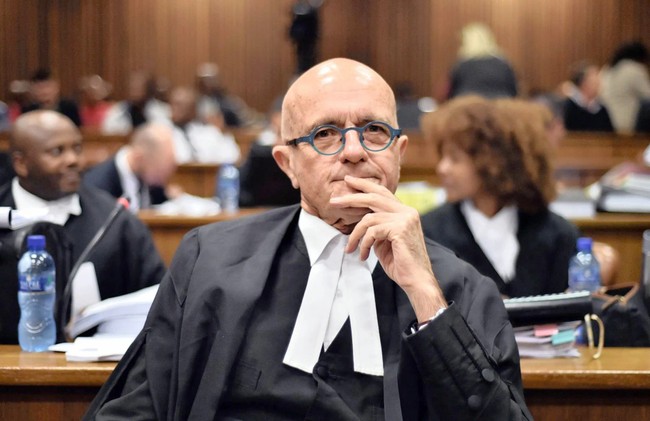
Those seeking to impeach a sitting president are fighting a political war and would jump at the chance to bring down an opponent.
So said advocate Wim Trengove SC in the Western Cape High Court on Wednesday, arguing that President Cyril Ramaphosa’s bid to have the Phala Phala impeachment report reviewed and set aside should succeed.
The application is the final legal hurdle before Parliament can continue with its public impeachment inquiry into Ramaphosa, a process that could result in his removal from office.
The matter is being heard by a full bench comprising Judge President Nolwazi Mabindla-Boqwana, Judge Mark Sher and Judge Ncumisa Mayosi.
It is on the court roll until Friday.
It stems from a criminal complaint laid by Arthur Fraser, former director-general of the State Security Agency.
Fraser told police in June 2022 that millions of dollars hidden in furniture had been stolen from Ramaphosa’s Phala Phala game farm in Limpopo in February 2020.
He said the theft had been concealed.
ATM leader Vuyolwethu Zungula relied on those allegations when he moved for Ramaphosa’s impeachment in the National Assembly.
That motion triggered the procedure in the parliamentary rules for removing a president, under which the Speaker sends a substantiated charge to an independent panel to decide whether there is enough evidence for an impeachment inquiry.
The panel, chaired by former chief justice Sandile Ngcobo, found in November 2022 that there was enough evidence for Ramaphosa to answer four proposed impeachment charges.
It is that report Ramaphosa is now asking the court to set aside.
“These are not people seeking justice, they are politicians fighting a political war,” Trengove said.
“And they would grasp at an opportunity of gunning for an opposition president.
“They need merely make a prima facie case, which is a very, very low threshold.”
He said the rules therefore required an independent panel to act as a buffer between a politician’s complaint and a public impeachment hearing.
The panel failed to do so, he argued.
Trengove said the impeachment committee that would hold that hearing was made up of the president’s political enemies, among them the man who laid the complaint against him.
“The president’s political adversaries sit on that committee,” he said.
“In this case, it includes Mr Zungula, the complainant, who is a member of that committee [and] Mr [Julius] Malema of the EFF, who has taken sides in this matter.
“These are people who are avowedly committed in the struggle against the president.”
Pictured here is President Cyril Ramaphosa’s legal representative Advocate Wim Trengove SC
Trengove said he was not attacking the rules or the conduct of the MPs on the committee.
“Now I’m not suggesting that they acted improperly in any way. I’m not suggesting there’s anything wrong with the rule,” he said.
“But it is a profoundly humiliating process where the president sits at the mercy of his political opponents.”
Mabindla-Boqwana put it to him that the committee was not the end of the process.
“It’s the National Assembly ultimately that will make a decision,” she said.
“So is the president really sitting at the mercy of his political opponents when it is the assembly that actually makes a decision?”
Trengove said he was not attacking the outcome.
The other question was whether what the panel relied on actually amounted to evidence at all.
“Anything can be information,” Sher said.
“So members of parliament can put anything before the panel. Allegations, innuendo, speculation, conjecture, hearsay upon hearsay.
“But the requirement which is on the panel is for it to state whether there’s sufficient evidence, not sufficient information.”
He said the reports Fraser attached to his statement came from people with no first-hand knowledge of the events, while Ramaphosa, Rhoode and presidential adviser Bejani Chauke had all given evidence under oath.
Trengove said Fraser had refused to say where his information came from.
“How can you attach the same value to a statement by a man who says to you, I have no personal knowledge of this, the facts are X, I don’t have any personal knowledge of those facts, and I’m not prepared to tell you where I got them?” he said.
“The president says he’s innocent. Mr Fraser says he’s guilty.”
The evidence test
Mabindla-Boqwana said the use of the word “information” did not lower the threshold in any event.
“In a court, it’s not prima facie information and prima facie everything. It’s prima facie evidence,” she said.
“So even at that stage, it’s evidence that’s looked at. Not everything.”
Two of the four charges concerned an instruction Ramaphosa was alleged to have given Major-General Wally Rhoode, head of the Presidential Protection Unit, to investigate the burglary instead of reporting it to police.
The panel put the amount stolen at about $580,000. Ramaphosa said the money was proceeds from a game sale.
In December 2022, the National Assembly voted against referring the panel’s report to an impeachment committee.
On May 8, the Constitutional Court set that vote aside and sent the report to the committee, reviving an impeachment process that had been dormant for more than three years.
Parliament’s impeachment committee was barred from holding public hearings until the High Court decided Ramaphosa’s review application.
Trengove’s case was that the panel asked itself the wrong question in both findings.
The rules required the panel to find sufficient evidence for an impeachment hearing, but he said it had instead asked whether there was a prima facie case, a term with a settled and much lower meaning in SA law.
Trengove said: “The independent panel must ask itself, on every charge, three questions.
“Firstly, did the president do it? Secondly, did he know that what he did was wrong? Thirdly, did he do it in bad faith?”
Mabindla-Boqwana pointed out that the panel had 30 days to report, could get information only from MPs and the president, and was limited to what the rules allowed it to do.
Mabindla-Boqwana asked whether the panel had looked only at the incriminating evidence, or also at Ramaphosa’s evidence.
“It didn’t,” Trengove said.
“It has cited lots of evidence in its report. But when it came to ask the critical question, it never did a balancing exercise.”
Sher put to him that the panel had in fact weighed the probabilities when it dealt with the trip Rhoode made to Namibia after the theft.
“I don’t think it’s correct that they didn’t do a weighing up,” Sher said.
“I think they did a weighing up.”
Trengove said that passage proved his point.
“For them to take incriminating evidence, which doesn’t make a complete case, and then to draw a further incriminating inference from it to make a prima facie case, does not address my problem at all,” he said.
“Where do they weigh up what the president said about it against the Fraser version? They don’t weigh it up.”
Asked by Sher what standard he was proposing instead, Trengove said the panel had to decide whether there was enough evidence to warrant the momentous act of sending the matter to an impeachment hearing.
“That, with all due respect, is very woolly,” Sher said.
“And it worries me, because it means that someone reading what Mr Fraser said could conclude that just on what Mr Fraser says, these are very serious things that Mr Ramaphosa, the president, is being accused of. This obviously must go to impeachment.”
Trengove rejected that.
“Not at all, my lord. That is unfair,” he said.
‘Wrong start’
Mayosi took Trengove to paragraph 69 of the report, where the panel wrote that the first stage of the removal process began with its own consideration of the motion.
“Would you not say, and this for me, reading this, seemed to be a penny-dropping kind of moment, that the panel missed a step in its identification of the context within which to interpret its mandate?” she asked.
“And the step that they missed is the motion.”
Trengove agreed.
“As if the process starts with them, which was not so,” he said.
“The process starts with the motion. And let me just emphasise, the motion must make a prima facie case, not just plead one.”
Trengove also said the panel had misread the Constitution when it found Ramaphosa had a case to answer for doing other paid work by running a farming business.
He said the family farm belonged to a trust and was being managed by a close corporation of which the president was the sole member, with a manager and staff doing the work.
“The president says, ‘of course I own a farm’.
“The farm is run by a manager and employees. I don’t do work for the farm and I don’t get paid for the farm,” he said.
He said the Constitution barred members of the executive from doing paid work, but not from owning a business.
The executive ethics code prohibited them only from receiving payment for work or services, he said.
Asked from the bench what the role of a review court was in those circumstances, Trengove said he was not asking it to decide whether the panel’s answers were right.
“You ask the wrong question, it doesn’t matter what your answer is, because you asked the wrong question in the first place,” he said.
“We’re not testing the answers to the question. We’re challenging the question.”
There is something irresistible about a good murder mystery; add a retired actor with an inflated sense of his own detective abilities, a no-nonsense police officer and the picturesque Welsh countryside, and you have the unconventional world of "Death Valley".The British comedy-drama once again sees acclaimed actor Timothy Spall, known for "Harry Potter", "Alice in Wonderland" and "Mr Turner", step into the shoes of John Chapel, a retired actor who […]