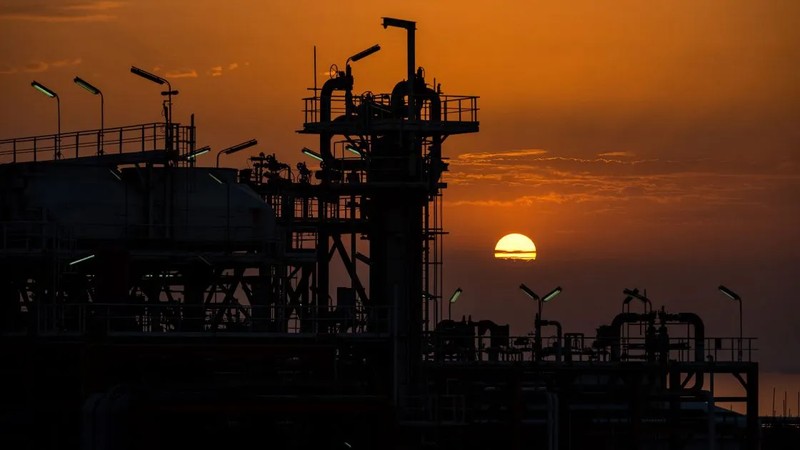
The recent United States, Iran triggered the largest disruption to global oil supplies after Tehran restricted shipping through the Strait of Hormuz. According to the International Energy Agency at its peak, the conflict disrupted an estimated 14 million barrels of oil per day, sparking fears of a prolonged global energy crisis. Fossil fuel dependent countries such as South Korea’s (Korea) and South Africa became vulnerable to the oil disruption. Given the volatile diplomacy between US and Iran, where buffer reserves risk becoming globally drained, and looming future price spikes one would expect the global economy to shrink.
Instead, according to the International Monetary Fund (IMF), the global economy as a whole has absorbed with surprising ease the loss of over a billion barrels of oil supply since the Iran war began. The key reason for the absorption states the IMF is due to developments in Artificial Intelligence (AI) in countries such as South Korea which cushioned the global financial system. Needless to say, the US-Iran war deeply impacted Korea given its severe dependence on Middle Eastern energy imports which posed a challenge to the country’s economic growth. However, Korea’s economy remained resilient because it used AI as a crucial absorption buffer. Critical for South Africa which recently emphasised AI as an economic driver at the recent Google Cloud Summit in Johannesburg is whether it can also quickly adapt its economy during future oil shocks through absorption strategies.
It’s important to note that when the fuel crisis began South Africa did not devise a new AI economic tool to address oil disruption outcomes but mainly adhered to its existing framework, which depends on a National Treasury budget strategy of balancing fiscal consolidation with moderate infrastructure spending. While it is important for the government to maintain finance legislative frameworks necessary to maintain economic stability, this article argues that it is also essential for the government to not only speedily adapt to challenging global economic terrains but also define its global niche areas that promote absorption strategies as was the case with Korea.
Korea’s economic advantage despite being vulnerable to the global oil disruption is based on two factors: it created a new growth model through AI that became economically relevant during the oil disruption, and secondly, it strategically prioritised AI by creating an AI niche for itself. As part of its new growth model, Korea aggressively pivoted its industrial policy to dominate the global AI hardware supply chain. Furthermore, this year the Bank of Korea (BOK) also unveiled an AI model built exclusively for its central bank. The BOKs basically established the first deployment of an in-house AI model by a central bank anywhere in the world. In essence, Koreas advantage during this energy crisis was that it created a new growth model which treated AI as an economic emergency instead of just an ongoing government research subject littered with unused policy documents.
Secondly, Korea carved itself a niche by finding a unique role for itself in the AI value chain process inclusive of sectors such as defence or renewable energy. Rather than attempting to compete directly with US software companies on foundational large language models etc, the country focused its investments on manufacturing the specialised hardware that powers AI. For example, this strategic niche is based on Koreas ability in making AI a critical component in defense systems by actively integrating artificial intelligence into its Cheongung-II anti-missile systems to deal with complex threats like drone swarms and ballistic missiles. Korea’s anti-missile system was deployed in the United Arab Emirates against waves of Iranian ballistic missiles and drones with an interception rate of over 96% of Iran’s missiles to the UAE.
Adding to this AI defence niche was production costs. Korea sold its anti-missiles at a much cheaper rate of around one million dollars, compared to nearly four million for the US Patriot PAC-3 produced by Lockheed Martin. For Gulf countries rapidly depleting their anti-missile stocks due to the US-Iran war, the combination of high performance and low cost transformed the Korean system from an attractive alternative into an urgent necessity. In essence South Korea strategically utilised AI in critical supply side sectors.
Due to Korea’s proactive approach in meeting global technology demands during the energy crisis, daily exports topped USD 4 billion. Koreas strategic niche generated massive export surges of AI-focused memory chips, batteries, shipbuilding, autos, defence systems and grid technology. South Korea annual exports could surpass USD 900 billion this year moving Korea into the world’s top five exporting nations. Consequently, the global stock market is rethinking what Korean equities represent as they are now considered an exposure to AI memory chips, batteries, ships, autos, and an increasingly security-aware industrial state which overrode the energy risk. Due to the global exchange stock market rethink, the Korea discount phenomena which refers to a lower price-earnings (PE) ratio of Korean stocks relative to their global peers has been dismantled and replaced by South Koreas index recovery and a billion-dollar export performance.
The key considerations South Africa should consider in terms of absorption as an fossil fuel dependent country like South Korea is to have the ability to restructure or industrially reposition its economic growth model despite any given economic global challenge. The fuel crisis forced Korea to redesign the foundations of its economic growth model by creating an AI economic niche which meant quick adaptation, a second absorption lesson we should learn. Particularly since AI is projected to add up to R528 billion ($52.2 billion) to South Africa’s GDP by 2035. South Africa has an advantage in the AI industry as it is also a geographical centre consisting of natural resources for global semiconductor supply chain tools.
Finally, there is no reason why South Africa cannot not become a regional AI driver by possibly cushioning the continent from future global economic shocks. Given South Africa’s need for more technical AI industrial skills South Africa will need to partner with the private sector. Its AI economic growth relies on massive data centre and cloud infrastructure investments from global tech firms like Microsoft and Amazon, coupled with targeted training hubs like the new Google Digital Innovation Centre in Soweto. A partnership with a country like South Korea which has become a world leader in the global AI hardware supply chain would also be a strategic boost in terms of AI short term and long-term planning.
* Dr Yazini April-Mbulawa is the Executive Director for the Global South North Centre based in Sandton, South Africa. She is the former Coordinating Head of the BRICS Research Centre, Human Sciences Research Council. Her research expertise lies in industrialisation in South-South countries.
** The views expressed do not necessarily reflect the views of IOL.


