South Africa has seen this story before. An economic activity emerges because ordinary people need to survive, government refuses to recognise it on terms that reflect economic reality, and the activity continues regardless of what the law says.
As the state fails to establish an accessible regulatory framework, powerful intermediaries begin controlling access, collecting payments and settling disputes through intimidation and violence. Eventually, criminal networks become so entrenched that they reach into the institutions of government itself, while the original economic need remains unresolved.
This is, in important respects, the history of South Africa’s minibus taxi industry. Unless we learn from that history, it threatens to become the enduring story of artisanal mining.
During apartheid, Black taxi operators confronted a transport system designed around racial exclusion, restrictive licensing and the protection of established bus operators. Yet apartheid’s own spatial engineering had created enormous demand for affordable transport between distant townships and centres of employment.
Rather than acknowledging this economic imperative, government attempted to contain an emerging Black-owned industry that did not fit its preferred corporate economic model. The 1983 Welgemoed Commission even recommended phasing out kombi taxis to protect existing bus services. Although never implemented, the recommendation exposed the extraordinary assumption that established operators were better placed to meet people’s transport needs than the emerging industry already responding to those needs.
But commuters still needed transport, and ordinary people were prepared to provide it. Despite government’s best efforts, the taxi industry did not disappear. It expanded.
By the late 1980s, government had shifted towards deregulation, opening the industry without establishing adequate mechanisms to manage competition, routes or disputes between operators.
Taxi associations increasingly filled the regulatory vacuum. Many provided legitimate representation and coordination, but some evolved into powerful territorial gatekeepers, controlling who could operate, where they could operate and what they were required to pay. In parts of the industry, intimidation, assassination and extortion became instruments of economic regulation.
The post-apartheid state inherited this troubled industry and introduced successive attempts at formalisation. Yet recognition did not necessarily produce accountability, and decades of institutional failure allowed coercive networks to become deeply entrenched.
Today, minibus taxis account for approximately 80% of public transport journeys to work. The industry apartheid authorities once contemplated eliminating has become indispensable to South Africa’s economy.
But the consequences of inadequate governance remain devastating.
The Madlanga Commission has exposed disturbing relationships involving criminal allegations, politically connected businesspeople, police officials and commercial interests extending beyond the taxi industry. Evidence concerning alleged extortion of a mining business involved in the Moloto Road project illustrates how coercive influence associated with taxi figures can extend into mining and public infrastructure.
Even more concerning are revelations involving businessman Suliman Carrim and his financial relationships with figures including Oupa “Brown” Mogotsi, Vusimuzi “Cat” Matlala and Hangwani Morgan Maumela, alongside evidence of a proposed multimillion-rand chrome washing and crushing venture.
These revelations must be considered against the proliferation of illegal chrome mining and unauthorised washing plants around Bapong and elsewhere in North West. While police concentrated considerable coercive force on illegal gold mining at Stilfontein, culminating in a siege during which 93 miners died, the illegal chrome economy elsewhere in the province was expanding at an increasingly devastating scale.
This raises a disturbing question: could politically connected commercial interests have benefited from selective policing, with enforcement concentrated against one illegal-mining network while others expanded?
There is not yet evidence establishing such a connection, nor that the proposed chrome venture processed illegally mined ore. But the relationships emerging from Madlanga, alongside the documented expansion of unauthorised chrome-processing operations, demand investigation. The issue is whether powerful vested interests can influence which economic activities are suppressed and which are allowed to flourish.
And herein lies the lesson South Africa stubbornly refuses to learn. When government fails to govern an economic activity that answers a genuine economic need, it creates opportunities for others to govern it through money, intimidation and guns.
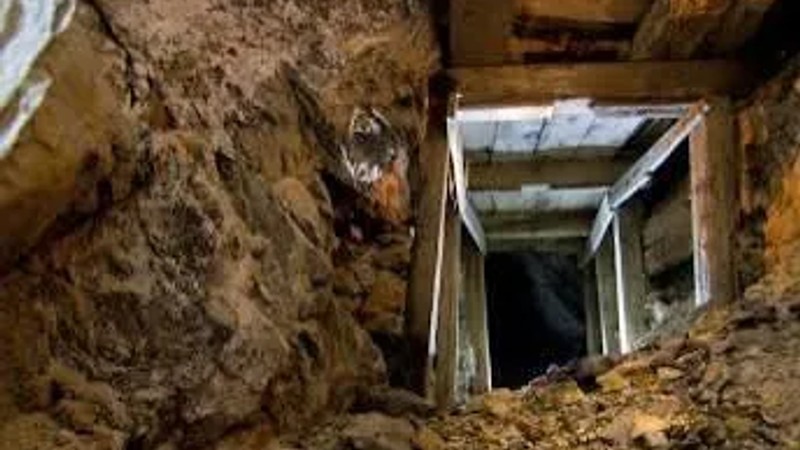
South Africa is now repeating this mistake with artisanal mining.
For more than a century, South Africa’s mineral economy has been organised around the ownership structures, financial capabilities and operating models of large mining corporations, while communities living alongside some of the world’s richest mineral deposits remain trapped in poverty and unemployment.
The contradiction is extraordinary. PwC’s 2026 mining report shows that major mining companies generated R185 billion in net profits in the latest reporting year, while Oxfam estimates that the richest 1% of South Africans controlled 54.9% of the country’s private wealth in 2024. Mining alone did not create this inequality, but it has been central to an economic system in which enormous wealth is extracted from finite mineral resources while ownership and economic power remain concentrated.
The deeper problem is not simply that ordinary people are excluded from mining, but that they are excluded from meaningful participation in an economy that has become extraordinarily effective at generating wealth without distributing it fairly.
For decades, South Africa has relied on an economic model that concentrates ownership, productive assets and opportunities in relatively few hands, while millions remain unemployed, impoverished and dependent on an economy that offers them little prospect of improving their circumstances. Mining is simply one of the starkest expressions of this contradiction: enormous wealth is extracted from beneath communities that remain among the poorest in the country.
Yet rather than confronting the structural inequality that drives people to seek livelihoods wherever they can find them, government continues to treat their economic desperation primarily as a problem of law enforcement. People who have been excluded from the formal economy are then criminalised for attempting to create economic opportunities outside the structures that excluded them in the first place.
This is precisely the mistake made with the taxi industry. The economic demand did not disappear because government refused to accommodate it, and neither will the need to survive disappear because government declares particular forms of economic activity unlawful.
The fundamental problem is therefore not artisanal mining itself, but an economic system that denies millions meaningful access to productive opportunities and then expects policing to manage the consequences of that exclusion.
MACUA has warned government about this for almost a decade. In 2015, we convened discussions on artisanal mining. In 2017, MACUA joined mass protests and negotiations in Kimberley, where miners demanded the right to work legally without harassment. Those struggles helped secure the landmark Kimberley permit arrangements announced in 2018, demonstrating that government could recognise and regulate artisanal mining when compelled to engage with economic reality.
Yet almost ten years later, we are still fighting for a workable national framework.
The proposed amendments to the Mineral and Petroleum Resources Development Act finally recognise artisanal mining as a distinct category, but continue to reflect government’s corporate-centred understanding of mineral extraction. At NEDLAC, government has proposed artisanal permits restricted to 1.5 hectares and a non-renewable period of no more than three years, while contemplating the designation of areas that may be disconnected from where livelihood mining actually occurs.
A miner in Bekkersdal cannot simply be expected to relocate hundreds of kilometres because government finds a different location administratively convenient. Nor does a viable livelihood cease to exist when a three-year permit expires. A regulatory framework that ignores these realities risks pushing people back into the very illegality it claims to want to eliminate.
The deeper problem, however, is South Africa’s profoundly unequal distribution of mineral wealth. The G20 inequality report commissioned under South Africa’s presidency and chaired by Nobel laureate Joseph Stiglitz reinforces a fundamental truth: economic growth does not automatically produce shared prosperity when ownership, bargaining power and economic opportunities remain concentrated.
South Africa cannot continue extracting enormous mineral wealth while surrounding communities remain dependent on precarious livelihoods, charitable benefits and unfulfilled development promises.
We need an economic settlement that distributes mineral wealth more fairly, expands community ownership, supports cooperatives and creates productive opportunities from below. Artisanal mining must be part of that settlement, with realistic permits, access to viable deposits, negotiated arrangements with existing rights holders, technical assistance, safe working conditions and lawful markets.
None of this requires tolerating criminality. It requires recognising that policing and economic development must work together, rather than pretending one can substitute for the other. The taxi industry should have taught South Africa that lesson decades ago.
The central lesson is that governments cannot criminalise away economic necessity. When millions of people are excluded from meaningful economic opportunities, the activities through which they seek to survive will persist, regardless of whether the state recognises them. By refusing to confront the structural inequality that produces this desperation and failing to create realistic pathways into the formal economy, government does not eliminate the activity. It merely abandons vulnerable people to exploitation by those with the money, political connections and guns to control it. The tragedy is that the state then deploys its coercive powers against the consequences of an economic crisis that its own policies have failed to resolve.
We cannot afford another generation of taxi mafias operating underground in our mineral economy.
Hunger cannot be policed away. And an economic system that excludes millions from the wealth beneath their feet cannot expect those millions simply to disappear.
The choice is not between tolerating criminality and criminalising poverty. It is between building an inclusive, properly governed mineral economy and continuing to create the conditions in which criminal networks prosper.
Christopher Rutledge is the Executive Director at MACUA-WAMUA Advice Office
The views expressed do not necessarily reflect those of IOL


