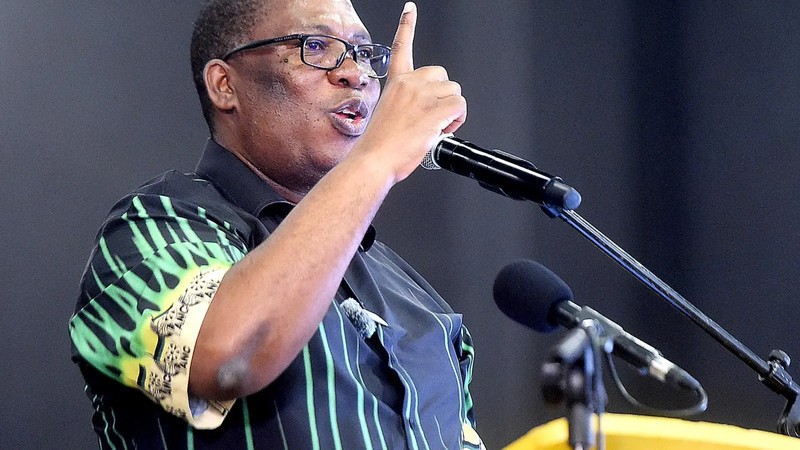
ANC Gauteng provincial convener Panyaza Lesufi has admitted that the party has to do better on service delivery, but insists the party has delivered roads, schools, clinics and hospitals.
However, he acknowledged that the government had underestimated the demand for services, saying Gauteng was dealing with extensive migration that had not been properly managed
The African National Congress is expected to launch its election manifesto at Riverside Park near Diepsloot on Sunday, with party leader Cyril Ramaphosa expected to deliver the address.
With the local government elections less than three months away, the manifesto is expected to outline the party’s plans for local governance, service delivery, economic development and community upliftment.
On Saturday, the ANC announced finalists for potential mayoral nominees for the upcoming local government elections in metros and municipalities.
The party was initially expected to unveil its mayoral candidates, but instead announced potential candidates for various leadership positions.
It said the final mayoral candidates would be revealed in September.
Speaking to Newzroom Afrika on Sunday about the manifesto launch and who the party was targeting, Lesufi said the ANC faced a difficult challenge because voters had different expectations.
“My research indicates that we are an unfortunate party. Very unfortunate,” he said.
“Somebody who does not have a house says, ‘I’m not going to vote for you because I don’t have a house.’ And the one that has a house says, ‘I’m not going to vote for you because I don’t have a job.’ And the one that has a job says, ‘I’m not going to vote for you because I’ve not taken my child to NSFAS at the university.’
“The one that has NSFAS says, ‘NSFAS is taking too long to pay.’ The one that doesn’t get NSFAS says, ‘This street is full of potholes. I don’t have electricity.’ So we have this moving target.”
Lesufi said the ANC needed to communicate more effectively about its broader development agenda.
“If we can master how to communicate to ensure that it’s no longer about individual interest but the collective development of society and collective development of protecting the budget of municipalities, I think our people understand,” he said.
“Surely, we have to push people to go out and vote. Surely, we also have to indicate the other side. And that’s the reason why we’re here. To say there might be potholes. There might be areas where rubbish is not collected. But see the development that we’ve made, especially in the Brima side, where the rich and the poor can stay in the same place, where the rich and poor can walk to an industrial area.
“They can walk to a retail store. And they can have infrastructure that is clean, infrastructure that does not have challenges. So it’s a combination of the two.”
Lesufi acknowledged that society had experienced shortages of water and problems such as potholes.
“And you can’t blame them,” he said.
“But there’s also another hand. And I’m glad and excited that the ANC agreed to come to Riverside so that we can showcase the new form of housing in South Africa, the new form of human settlements in our country.”
Asked whether people would be more likely to support the ANC if they were convinced that it had done the best it could with the resources available and given the scale of the challenges, Lesufi said the demand for services was enormous.
“The demand is massive. There’s no one who can accuse us of never having built a single road. There’s no one who can accuse us of never having built a single school, a single clinic or hospital. There’s no one who can accuse us of not having built a police station or a road,” he said.
He insisted that the demand was huge and said the government had failed to properly manage two critical issues.
“One is immigration, where other people from other provinces feel that the better provinces are okay. Two are people who are coming from the continent who believe that they can be accommodated here,” he said.
“So the budgeting and the planning could not match that number of population growth. And that’s where we’ve made a huge mistake. And that is why you’ll see in this manifesto that we want to arrest that situation.”
Lesufi said the ANC wanted to establish clearer responsibilities for municipalities and improve oversight.
“Let’s have the bottom line. Let’s know what is expected of each municipality, each council, and their responsibilities, how they will be monitored, so that we can learn from this mistake,” he said.
Lesufi claimed that other political parties, including the Democratic Alliance (DA), could only make promises because they did not control the country’s fiscal resources.
“Because the fiscals are gripping the hands of the African National Congress. And therefore, in some instances, there will be no need for those political parties to do what they think they can do without working with the African National Congress,” he said.
“But what do they do now? They insult the African National Congress. They undermine the African National Congress. They think they can expose the African National Congress and mobilise society to say, if we have to go forward, it must be without the ANC. Which many of you know, you can’t rule out the African National Congress.”
However, Lesufi said the ANC could not afford to be “arrogant.”
“But we can’t be arrogant. We have to ensure that we manage this situation better and develop our country,” he said.
He said the role of local government extended beyond basic service delivery to include development, spatial planning and budgeting.
“The problem is that people want to confine South Africans to potholes and garbage collection only, forgetting that the role of local government goes beyond that. It’s developmental, it’s spatial planning, it’s budgeting, and on those three, no one has challenged us. We’ve made the spatial planning of this particular province, for example, and all our municipalities, spot on.”
Asked about the apparent disconnect between the ANC’s claims about development and what voters experience daily, Lesufi said it reflected a broader misunderstanding of governance.
“To me, it’s an understanding of governance. I’ve seen somebody seeing a pothole, writing ‘ANC’ around that pothole, only to find that the municipality is not run by the ANC.”
“It’s because we are the bearers of people’s hopes. Everyone believes that it’s through the African National Congress that our hope can be realised,” he said.
Lesufi pointed to electrification as an example of the ANC government’s record.
“No person or household can say, ‘I don’t have access to electricity.’ The challenge may be that the transformer is not working. The challenge might be load reduction. The reality is that you’re connecting them to the grid, which is very important and fundamental,” he said.
He made a similar argument about water.
“Also water. No one can say I can walk two kilometres, for example, in Gauteng. I don’t want to speak of other provinces. I can walk two kilometres because I don’t have water,” he said.
Lesufi said the challenge was increasingly related to ageing infrastructure, rather than access to water itself.
“So we’ve managed access. We’ve managed infrastructure development. We’ve managed budgeting. We’ve repositioned municipalities. But the reality is they failed to manage population growth. They failed to manage undocumented citizens in our country, in our province,” he said.
He claimed Gauteng was the province hardest hit by undocumented migration.
“You go to our hospitals. You go to our schools. You go to our retail stores. The economy of this province is also controlled by undocumented citizens. And this manifesto today is redefining the path.”
Lesufi said the manifesto launch was intended to set out the lessons the ANC had learned and its vision for the future.
“And no one, no one can provide an alternative future for this country and for this province, except the African National Congress,” he added.
simon.majadibodu@iol.co.za
IOL News