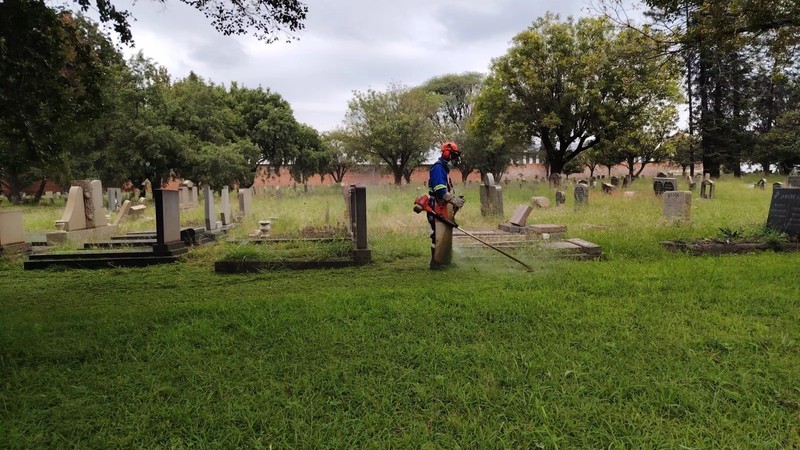
As land availability in the City of Tshwane becomes increasingly limited, it is projected that existing burial spaces will reach full capacity in less than 30 years.
The looming cemetery crisis has prompted the city to sound the alarm and highlight the urgent need for alternative solutions to meet the community’s burial needs.
The city offers cremation as an alternative to traditional burial, but currently only has one crematorium, located in Pretoria West.
Three years ago the crematorium closed for significant refurbishments and upgrades to enhance operational efficiency and comply with environmental regulations.
As a result of the facility’s closure many bereaved families and undertakers had to travel long distances to access cremation services outside the municipality, incurring unnecessary transport costs.
MMC for Environment & Agriculture Management Obakeng Ramabodu highlighted that according to the city official report 6000 burial spaces are required annually for burial purposes.
Ramabodu urged communities to continuously engage on alternative burial methods to help alleviate the burden of burial land constraints in the city.
The MMC’s call follows the recent roundtable discussion at Tshwane House, where different stakeholders convened to engage with various interests on matters pertaining to alternative burial methods considered by the city.
Ramabodu said various stakeholders were gathered from across the city, including church organisations, traditional leaders, traditional healers, the South African Council of Churches, and the South African Local Government Association.
“The roundtable discussion created a platform for government and stakeholders to engage in a meaningful dialogue on the management of human remains and sustainability of burial practices,” he said.
He highlighted the increasing pressure on burial space due to fast population growth and limited space for cemetery development.
“The existing cemetery space is projected to last approximately 20 to 30 years. With the land becoming increasingly limited, the city is faced with a challenge to identify new burial sites, while we must do our best to upgrade existing ones,” Ramabodu said.
He said that during the discussion it was noted that several geographic factors affect the suitability of land used for burial purposes.
For example, he cited that high groundwater tables make developing land for a cemetery impossible.
“These environmental constraints further complicate the city’s ability to expand its burial infrastructure,” he said.
He explained that stakeholders acknowledged the complex management of cemeteries and that challenges such as rapid urbanisation, financial sustainability, and repatriations form a web of broader challenges associated with burial management in the city.
Among the concerns raised regarding burial practices were the importance of cultural and religious traditions and that alternative methods must be approached with sensitivity and respect for deeply held beliefs.
Other stakeholders highlighted that for many communities, burial practices are closely linked to spiritual customs and traditions, including the ability for families to visit and honour loved ones at burial sites.
Ramabodu said: “Despite the diversity of views expressed during the roundtable discussion, stakeholders agreed that continued engagement and further consultations are essential in identifying solutions that balance environmental sustainability, land availability, and respect for cultural values.”
Last year, the city indicated that it was facing a growing concern as illegal land occupation hindered the development of new cemeteries and the expansion of existing ones.
“Illegal land occupation is now disrupting the development of cemeteries across the city and aggravating the challenges associated with finding suitable land for burial purposes,” municipal spokesperson Lindela Mashigo said at the time.
rapula.moatshe@inl.co.za


