As anti-immigrant tensions continue to ripple across South Africa, a new wave of online hostility has emerged, this time allegedly targeting Muslims.
Palestine Solidarity Campaign said it is deeply concerned by what it describes as a rise in Islamophobia on social media following efforts by members of the Muslim community to assist migrants who were allegedly displaced by xenophobic attacks, as well as the appointment of Yusuf Cassim as Deputy Minister of Higher Education.
PSC coordinator Professor Usuf Chikte said the organisation believes the recent online attacks reflect a broader pattern of anti-Muslim rhetoric that has intensified in the wake of debates around migration, Palestine and South Africa’s foreign policy.
“This is nothing new. Zionist networks have long used Islamophobia as a weapon, framing anyone who exposes Israel’s genocide and apartheid as a security threat and dressing up that attack in the language of terrorism and disloyalty,” Chikte said.
He alleged that several issues were converging to fuel hostility towards Muslims online, including anti-migrant sentiment, criticism of South Africa’s case before the International Court of Justice against Israel, attacks on Muslim humanitarian organisations and criticism directed at Muslim public figures.
“What we’re seeing now is the convergence of several narratives: anti-migrant rhetoric, opposition to South Africa’s ICJ case, attacks on Muslim humanitarian organisations, and hostility toward Muslim public figures, all appearing together, reinforcing one another,” he said.
Chikte further alleged that organisations supporting Palestine had increasingly become targets of coordinated campaigns aimed at undermining their work.
He claimed the PSC; the Muslim Judicial Council (MJC) and humanitarian organisations had faced smear campaigns and strategic litigation designed to silence them. He also alleged that some online activity targeting Muslims appeared to originate from automated accounts, although he did not provide evidence to support this claim.
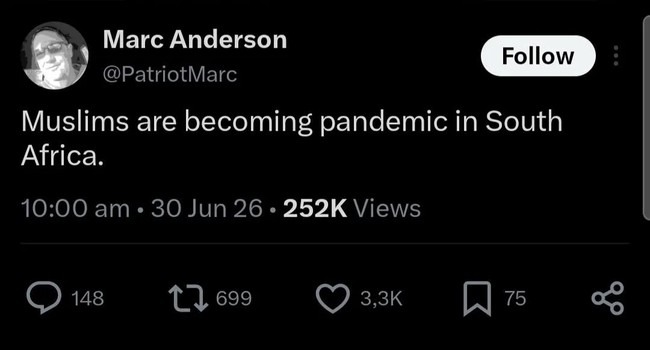
“Muslims are becoming a pandemic in South Africa,” Marc Anderson posted on X. “We must be careful, we are gonna watch out.”
Muslim leaders, analysts and politicians warn of alleged surge in online Islamophobia.
Referring to a recent court matter involving the PSC in the Western Cape High Court, Chikte alleged that Muslim protesters were subjected to Islamophobic abuse and that journalist Anwar Omar was attacked while covering proceedings.
He also referred to criticism directed at humanitarian Dr Imtiaz Sooliman, saying attacks on aid workers demonstrated how humanitarian work had become politicised.
“When humanitarian work itself becomes a target, the mask has clearly slipped,” he said.
Chikte warned that online hostility could have consequences beyond social media, arguing that repeated narratives linking Muslims to illegal migration, terrorism or divided loyalties risked normalising discrimination.
“South Africa knows from its own history exactly how dangerous dehumanising narratives become once they move from social media into public life,” he said.
He also criticised what he described as attempts to judge Muslims based on their faith rather than their actions, pointing to criticism directed at Muslim charities, journalists and public officials.
“When Muslim charities are attacked for doing humanitarian work, when a deputy minister is targeted for being Muslim rather than evaluated on his record, when a journalist is assaulted for simply doing his job, the message is that Muslims must continually prove their patriotism,” Chikte said.
Calling for action, Chikte said political leaders should reject religious prejudice, social media platforms should consistently enforce their hate speech policies, and law enforcement agencies should investigate cases where alleged online incitement crosses into criminal conduct.
Political and security analyst Ryan Cummings also expressed concern over what he believes is an emerging pattern of hostility directed at South Africa’s Muslim community.
“Am I the only person noticing that there is a coordinated campaign to expand hateful and prejudicial attitudes toward South Africa’s Muslim community?” he asked.
After the Presidency announced Cassim’s appointment, comments on the ministry’s social media accounts revealed elements of anti-Muslim sentiment.
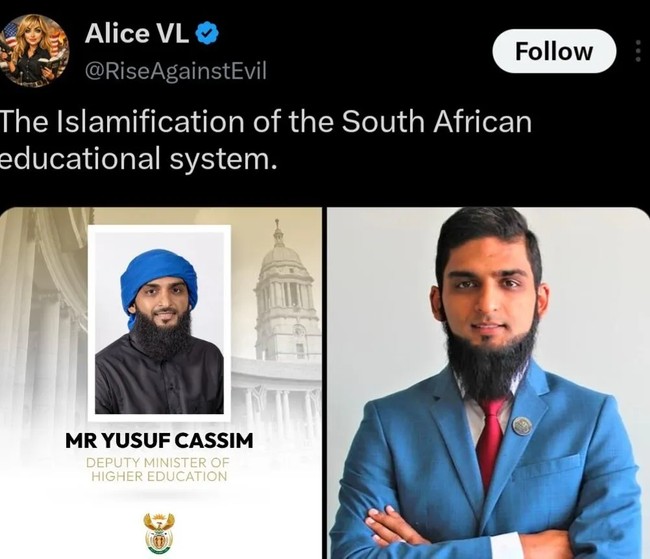
“The Islamification of the South African educational system,” wrote an individual going by RiseAgainstEvil on X.
Islamophobia fears mount as migrant tensions spill into attacks on South Africa’s Muslim community.
Democratic Alliance (DA) Tshwane mayoral candidate Cilliers Brink also weighed in on the debate, defending the Muslim community and Cassim amid the recent online criticism.
“The Muslim community has been part of South Africa for centuries,” Brink said. He also defended Cassim’s appointment, describing him as “an honest, hardworking public servant”, adding that the deputy minister was “a proud member of this community”.
He added: “And he doesn’t have to ask anyone’s permission to serve his country.”
Economic Freedom Fighters (EFF) national spokesperson Sinawo Thambo also condemned the online attacks directed at Cassim and expressed concern about what he believes is a growing climate of religious intolerance.
“This chap is South African; he matriculated from the same high school I did in Uitenhage (now Kariega) in the Eastern Cape.”
He argued that the current atmosphere of hostility was unlike anything he had previously observed in the country.
“We are on the brink of US-like Islamophobia, incredible that anyone still thinks that any of this hate is organic considering the US-Israel culture of hatred against the Muslim community and its genocide in the Middle East.”
He alleged that recent events had seen people profiled because of their appearance and religion, referring to raids aimed at identifying undocumented foreign nationals. He said such developments should concern all South Africans and called for solidarity against prejudice.
“We should all condemn the attacks on this individual, whether it’s from Zionists or the idiots who think every one in two people in SA is a foreign national,” Thambo said.
Johnny Clegg’s rhythm still beats in the heart of South Africa, and a powerful new music video has arrived to prove that his legacy will never fade.The official music video for "Great Heart" has just dropped, offering a breathtaking first glimpse into the highly anticipated "Scatterlings" project spearheaded by Jesse Clegg and fellow musician Msaki. View this post on Instagram A post shared by Jesse Clegg (@jesseclegg) Originally released in […]