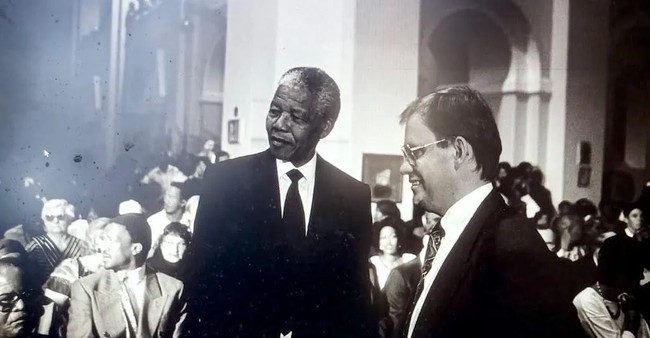
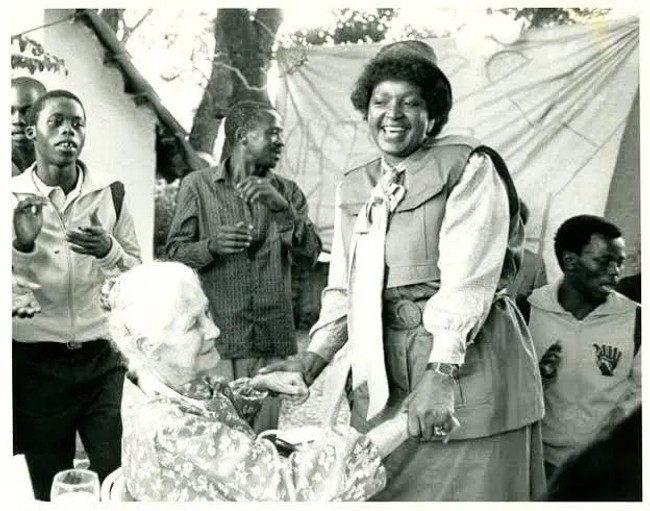
Seventy years after Mama Helen and twenty thousand women of every race marched on the Union Buildings, I sit with your spirit still burning in my chest. On this day, 9 August, the words you helped make immortal ring out again across the land:
Wathint’ abafazi, wathint’ imbokodo!
You strike a woman, you strike a rock.
Those words are not a slogan for a single day of remembrance. They are a living command. They are the sound of defiance that rose from the amphitheatre in Pretoria in 1956 and that continues to demand courage from every generation that refuses to bend the knee. Today I return to them with the full weight of what you taught me, because it was through you that I first understood what those words truly mean.
It was through you, Mama Helen, that I learned the real politics of resistance. Sitting on the veranda of your small, humble home at 35 Fanny Avenue in Norwood, I sat literally at your feet and received the history of our liberation struggle as living truth. You did not lecture. You did not perform. You simply spoke with the quiet authority of someone who had lived every word. The trees around the house cast long shadows across the wooden floor. The traffic of Johannesburg hummed in the distance. And there, in that ordinary suburban setting, you handed me a compass that has never failed.
You taught me that the struggle against apartheid was never only about laws and passes and identity documents. It was about the complete rejection of a system built on racial domination and economic theft. From you I learned that there can be no compromise with apartheid, no compromise with racism, no compromise with those who would sell the struggle for a seat at the table of the oppressors. Your own life was the clearest proof of that principle. You lived it without decoration and without escape.
Through you I came to know Mama Winnie Madikizela-Mandela, Mama Albertina Sisulu, and Mama Sophie de Bruyn. These were not names I encountered in books first. They became living presence because you opened the door to them. Through you I understood how the great Women’s March of 1956 was organised and what it truly stood for. You explained the careful planning, the discipline required to move thousands of women in small groups so that the authorities could not easily stop them, the petitions carried in the arms of ordinary women who had decided that enough was enough.
You made me see that the march was not a spontaneous outburst but the product of deep organisation, courage, and political clarity. Through you I came to grasp the living meaning of the Freedom Charter. You were present when it was launched at the Congress of the People in Kliptown on 26 June 1955, and it was you who stood and read out the clause: “There shall be houses, security and comfort.” Those words still demand fulfilment. They have not been realised. They remain an unpaid debt.
MADIBA MAGIC:
During the long years when the ANC and other liberation movements were banned, you kept alive the memory of those in exile, those behind bars, and all political prisoners. You refused to allow the regime to erase them from the consciousness of those who remained inside the country. Every Christmas Day that you were free of house arrest, friends and the families of political prisoners gathered at 35 Fanny Avenue.
At exactly twelve o’clock you would raise a glass of champagne and say, simply and with steel in your voice: “To our absent friends.” And every glass would answer. The ritual was solemn, almost sacred. It was an act of political memory and of defiance. When the regime confined you and forbade visitors, you still appeared at the garden gate at that same sacred hour, glass in hand, while comrades stood across the road at the legal distance, fists raised in the black power salute, glasses lifted in solidarity, voices calling “Amandla!” Even the prison walls on Robben Island knew of that ritual. The men and women who sat in those cells understood that they had not been forgotten. You made sure of it.
I remember arriving at your house one morning to find you, already in your eighties, sweeping shards of glass and splinters of wood from the floor after bullets had been fired through your windows in the night. You had spent the dark hours under the bed, sheltering against the gunfire, yet when I walked in your eyes still blazed with fire. “These bastards will never get me down,” you said. And they never did. The attacks came again and again. Stones through the windows. Threats on the telephone. Paint poured on cars. Shots in the night. A bomb wired to your front gate. You survived them all. Your body aged. Your spirit did not. That morning, as you swept the broken glass with steady hands, I saw more clearly than ever before what unbreakable resolve looks like. You were not performing courage for an audience. You were simply refusing to yield.
Even in the year of your death in 1992, you were fiercely critical of the compromises made in the early years of the negotiations after the unbanning of the ANC. With your clear political vision, you already saw the unacceptable direction and the dangerous compromises in which those early negotiations were heading. And as was characteristic of you, you spoke out and warned even at that early stage. You did so right up to your last breath on your deathbed. You shared the deep concern of Mama Winnie Madikizela-Mandela and Comrade Chris Hani that too much was being given away. You saw the danger of a settlement that would leave the fundamental economic structures of apartheid largely intact. You understood that political rights without radical economic transformation would leave the majority of our people still trapped in poverty and landlessness. You refused to celebrate prematurely. You insisted on principle when others were already preparing to lower the standard of what the struggle had demanded.
Your support for Mama Winnie never wavered. In the lonely years when she had to raise Zinzi and Zenani alone, while Nelson Mandela remained imprisoned, you were one of those who stood beside her, helping to care for the girls. You opened your home and your heart. Through every campaign of vilification and propaganda directed against her, you remained her defender, even when it cost you friendships and political comfort. You stood with her 100% without reserve. You never compromised. You understood the particular cruelty reserved for women who refuse to be broken, and you stood with her without calculation.
You wrote the truth into books that still speak. If This Be Treason remains your dramatic account of the Treason Trial, the longest political trial in South African history. Tomorrow’s Sun records your long journey of thousands of miles to document the lives of those banished to the remote rural areas for their resistance against apartheid and the pass laws. And your beautiful autobiography, Side by Side, takes its title directly from the closing words of the Freedom Charter itself:
“These freedoms we will fight for, side by side, throughout our lives, until we have won our liberty.”
Through that book the golden thread of no surrender runs from first page to last. It is not a sentimental memoir. It is a political testament. It records a life lived in unbroken opposition to racial domination and in unbroken solidarity with those who suffered under it.
ARCHIVES:
On Christmas Day, 25 December 1992, at exactly twelve o’clock midday — the hour you had always dedicated to your absent friends in prison and in exile — you left us. I was at your bedside in what was then still called the J.G. Strijdom Hospital. And it was one of the loneliest, saddest and most heartbreaking moments of my life. The coincidence of the hour was almost unbearable. The woman who had kept the memory of the imprisoned alive at that exact time every year now drew her last breath at that same hour. That hospital now bears your name: Helen Joseph Hospital. Even in death the regime’s name was erased and yours was raised in its place. There is a profound justice in that renaming. The man in whose name the hospital once stood was the very Prime Minister to whom the women of 1956 delivered their petition. History, in its own way, has answered.
There is not a single day in my political life that your mentorship does not shape. When the pressure comes to soften, to accommodate, to sell a little more of the dream for temporary advantage, I ask myself: What would Mama Helen have done? The answer is always the same. No compromise. No surrender. No polite acceptance of half-measures that leave the structures of inequality standing. The struggle continues until the fundamental economic transformation we fought for is achieved. Land. Wealth. Dignity. Houses, security and comfort for all. These are not optional extras. They are the unfinished business of the Freedom Charter and of the generation that marched in 1956.
Today, seventy years after the Women’s March, I salute you with the same cry that rose from the amphitheatre of the Union Buildings. I salute the rock that refused to crack. I salute the woman who taught me that principle is not a luxury but a necessity. I salute the mentor who formed my political understanding in the crucible of lived resistance rather than in the comfort of theory alone.
Wathint’ abafazi, wathint’ imbokodo!
You taught me that a woman who refuses to yield is a rock against which every wave of oppression must break. I remain your student. The fire you lit still burns. It burns in the refusal to accept cosmetic change while the substance of injustice remains. It burns in the demand that the Freedom Charter not be reduced to a historical curiosity but treated as a living programme. It burns in the memory of every Christmas glass raised to the absent friends. It burns in the knowledge that the struggle is not finished simply because formal political power has changed hands.
Mama Helen, the debt I owe you cannot be repaid in words. It can only be repaid in continued fidelity to the principles you embodied. No compromise with racism. No compromise with those who would sell out the struggle. Full commitment to the radical economic transformation that alone can make freedom real for the majority of our people.
The fire you lit still burns.
Amandla!
*Ambassador Carl Niehaus is an EFF Member of Parliament. He was a close comrade and friend of Helen Joseph.
** The views expressed do not necessarily reflect those of IOL
AmaZulu coach Arthur Zwane believes his side beat themselves in their dramatic 4-3 extra-time defeat to Sekhukhune United in the MTN8 quarter-final at Chatsworth Stadium on Sunday.Usuthu took an early lead through Thando Ngwenya and controlled much of the opening stages, but Zwane felt they failed to capitalise on their dominance and allowed Sekhukhune back into the contest.“I think the first 25 minutes we were in control of the game,” […]