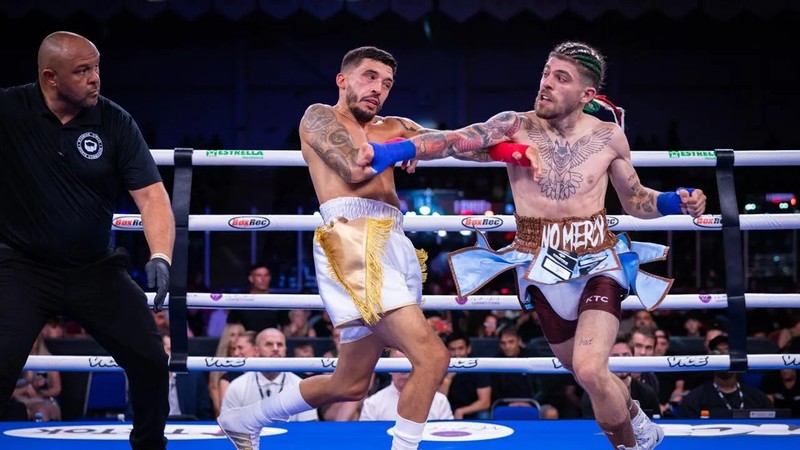
For decades, bare-knuckle boxing was viewed as a niche combat sport with limited mainstream appeal. Fast forward to 2026, and the landscape has changed dramatically. Packed arenas, major television and streaming deals, former UFC stars and world boxing champions crossing over, and growing international expansion have transformed bare-knuckle fighting into one of the fastest-growing sectors in combat sports.
At the centre of that growth are promotions such as Bare Knuckle Fighting Championship (BKFC) and BKB (Bare Knuckle Boxing), both helping usher the sport into a new era.
Founded in April 2018 by former professional boxer David Feldman, BKFC has grown from a Philadelphia-based startup into the biggest name in modern bare-knuckle boxing. It also became the first officially regulated and sanctioned bare-knuckle promotion in the United States in the modern era.
Since its inception, BKFC has established itself as a household name within combat sports, attracting some of the biggest personalities from both MMA and boxing. Former UFC stars Mike Perry, Eddie Alvarez and Jeremy Stephens, among many others, have all helped elevate the promotion’s profile, drawing fans from across the combat sports landscape.
There can be little argument that BKFC has mastered the art of signing recognisable names, but perhaps its biggest acquisition came outside the ring when global sporting icon Conor McGregor joined the company as a part-owner and one of its most influential ambassadors.
BKFC has also invested heavily in international expansion, staging events across North America, Europe and the Middle East while continuing to secure new broadcast partnerships and launch regional initiatives. Recent programming agreements, including with the YES Network, further demonstrate the promotion’s ambition to move beyond the pay-per-view model and into mainstream sports media.
But while BKFC continues to trend worldwide through its colourful press conferences, viral moments and McGregor’s often unpredictable appearances, there is another story quietly unfolding within the sport.
That story belongs to BKB.
Originally founded by legendary entrepreneur Mike Vazquez and Dhafir “Dada 5000” Harris as BYB Extreme Fighting Series before later adopting the historic BKB identity, the promotion has carved out its own unique space in the market through the Trigon — a triangular fighting surface that creates constant engagement and rewards aggressive fighting.
More importantly, the company continues to level up.
Having already hosted events across the United States and the United Kingdom, with plans to expand into markets such as Dubai and Mexico, BKB has assembled an executive team with decades of experience across media rights, broadcasting, live events, sponsorship, communications, marketing, commercial partnerships and international expansion.
Rather than simply building another fight promotion, it appears to be building a long-term global sports property.
While BKFC stages significantly more events each year — roughly 20 to 30 annually — BKB has taken a different approach.
Hosting around 10 to 13 major numbered events each year, the promotion has focused on quality over quantity, combining world-class production, elite matchmaking and a steadily improving roster of former boxing and MMA stars.
In recent months alone, BKB has signed notable names including Victor Ortiz, JoJo Diaz Jr., Lee Selby, Aspen Ladd and Henry “Hammerin’ Hank” Lundy, strengthening an already impressive roster featuring Paulie Malignaggi, Yuriorkis Gamboa, the Vargas brothers, Jade Masson-Wong, Alfredo Angulo, John Molina Jr., Lucas Browne, Cub Hawkins and Marko Martinjak.
Perhaps the company’s biggest statement came outside the ring when it recruited former Professional Fighters League executive Loren Mack as Chief Marketing Officer and Executive Vice President of Strategy.
Having held senior executive roles with the UFC, ONE Championship and the PFL, Mack has helped shape some of combat sports’ biggest global brands. His arrival signals that BKB is thinking well beyond simply promoting fight cards — it is building a sustainable international sports business.
The promotion also made headlines through its groundbreaking partnership with TikTok, becoming the first bare-knuckle promotion to livestream an event directly on the platform.
Its BKB 55 preliminary card from Cardiff, Wales, reportedly generated the highest watch time ever recorded for a live sports broadcast on TikTok, according to MMAmania.com. The promotion also reported engagement levels five times higher than those typically seen by traditional boxing on the platform.
Speaking after the event, BKB CEO David Tetreault told MMAmania.com:
“Our partnership with TikTok has exceeded every expectation. It introduced bare-knuckle boxing to a massive new audience and showed what’s possible when a combat sports promotion fully embraces digital platforms. As the first combat sports organisation to partner with TikTok, we also delivered the most-watched live sporting event in the platform’s history. Most importantly, we put BKB in front of tens of millions of people who had never seen our product before.”
While BKFC’s model has largely centred around volume and scale — staging frequent events across multiple countries while benefiting from exceptional brand recognition, particularly in the United States — BKB appears focused on premium positioning.
The promotion has invested heavily in production quality, storytelling, athlete recruitment and distinctive branding. Its Trigon immediately separates the viewing experience from traditional ring sports, while its carefully selected fight cards appeal to both lifelong boxing fans and newer combat sports audiences.
That strategy has allowed BKB to generate significant momentum despite hosting considerably fewer events than its biggest rival.
BKFC continues to enjoy outstanding global exposure through BKFC+, its official website, international broadcast partners such as DAZN and Fubo Sports Network, as well as regional pay-per-view offerings and selected free content on YouTube.
BKB, meanwhile, has built an impressive international broadcast footprint through premium television and streaming partners, including talkSPORT (UK and Ireland), VICE TV (United States and Canada) and Telemundo, giving the promotion access to millions of additional viewers.
There is no denying that BKFC remains the biggest and most recognisable brand in bare-knuckle boxing.
However, based on its recent momentum, executive recruitment, roster acquisitions, innovative media strategy and international expansion, there is a strong argument that BKB is on a healthy trajectory.
Ultimately, though, perhaps the biggest winner isn’t BKFC or BKB.
It’s bare-knuckle boxing itself.
Only a few years ago, many questioned whether the sport could survive.
Today, former UFC champions, world boxing champions and Olympic medallists are actively pursuing careers without gloves. Television networks continue to invest, social media engagement keeps climbing, and fans are embracing a faster, more aggressive version of combat sports.
Healthy competition between BKFC and BKB is only likely to accelerate that growth.
This weekend, BKFC returns to Sturgis, South Dakota, where BKFC Fight Night Sturgis will take place at the legendary Sturgis Buffalo Chip ahead of a concert by heavy metal icons Megadeth.
In the main event, undefeated and top-ranked cruiserweight Bryant “Defiant” Acheson (5-0) faces fast-rising Mike Jones (3-1) in a highly anticipated showdown.
Meanwhile, BKB continues its own international expansion.
The promotion recently confirmed two world title fights for its historic debut in Mexico on 19 September 2026, live from Tijuana in partnership with Zanfer Promotions, one of Latin America’s premier boxing organisations.
In the main event, BKB Super Cruiserweight World Champion Julian Fernandez will defend his title in front of his home crowd against former three-division BKB champion Dan “Big Pod” Podmore. In the co-main event, Mexico’s Cecy Ulloa will face Andy “The CrAsian” Nguyen for the vacant BKB Super Flyweight World Championship.
IOL Sport


