This week, it was brought to my attention that President Cyril Ramaphosa will deliver a keynote address at the University of KwaZulu-Natal in Durban as part of South Africa’s programme of hosting the 46th Summit of Heads of State and Government of the Southern African Development Community (SADC).
According to government communication, the President’s Public Lecture “is an opportunity for people from different sectors of society to participate in discussions about the regional integration agenda and strengthen public ownership of SADC’s Vision 2050.”
During this time, the SADC will convene its 46th Ordinary Summit of Heads of State and Government on 16 and 17 August 2026 in Durban under the theme: “Translating SADC Vision 2050 into Action: Pathways Towards Solidarity, Equality and Shared Prosperity.” I could not help but think about the timing of the summit and the public lecture, especially during a period where the winds of change are blowing in so many different directions across the Southern African Development Community.
I have been assessing the SADC region for a while, especially since the start of the anti-illegal immigration protests that have been taking across South Africa, particularly in KZN.One thing for sure is that it is no longer business as usual, and the leaders of the SADC member states know it.
A number of member states have had elections recently. Tanzania, for example, recently held elections which were marred by widespread allegations of violence and rigging after scores of young people took to the streets to protest against the incumbent.Then, we saw the elections in Malawi recently where people demanded change and elected Peter Mutharika as the new president.
South Africa is also facing its own challenges with the local government elections for 2026 coming up with a potentially record high voter turnout than expected. However, what caught my attention in particular was the elections coming up in Zambia.
Zambia is arguably one of Africa’s youngest, fastest-connecting democracies and currently, the President currently dominates the country’s screens, but the support online belongs to his challenger, which is another indication of how the winds of change are blowing in another direction.
Sixteen days before the Zambians vote, the data tells us a story that the raw numbers are hiding.
Online research reveals that Brian Mundubile, leader of the opposition National Reconciliation Party for Unity and Prosperity (NRPUP), is dominating the space when it comes to Zambia’s supportive conversation.
Across more than 16,000 tracked posts and 137 million measured views on five platforms since mid-2025, content favourable to Mundubile has been seen more often than content favourable to President Hakainde Hichilema: 40.0 million supportive views to 34.4 million. That is a 54-to-46 lead, built on more supportive posts outright: 3,667 against 2,631.
Two in three views of the challenger’s coverage are favourable to him. For the President, the figure is 44 percent. More than one view in five of his coverage is critical which is four times his challenger’s total.
This is according to the Zambia 2026 Digital Media Monitor, which is an independent project tracking this electoral discourse. The monitor meticulously categorised posts to distinguish between supportive,neutral, and critical tones.
On raw volume, Hichilema has around 77 million views against 59 million: the routine advantage of ahead of state whose every official act generates coverage.
However, it must clearly distinguished that this is not a poll, and it does not predict a result. What it measures, at a scale few election-media studies anywhere attain, is what elections in the digital age increasingly turn on: not who is seen most, but who is seen best.
Brian Mundubile,
A sizeable online nation, and a young one
On Thursday, August 13, Zambia a member state of the SADC goes to the polls. The country of 22.1million people is one of the world’s largest copper producers and one of Africa’s more durable electoral democracies. It has removed sitting governments at the ballot box three times, back in 1991, 2011 and 2021. The million-dollar question is; how will they balance their elections while engaging with Ramaphosa in Durban? That remains to be seen.
According to census data, the median Zambian is 17.9 years old. What is interesting about this is that half the country was born after the smartphone. What Zambians see on their screens is not a sideshow to this election. For its youngest and most engaged voters, it is the campaign.
That digital public square is small but growing fast. More data from the monitor shows that the regulator counts 14.7 million active internet subscriptions roughly 7.3 million people online, a third of the country. The politically decisive number is narrower: some 4.1 million Zambians use social media, upnearly 21% in the past year. That’s close to half the registered electorate.
Facebook is effectively the national platform, reaching those 4.1 million. X reaches roughly 133,000 people inside Zambia. That matters, because X is where the President’s largest platform lead sits, and much of its audience is diaspora and international, and are largely not considered voters.
What the data tells us is that digital sentiment is no longer a niche signal, it is a window on the most politically energetic segment of a very young electorate.
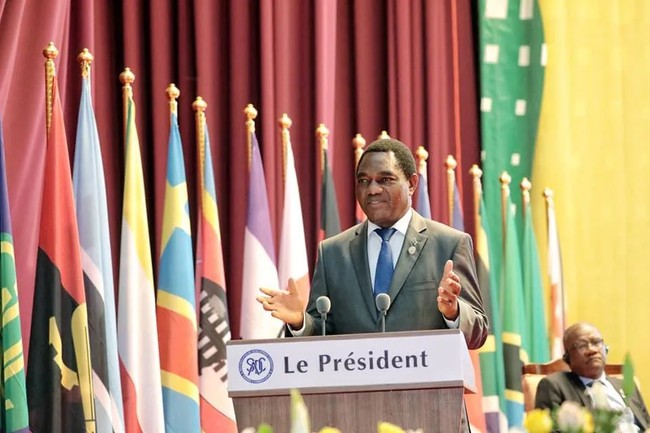
President Hakainde Hichilema
What the discontent is about
When you look at the history, Zambia’s recent years have tested its people severely. The country is emerging from a 2024–25 drought, described as the worst in living memory. It withered the maize harvest, left millions needing food assistance, and collapsed hydropower dam levels. That brought electricity cuts of up to 20 hours a day to households and small businesses.
It struck an economy already strained by a historic debt default, a weakened kwacha, and painful prices for fuel and mealie meal. In a country with a median age of 17, youth unemployment and the cost of living dominate daily life and daily conversation.
Against that backdrop, the tracked record shows discontent discharging through high-voltage political flashpoints. The most-viewed critical coverage of Hichilema clusters around police and ruling-party conduct toward opponents, and the months-long dispute with the family of former President Edgar Lungu over the custody and burial of his remains after his death in June 2025.
Behind these: mining policy, corruption allegations, and cost-of-living complaints. Rights groups addcontext. Amnesty International recorded an intensifying crackdown on dissent in 2024. Human Rights Watch flagged the imprisonment of an opposition official. Western partners questioned sweeping cyber-security legislation.
In the campaign’s closing weeks, the data includes widely circulated reports of violence around opposition events, including attacks on Mundubile’s team in Kitwe in July 2026. That viewership registers directly in the critical-coverage totals.
The government machinery versus the grassroots
The composition of coverage may be the dataset’s most telling layer. Just under half of Hichilema’s,9,373 tracked posts, 4,670, are produced by media outlets. The routine harvest of incumbency: state functions, official travel, newsroom convention.
Mundubile’s coverage skews the other way 2,287 of his posts were uploaded by individual supporters.That’s 1.5 times the President’s supporter-generated volume, despite the challenger commanding nostate machinery and, by his own account, little money.
On Facebook, the platform that reaches virtually every Zambian social-media user, Mundubile leadsviews two to one. On YouTube the race is a statistical dead heat, but the heat is not symmetrical: a third of the President’s YouTube viewership sits on critical content, against 6% of his challenger’s.
The President’s clearest leads are on TikTok and X — the platform with the smallest Zambian audience.
Analysts of African elections will recognise the pattern. Organic, supporter-driven volume for a challenger against institutionally generated volume for an incumbent was a feature of Zambia’s own 2021 upset, when Hichilema was the challenger.
For me, what we need to look out for is whether Zambia is a test of whether Africa’s most-praised democratic alternation of 2021 consolidates or erodes. There have been warnings from civic rights groups, especially since Zambia sits at the center of the critical-minerals economy. As one of Africa’s largest copper producers, with newly restructured debt and Western mining investment, stability and rule of law matter for the SADC member state.
It will be interesting to hear President Ramaphosa’s views on the winds of change blowing through the SADC community and what his thoughts are on the peaceful, credible transfer of power or if a peaceful,credible re-election would resonate across Southern Africa, where both outcomes have grown rarer.
International observation missions from the AU, SADC, the Commonwealth and the EU are expected and diplomats and media practitioners in Lusaka have pressed for full observer access through tabulation,where past disputes have concentrated. Zambians have been here before. Twice in living memory they have looked at an incumbent with every structural advantage and quietly voted for change.
One thing is for certain, the political stakes in Zambia extend beyond its borders, where the implications of this electoral battle resonate throughout Southern Africa. Ramaphosa’s vision 2050 lecture at UKZN is definitely one that should give us insight into the future of the SADC.
* Ayanda Mdluli is the Editor of Thought Leadership and Opinions at IOL
** The views expressed do not necessarily reflect those of IOL
A 26-year-old Johannesburg attorney who was abducted outside her Northcliff home on Wednesday evening has been rescued safely, while police have arrested suspects and recovered a vehicle linked to the crime.Police spokesperson Colonel Dimakatso Nevhuhulwi confirmed that the suspect is due in court soon. Investigator Mike Bolhuis of Specialised Security Services (SSS) confirmed that Alex Soleil van Heerden was rescued in Vosloorus on Thursday night, less than 28 hours after she […]