The Inter-Ministerial Committee (IMC) will approach the Constitutional Court for a supervisory order to oversee the implementation of its ruling allowing undocumented immigrants to apply for asylum in South Africa, regardless of how they entered the country.
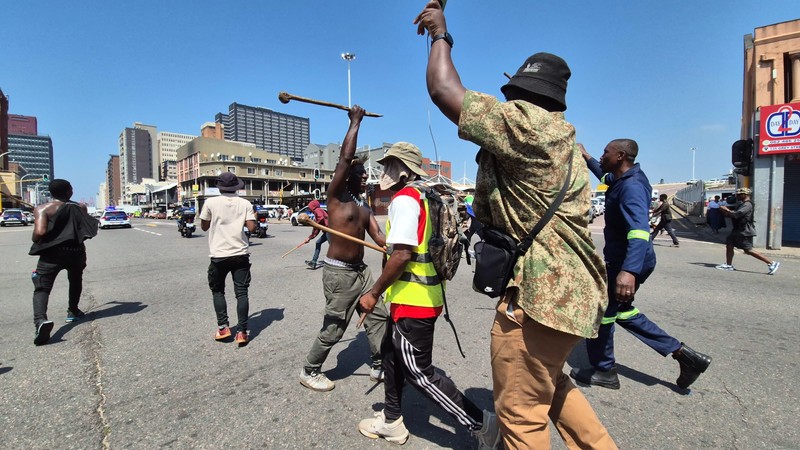
The announcement comes after violent protests in KwaZulu-Natal and Gauteng last week, during which several cars and houses were torched, and stores looted.
At a media briefing on Sunday, IMC chairperson and Minister of Justice and Constitutional Development Mmamoloko Kubayi said the government had considered the implications of the judgment and consulted legal advisers on possible responses.
Government seeks supervisory order
Kubayi said the briefing aimed to update the public on the Constitutional Court judgment relating to asylum applications and the administration of the country’s asylum system.
“We are also here to talk to South Africans about the need to work with us as government in our efforts to resolve this issue and, most importantly, to exercise restraint in their justifiable protest against the unintended consequences arising from this judgment.”
She reiterated the government’s acknowledgement of the judgment and reaffirmed its commitment to upholding the Constitution, the rule of law and South Africa’s national and international obligations towards refugees and asylum seekers.
“Following detailed legal consultations, we have been duly advised that the government can approach the courts to seek a supervisory order in this regard.”
“A supervisory order, in practical terms, would enable the court to retain oversight of the implementation process and provide guidance on how the order should be operationalised.”
“Such an order may also include a suspension period to allow the Department of Home Affairs the necessary time to develop and strengthen administrative, human resource, infrastructure, and processing capacity required to implement the judgment effectively and sustainably.”
Kubayi said the government believed this approach would provide a responsible and lawful mechanism to fulfil its constitutional obligations in an orderly, practical manner and in the public interest.
“It will allow the government to avoid administrative disruption while ensuring that the rights recognised by the court are progressively and meaningfully realised.”
“Accordingly, the government will request the court to provide guidance on the nature and scope of the supervisory measures that may be required, as well as the appropriate duration of any suspension period necessary to build the operational capacity required for implementation.”
She stressed that the objective was not to delay compliance but to ensure it was effective and sustainable, serving both the administration of justice and the broader public interest.
High Court to consider conflicting directives
The IMC has also directed relevant government departments and entities cited in the proceedings to participate in a court hearing scheduled for October 29, 2026.
The hearing will be conducted by a panel of judges appointed by the Judge President of the Gauteng Division of the High Court.
“The panel will review two conflicting directives on the same legal question regarding asylum seekers which are set out in two different judgments in the Gauteng Division of the High Court.”
“The High Court panel hearing will consider submissions that have the same bearing on the administrative implementation of the 7 July 2026 Constitutional Court judgment.”
Kubayi emphasised that the government remained legally bound to comply with the Constitutional Court’s order while pursuing the legal processes.
She said failure to comply could amount to contempt of court.
“We are in a situation where the IMC must find a balance between compliance with the court order and listening to the concerns of many South Africans, and we believe we will be able to find that balance, though we need time and patience that we will request formally from the court and that we are requesting today from our citizens.”
New asylum registration system by November
The IMC welcomed the Department of Home Affairs’ planned introduction of a phased intention-registration and appointment system for asylum seekers by November 10, 2026.
Kubayi said the system would be implemented to ensure there was no interruption in access to the asylum application process.
Under the proposed model, applicants will be able to register their intention to seek asylum through an online platform and receive a receipt with an appointment at a Refugee Reception Office (RRO).
Assisted registration will be available at every RRO and, on request, for people in police or immigration detention. Assistance will be provided through officials, legal representatives and civil society partners in the main languages.
The receipt will record the holder’s personal particulars, biometrics, declared intention to apply for asylum, reference number and appointment details.
It will also clarify that the document is not a section 22 visa and does not confer recognised asylum status, while explaining the application of section 2 of the relevant Act and the holder’s obligations.
“Non-refoulement attaches by operation of law to any person who has declared an intention to seek asylum; the receipt is the proof of that intention and the means by which the Department operationalises the protection.”
Kubayi said Home Affairs would instruct officials and the Border Management Authority (BMA), including inspectorate, port, border and RRO staff, not to remove or refoule holders of valid receipts, or arrest or detain them solely for being in the country without a visa while they await lodging and the final determination of their applications.
“Further, the SAPS, the Department of Correctional Services, the National Prosecuting Authority and the courts will be informed accordingly.”
Protection limited to first-time applicants
Kubayi said people whose earlier asylum claims had been finally rejected would be treated differently.
She said they had no right under the Act to make a subsequent application and could not reactivate the protection under section 2 simply by declaring an intention to apply again.
“The court expressly left open whether the Act is under-inclusive in making no provision for a genuinely new claim arising after final rejection.”
“Until that question is resolved, a specific and new claim that removal would expose such a person to persecution or serious harm should be referred for legal advice before removal.”
She said the receipt would protect only people who had registered an intention to make a first asylum application. Deportations for other contraventions of the Immigration Act would continue.
Officials would still be required to receive an expressed intention to make a first application at any stage, including from people in detention.
“If the appointment is not attended, and no extension is sought, it falls away. Further, those rejected will be flagged and cannot abuse the system by logging new applications.”
The platform will protect confidentiality under section 21(5) and personal information in terms of the Protection of Personal Information Act 4 of 2013. It will also be accessible to people without devices or documents.
Kubayi said the system would include published service standards, a complaints mechanism and statistics made available to the courts for monitoring and reporting.
Government considers legislative changes
The government is also preparing legislation in line with the Revised White Paper on Citizenship, Immigration and Refugee Protection, which was approved by Cabinet.
“Parallel to the above, the Minister of Home Affairs is in the process of drafting legislation in line with the Revised White Paper on Citizenship, Immigration and Refugee Protection approved by Cabinet, which draft legislation is envisaged to be processed through Parliament in the next financial year.”
Kubayi said the proposed legislation would, among other measures, allow applications to be lodged remotely.
“We have requested the Minister to fast-track this process. This is the legislation that will include the matter of the first Safe country from the country of origin as articulated by the white paper and correctly so being reminded by our citizens.”
Home Affairs has also reported progress towards implementing President Cyril Ramaphosa’s June announcement that refugee reception centres would be moved to ports of entry, starting with Beitbridge by December.
Kubayi said the government would consider public suggestions to establish refugee camps, particularly for people whose asylum applications were still being processed, taking into account the legal and financial implications.
“We will process this suggestion from legal and financial implications.”
She reiterated that enforcement of immigration laws would continue.
“Our work on enforcing the law will continue; this therefore means deportations will continue.”
“Protection applies only to people who have asked to make a first application for asylum.”
Kubayi said people who were in the country illegally and had not applied for asylum, as well as those whose claims had been finally rejected after any review or appeal, would continue to be deported as required by law.
Government urges calm amid protests
Kubayi said public discussions about the judgment had created uncertainty, speculation and heightened tensions in some communities.
“The IMC is acutely aware that public discussions surrounding the judgment have generated uncertainty, speculation, and, in some instances, heightened tensions within communities.”
“We therefore call on all members of the public, civil society organisations, community formations, and political stakeholders to exercise restraint and allow the legal processes now underway to run their course.”
She said South Africa remained a constitutional democracy governed by the rule of law, adding that issues relating to asylum, migration and border management had to be addressed through lawful processes rather than misinformation, intimidation, incitement or violence.
Thirty arrested over public violence
Kubayi said 30 people had been arrested since Thursday in connection with public violence and alleged attempts to destabilise communities.
Of those arrested, 25 were in KwaZulu-Natal and five in Gauteng. The offences included public violence, illegal gathering, obstruction and resisting arrest.
Those arrested include individuals identified as ringleaders who allegedly threatened to disrupt planned football matches in Durban on Sunday.
“We reiterate that law enforcement will not allow threats, intimidation or unlawful conduct to undermine public safety, disrupt sporting events or destabilise communities.”
Kubayi said the government supported law enforcement efforts to protect lives, safeguard property and uphold the rule of law.
“We will indeed act decisively, professionally and within the confines of the law against anyone who threatens public order.”
simon.majadibodu@iol.co.za
IOL Politics


