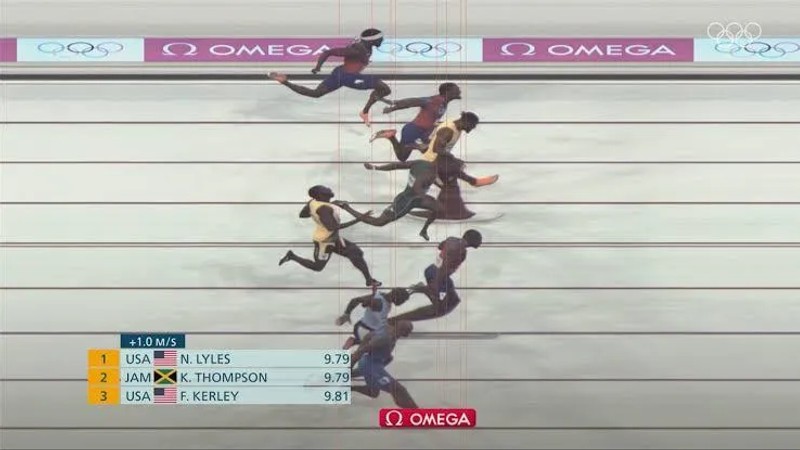
For football fans, VAR, the semi-automated offside graphic, is an instantly recognisable staple of modern broadcasts: a sleek, 3D computer model isolating a forward’s knee or toe millimetres ahead of a defender.
Now, track and field is adopting the exact same visual language to revolutionise how global audiences experience photo finishes.
Ahead of the inaugural World Athletics Ultimate Championship in Budapest, Sony and World Athletics unveiled a broadcast proof-of-concept designed to transform split-second race decisions into immersive television.
Rather than relying solely on traditional side-on slit-scan photographs, Sony is deploying optical tracking technology – developed alongside its Hawk-Eye division – to capture real-time athlete movement data.
This data is instantaneously converted into three-dimensional computer graphics (3DCG) for the international host feed, giving rights-holders access to virtual, multi-angle replays that mimic the precision visuals seen in elite European football.
The visual parallel is striking.
Just as VAR offside lines clarify crowded penalty boxes, these 3D renders remove the ambiguity of tight finish-line scrambles. Instead of asking casual viewers to decipher a static, two-dimensional photo to see whose torso crossed the plane first, the broadcast can pivot smoothly around virtual runners to highlight the exact point of impact with the finish line.
Track events are routinely decided by thousandths of a second, yet traditional photo-finish imagery often feels clinical and detached for home audiences.
By capturing full-body spatial mechanics and rendering them in real time, World Athletics is not just assisting officials with fairer calls, it is turning the millimetre-thin margins of world-class sprinting into high-drama, prime-time viewing.


