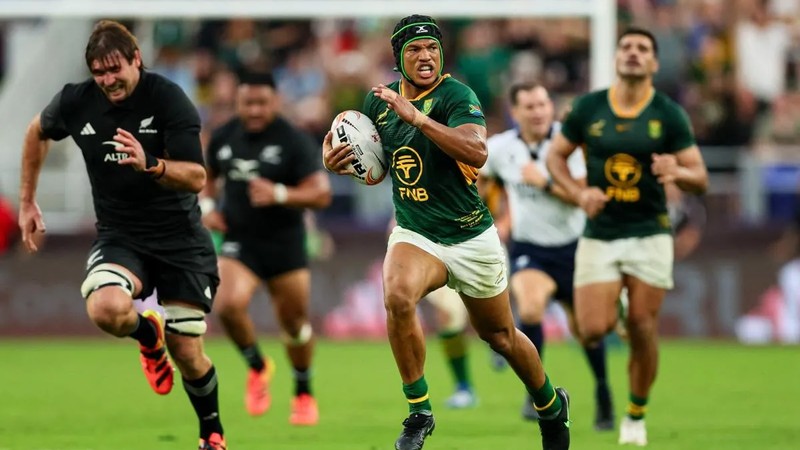
The Springboks’ attack across their 3–1 series triumph over the All Blacks was a tactical evolution, transforming from a blunt instrument at Ellis Park in the first Test into an unstoppable, multifaceted threat by the time the dust settled in Baltimore.
The opening Test in Johannesburg exposed a team struggling for rhythm, cohesion, and poise. The players looked persistently rushed, panic set in under pressure, and the passing out of the back door was frustratingly inaccurate.
The chaotic performance bore a striking resemblance to the previous year’s defeat against the All Blacks in Auckland. In both fixtures, the Springboks were their own worst enemies — rushing their execution, forcing desperate passes in contact, and abandoning the patience that normally underpins their game.
Relying too heavily on lateral, predictable phase play allowed New Zealand’s defence to make easy, dominant tackles behind the gain line. However, the subsequent adjustments made in Cape Town and Soweto laid the groundwork for an offensive explosion in the United States.
A central hallmark of this shift, particularly inside the opposition 22, was a subtle tweak to South Africa’s ball-carrying. The Boks did not abandon brute force, but added nifty footwork to find gaps and target the All Blacks’ defensive line.
Inside the red zone at DHL Stadium, centres Damian de Allende and Jesse Kriel consistently used subtle pre-contact stepping to target weak shoulders rather than running straight at defenders. This late movement generated rapid momentum, exposed defenders on their heels, and forced the All Blacks into passive, uncertain tackles.
It also helped that the Boks’ attacking breakdown was much more fluid than at Ellis Park following the return of captain Siya Kolisi, who capped off a fine display in Cape Town by running a superb line to score.
By the time the series culminated at M&T Bank Stadium in Maryland, the Bok attack had turned electric. The passing was immeasurably slicker, with flyhalves Sacha Feinberg-Mngomezulu and Manie Libbok pulling the strings and finding absolute flow in distribution. Their ability to fix defenders before releasing crisp, accurate passes allowed the backline to execute at full pace without compromising accuracy.
Kurt-Lee Arendse was the primary beneficiary in the finale, floating across the park to ignite attacks from broken play, first-phase strikes, and sharp counter-attacks. Arendse’s ability to inject himself as a option off the first receiver from a second-half lineout gave the attack an unpredictable, deadly dimension that systematically unpicked the Kiwi defence.
Giving the ball more air and offloading in the tackle allowed the Springboks to achieve over 60% gainline success by blending their undoubted power with finesse. Arendse made the most of the spatial freedom, racking up a staggering 169 metres with ball in hand alongside four line breaks and nine defenders beaten.
What started as a rushed, mechanical setup in Johannesburg ended in Baltimore as a clinical blend of brutal tight-five power, clever contact skill, and unscripted pace.
While there have been glimpses of this all-round game over the past couple of seasons, notably in Wellington and against Argentina in Durban, this series provided definitive proof that the Springboks’ attacking evolution has reached a new level.


