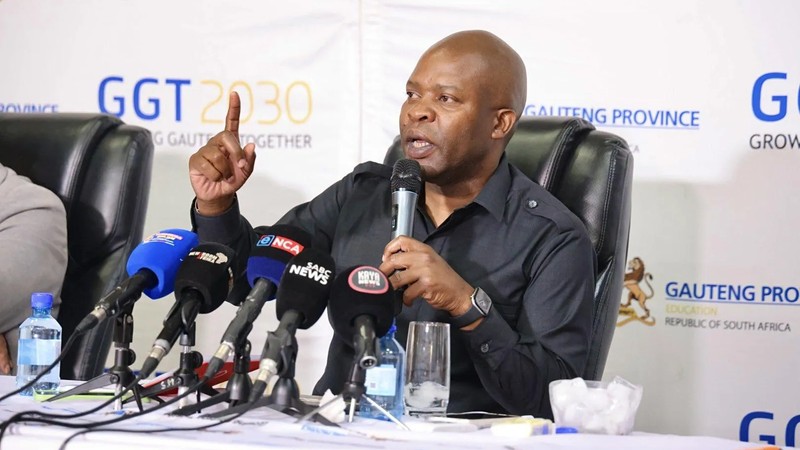
Gauteng Education MEC Lebogang Maile has painted a grim picture of school safety in the province, revealing thousands of incidents linked to violence, vandalism, substance abuse and criminal activity over the past five years.
Briefing the media on school safety, Maile said Gauteng’s education system is increasingly reflecting wider societal crime patterns, warning that “the high crime levels in the province are mirrored to a large extent in our schools.”
According to departmental figures, schools across the province have recorded more than 4,600 incidents of violence and over 4,100 cases of vandalism during the period under review. In addition, nearly 400 incidents of sexual misconduct and about 1,400 search-and-seizure operations were recorded.
“These numbers are a concern as they indicate that schools are under threat,” Maile said, adding that violence, vandalism, substance-related incidents and learner misconduct remain persistent challenges affecting teaching and learning.
The MEC attributed the crisis to a combination of factors, including gang activity, drug use and broader community instability.
“School safety is part of the broader societal challenges relating to crime, violence, substance abuse and social instability that confront South Africa,” he said.
He warned that unsafe school environments are directly undermining education outcomes, noting that “learners cannot learn effectively in environments characterised by fear, intimidation or violence.”
The department has identified 245 high-risk schools following a provincial environmental scan, which profiled more than 1,300 schools. Key risks include gang violence, bullying, substance abuse, sexual harassment, theft and vandalism.
While interventions such as CCTV installation at 606 schools and the deployment of private security to over 120 schools have been implemented, Maile said long-term solutions require broader community involvement.
“Safe schools are therefore not only a security imperative but an educational imperative,” he said, stressing that schools must be protected as community assets.
Maile also emphasised that sustainable safety cannot be achieved through security measures alone, pointing to psychosocial support programmes reaching thousands of learners facing trauma, bullying and mental health challenges.
Reiterating the call for collective responsibility, he said: “Schools are not merely government facilities. They are community institutions, centres of learning and symbols of hope for future generations.”
The department is currently reviewing its school safety strategy, which is expected to be finalised in 2026, with a stronger focus on prevention, early intervention and community-led solutions.
IOL News


