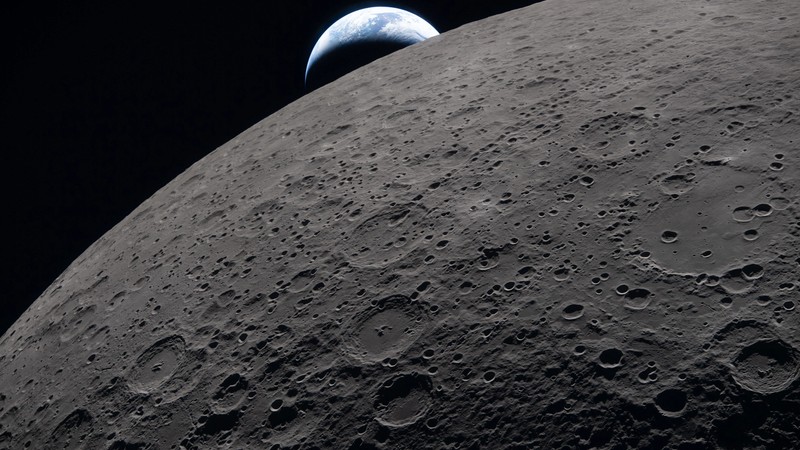
During their historic lunar flyby, astronauts on NASA’s Artemis II mission witnessed meteorites striking the rugged surface of the moon, a sight that has piqued scientists’ curiosity.
“That was definitely impact flashes on the moon. And Jeremy (Hansen) just saw another one,” mission commander Reid Wiseman reported on Monday while flying around the Moon – the first such journey by humans in more than half a century.
“Amazed,” replied Kelsey Young, the mission’s lunar science lead, as she followed the spacecraft from more than 400 000km away on Earth.
“I don’t know if I expected to have the crew see any on this mission, so you probably saw the surprise and shock on my face,” she said, recounting the strikes at a press briefing the next day.
Among NASA’s team in Houston, there were “audible screams of delight” from scientists when the crew described flashes of light caused by meteorite impact, Young said.
The phenomenon is “something that we have not witnessed often,” the mission’s backup astronaut Jenni Gibbons said.
“They were really high-priority science for us, so the fact that they saw four or five was just outstanding.”
As the astronauts hurtled towards home, NASA asked them this week about the meteorite strikes they saw during their nearly seven-hour observation period.
“Were they prolonged? And did you notice any colour?” Young asked.
“It’s a pinprick of light,” replied Canadian crew member Hansen. “I would suspect there were a lot more of them.”
“I would say they were a millisecond, like the fastest a camera shutter can open and close,” added Wiseman, who said the flashes were “white to bluish white.”
“To me, there was no doubt we were seeing it, and we were all seeing it,” he added.
According to NASA’s tally, the team, which broke the record for the furthest distance from Earth during their flyby, reported a total of six meteorite impacts on the lunar surface.
Ground crews are now working to match these observations with data from a satellite orbiting the moon, said Young, adding that the majority of the sightings took place during a solar eclipse, when the moon passed in front of the Sun.
“I’m personally… surprised they would see that many, although they (had) been trained to look for them,” said Bruce Betts, chief scientist at the Planetary Society.
According to Betts, the descriptions will allow scientists to “get some idea of the frequency of impact” as well as the size of the projectiles.
One question was what size an object needed to be to create a flash visible to the astronauts, Betts said.
“It’s not a piece of dust, but it’s not a meter-size boulder, either.”
The observations raise questions and show that the “daily flux of meteors should be monitored more closely in the future before a lunar base is established,” said Peter Schultz, Professor Emeritus of Geological Sciences at Brown University.
On Earth, smaller objects “burn up high in the… atmosphere due to friction” before they reach the ground, noted Betts, which is not the case on Earth’s natural satellite.
“There is more of a challenge on the Moon,” he said.
AFP