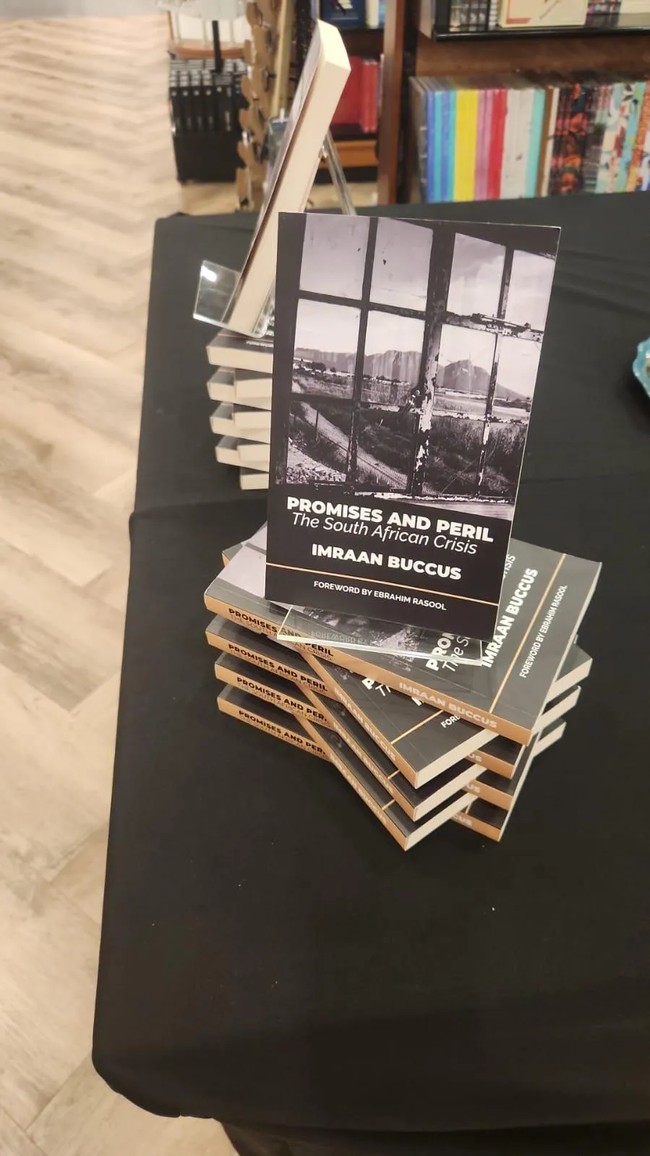
The ANC’s leaders today are nothing like the generation that fought apartheid, a political analyst told a Cape Town book launch, with struggle veteran Albie Sachs sitting in the room.
Imraan Buccus was launching his book, Promises and Peril: The South African Crisis, at Exclusive Books at the V&A Waterfront recently, in conversation with Stellenbosch University distinguished Professor Aslam Fataar.
Sachs, the retired Constitutional Court justice, opened the evening.
“I think the leadership of the ANC today is not the leadership we had during the time of Albie,” Buccus said.
“People who came up with huge philosophies, huge intellectual talks. But the leaders we have today don’t come from that.”
The party lost its majority in the 2024 general election, dropping to about 40% of the national vote, and now governs in a coalition.
Buccus said it deserved credit for how it took that.
“What we can be proud of is that though the ANC is losing its majority, it very graciously accepted defeat,” he said.
Imraan Buccus launched Promises and Peril, warning that South Africa faces a deep political crisis and urgent choices.
He said the slide was not unique to SA, and had played out across the continent.
“Liberation movements get pushed to the periphery, and I think in large part because of corruption, and because of infighting,” he said.
Speaking after the launch, he said the country was at a critical moment 32 years into democracy.
“There’s a deep need for us to think more critically about our political future,” he said.
He traced the rot back to 1994 itself, when a party elected to build was handed an economy that would not let it.
“People had, of course, huge expectations of this movement,” he said.
“Say we need to build a million homes, and [former president Nelson] Mandela thinks, well, we have a million homeless people, hypothetically, build a million homes, and the problem is solved.
“And of course, markets don’t work like that.”
Asked from the floor whether there was any danger in what he publishes, Buccus said he had been warned off.
“I’m sometimes told I shouldn’t be writing the things I am writing, especially in the case of KZN,” he said.
“For those of you who know the politics of KZN, there’s a huge gangsterisation of politics, and there’s a huge politicisation of gangsterism.”
He offered a former eThekwini mayor as an example of the sort of figure he had written about.
Zandile Gumede, who ran the metro until the ANC ordered her to step aside, is on trial in the Durban High Court with 21 co-accused over a R320m Durban Solid Waste tender, on charges including fraud, corruption and money laundering.
She denied wrongdoing, and this month was unveiled as MK Party deputy convener in KZN.
“In SA, you can’t be saying things like that to a lot of people who are so politically connected,” Buccus said.
He said the job of exposing that world had largely fallen to the press rather than to the state.
“Arguably, investigative journalism has done more than many institutions of state in terms of exposing corruption, in terms of exposing much of what happens in South African society,” he said.
The book, published by African Perspectives, is part memoir and part political analysis, with a foreword by former SA ambassador to the US Ebrahim Rasool.
Its central claim is that the wall between government and organised crime has come down.
“In post-colonial societies, when it reaches a certain point, there’s a very fine line between the state and the underworld,” Buccus said.
That line is currently the subject of a judicial commission in Pretoria.
The Madlanga Commission was set up by President Cyril Ramaphosa in July 2025 after KZN police commissioner Nhlanhla Mkhwanazi accused politicians, senior police officers, prosecutors and intelligence operatives of colluding with criminal syndicates.
Police minister Senzo Mchunu and national police commissioner Fannie Masemola are both suspended; Masemola is among 13 officers facing criminal charges, and the commission is due to report mid-November.
Buccus said the scale of it should surprise nobody.
“You would have seen how complex that is, when the head of the police service is accused of having all of these relations with the underworld,” he said.
“But I would say not surprising.”
He pointed to Mexico, where the Institutional Revolutionary Party governed for seven decades until 2000.
“The only reason it stayed in power in the last few years is because of its connection to the drug cartels,” he said.
The book opens with a chapter Buccus said he had not expected to write, about a teenager in a Durban mosque during apartheid who asked the wrong question.
“I asked the imam what my faith or what does religion say about oppression,” he said.
“He looked at me, and he said, ‘ Those are not things you should concern yourself with; you should focus on being a good Muslim, going to the mosque, praying, fasting.
“And I said, does that mean my faith has nothing to say about all of the oppression I see around me?”
He was later taken to an Islamic study programme where he first heard the names Malcolm X and Ali Shariati, the Iranian sociologist whose writing helped shape the 1979 revolution there.
Asked where the country goes now, Buccus said the answer was not in Parliament but in the movements outside it.
He cited Abahlali baseMjondolo, the shack dwellers’ movement founded in Durban in 2005, which he said now claims about 120,000 members.
“If you look at all these left movements, and I make the argument that if they come together, there’s huge electoral space on the left,” he said.
“I think what we haven’t explored in South Africa enough is electoral possibilities on the left.”
A speaker from the floor put it back to him that the analysis in the book was severe, and warned against ending in despair.
“Pessimism is the antithesis of faith,” he said.
“Promises is when the politicians and the institutions choose the high road, and peril is when we choose the low road, and we know where that is taking us.”
Promises and Peril: The South African Crisis is available at Exclusive Books stores nationwide and online.
The rivalry between the Springboks and the All Blacks has never needed artificial hype to stoke its flames, but former Crusaders scrumhalf Bryn Hall has provided an intriguing spark nonetheless.Speaking on the Aotearoa Rugby Pod, Hall claimed that the All Blacks possess the tempo and attacking capability to "run the Springboks off their feet" when the two sides lock horns in the upcoming Greatest Rivalry Series.While the All Blacks’ high-octane […]