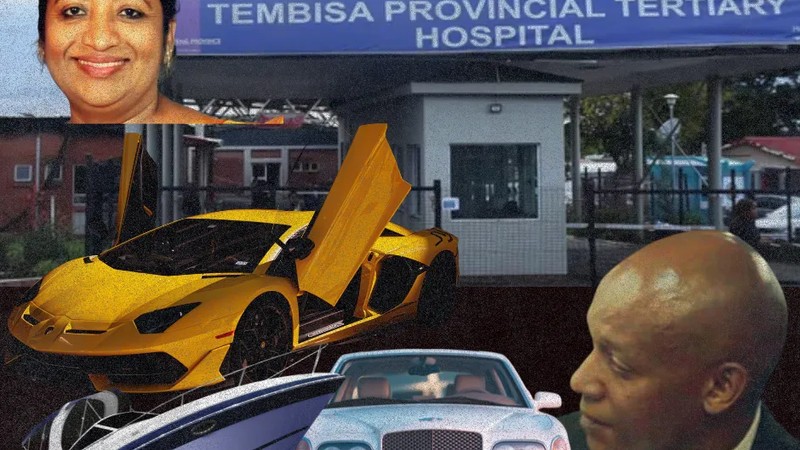
The government has been called to treat businessman Hangwani Maumela, who is implicated in the looting of more than R2 billion at Tembisa Hospital, equally to every citizen and hold him accountable for his actions despite his political connections.
This is according to the civil society organisations, Public Interest SA and Corruption Watch, which said justice must be administered without fear, favour, or prejudice.
Maumela is the nephew of President Cyril Ramaphosa by previous marriage.
While the president has consistently distanced himself from Maumela and stated they have no personal relationship, their familial link stems from the fact that Maumela is the son of the sister of Ramaphosa’s former wife.
The calls come after the Gauteng High Court, Johannesburg, on Monday ordered the final forfeiture of assets worth approximately R326 million linked to the alleged Maumela syndicate, marking a significant shift for the National Prosecuting Authority (NPA) in its efforts to combat corruption related to the Tembisa Hospital procurement scandal.
The forfeiture order follows a preservation order granted on August 14, 2025, and covers an extensive collection of luxury real estate in some of South Africa’s most exclusive suburbs, including Bantry Bay, Sandhurst, Hartbeespoort, Ballito, and Three Anchor Bay.
Also forfeited are several high-performance vehicles, including Lamborghini Urus, Huracan STO, Aventador SVJ and Aventador Ultimate models, a Bentley Continental GT V8, an Isuzu D-Max, a luxury boat, and a multipurpose trailer.
However, Maumela remains a free man and has remained largely out of the public eye despite these developments.
The Public Interest SA said all individuals, irrespective of their political connections, social standing, or economic influence, must be treated equally before the law.
The organisation said that although the final asset forfeiture order is undoubtedly a significant victory in the fight against corruption, this should not be regarded as the end of the accountability process.
“It must form part of a broader strategy that includes thorough criminal investigations and, where the evidence supports it, successful prosecutions of those responsible. Recovering illicit assets and holding perpetrators personally accountable are complementary, not mutually exclusive, objectives,” said the organisation.
On the other hand, Corruption Watch said that while it cannot assume that political interference could delay prosecution, this aligns with a deeply concerning trend of state inaction frequently observed in high-profile cases, particularly regarding the failure to finalise investigations and secure convictions.
“That pattern is not just speculation but is a reality, so the possibility of political interference cannot be entirely dismissed,” said spokesperson Janine Erasmus.
Erasmus added that while public money used for private enrichment must be recovered and used properly, individual accountability is equally important, and those who willingly engage in corruption should not be allowed to get away with what amounts to a slap on the wrist and then simply go on to repeat those corrupt acts elsewhere.
“We reiterate our view that decisive action must be taken against those involved in stealing R2 billion from Tembisa Hospital. Asset forfeiture is just part of the process and is not a substitute for prosecutions and convictions,” she said.
The legal order was granted to the Asset Forfeiture Unit (AFU) as a result of a probe into corruption and procurement fraud allegations at Tembisa Hospital between 2019 and 2022.
This case originates from the murder of Babita Deokaran, a high-ranking Gauteng Health Department official, on August 23, 2021. She was killed shortly after blowing the whistle on questionable transactions at Tembisa Hospital, where her investigations uncovered multiple businesses benefiting from rigged and overpriced tenders.
The National Treasury’s Specialised Audit Services Unit (SAS) and the Special Investigating Unit (SIU) confirmed that 14 companies controlled by Maumela secured over R400m in irregular contracts between 2016 and 2022.
The expanded SIU investigation later proved that Maumela’s wider syndicate network fraudulently siphoned more than R800m from the hospital.
Asked what is preventing Maumela’s arrest, SIU spokesperson Selby Makgotho said it is not the unit’s place to answer questions about arrests and prosecutions, saying the questions should be raised with the SAPS, the Hawks, IDAC, and the NPA.
NPA’s spokesperson Kaizer Kganyago said the investigation into the criminal case is being done by the Hawks, guided by the NPA’s Specialised Commercial Crimes unit (SCCU), adding that once they are ready, they will send the docket to the Director of Public Prosecutions (DPP) for a decision.
Asked what specific gaps remain in converting the SIU referrals and financial intelligence into an admissible, trial-ready criminal docket, Kganyago said: “We cannot comment on an ongoing investigation.”
Hawks spokesperson Katlego Mogale could not respond at the time of this publication.
Questions were also sent to the Gauteng Health Department, however no response was received at the time of publication.
manyane.manyane@inl.co.za


