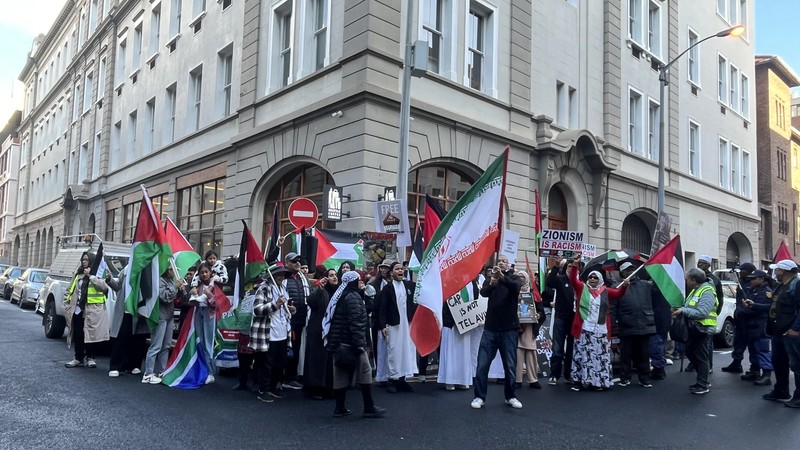
The Palestinian Solidarity Campaign (PSC), together with four individuals, is seeking leave to appeal a Western Cape High Court order that imposed a series of restrictions on statements and protest conduct involving Cape Union Mart.
The application asks the High Court in Cape Town to grant leave to appeal to the Supreme Court of Appeal against a judgment restraining PSC members PSC from linking Cape Union Mart, its brands and its chairperson to the Israeli regime and the genocide in Gaza.
The applicants in the original proceedings are Cape Union Mart International (Pty) Ltd and its executive chairperson, Philip Joseph Krawitz.
The activists are: the PSC, Magmuda Ockards, Muhammad Shafiq Gamiet, Mohamed Zaid Jeenah, Sherazaad Rahima Sylvester, and Sayed Ridhwaan Mohamed. The Centre for Applied Legal Studies is cited as friend of the court.
The activists argue that the restrictions imposed by the high court are too broad and unjustifiably limit freedom of expression and protest.
One of their central complaints concerns a paragraph which they say prohibits claims that Cape Union Mart or its brands are associated with Israel “in any way”, including statements which may be true and non-defamatory.
The group argue that the court did not identify a sufficient right or injury to justify such a broad restriction. They contend that Krawitz’s positions as Cape Union Mart’s executive chairperson and chair of Keren Hayesod’s South African campaign provide a basis for public discussion about his leadership roles and the rationale behind the boycott campaign, without necessarily establishing that Cape Union Mart funds unlawful conduct.
They further challenge restrictions on statements alleging that the applicants fund a conflict, as well as restrictions concerning allegations of “complicity” or “support”.
According to the application, those provisions could cover substantially different future statements regardless of their factual context. The respondents argue that any interdict should instead be confined to specific unlawful statements or conduct that had been proved or was reasonably apprehended.
Challenge attribution of protest material
Another major ground of appeal is that the court imposed the restraints on all the members without sufficiently establishing which respondent had published, authorised or adopted each of the statements and posters complained about.
The activists acknowledge that the PSC and some individuals admitted responsibility for particular publications. These included the PSC’s production of certain material and Jeenah’s display of a “They Fund Genocide” poster.
However, they argue that those admissions did not establish that every person was responsible for every publication at the protests.
They further argued that organising or attending demonstrations did not, without more, establish adoption of every publication made or displayed during a protest.
They also challenge the restrictions concerning protest conduct, arguing that the court did not sufficiently determine the disputed conduct of each respondent before granting paragraphs 7 and 8 of the order.
It was further argued that the High Court misapplied the test for determining whether their defences had a sustainable foundation.
They contend that, in considering an interdict involving allegedly defamatory publications, the court should have considered whether evidence potentially available at trial could support their defences. They argue this could include evidence not yet in their possession, particularly where relevant records were controlled by the applicants or other institutions.
They also argue that the court erred in disregarding a number of institutional publications relied upon in their defence.
According to the application, the documents were relevant to issues including institutional status, programmes and Krawitz’s affiliations, as well as the context in which the respondents made their comments.
They argue that the documents did not necessarily prove that the applicants funded the activities described in them but could nevertheless have been relevant to the factual context and the respondents’ protected comment defence.
They further contend that the court failed expressly to determine an abuse-of-process objection raised in their papers. They say the objection concerned alleged omissions about other organisations and a protest memorandum, alleged misdescription of Krawitz’s affiliations and what they described as the selective use of court proceedings to suppress lawful protest.
Cape Union Mart defends court decision
Cape Union Mart has defended the court’s rulingh after learning that the PSC has brough an application for leave to appeal the judgment.
Cape Union Mart said it, together with its chairman Philip Krawitz, had approached the court over specific conduct which the court found warranted relief.
“We stand by that judgment,” the company said.
According to the retailer, the conduct at issue included the alleged harassment and intimidation of customers and employees, alleged breaches of the Regulation of Gatherings Act, as well as claims linking the company and Krawitz to the conflict in Gaza and Israel’s military actions.
The company described these claims as false and defamatory, saying they had been made without proof.
“Our High Court action was the option of last resort to get the respondents to simply refrain from making the false claim that the applicants are funding a genocide and are killing babies,” Cape Union Mart legal adviser Simone Sulcas said.
Cape Union Mart also addressed claims concerning its corporate social investment activities.
The company said it has a longstanding corporate social investment policy and donates money to several causes in South Africa but has never donated funds to any entity outside the country.
The company said it trusted that the activists would comply with the High Court judgment as the legal process continued.
sinenhlanhla.masilela@iol.co.za
IOL News
Get your news on the go. Download the latest IOL App for Android and IOS now.


