President Cyril Ramaphosa’s bid to have the report that triggered his Phala Phala impeachment inquiry set aside rests, in part, on a court case about a schoolboy suspended from class.
His advocate, Wim Trengove SC, relied on the judgment in the Western Cape High Court on Wednesday as he argued that, contrary to the respondents’ contention, Ramaphosa’s application was not premature.
This despite Parliament’s impeachment inquiry not having been concluded.
Ramaphosa asked the court to set aside the Section 89 independent panel’s report, which found in November 2022 that there was enough evidence for him to face four impeachment charges.
The charges stem from the theft of about US$580,000 in cash that had been hidden in furniture at his Phala Phala game farm in Limpopo in February 2020.
The panel was chaired by former chief justice Sandile Ngcobo.
Its report required the National Assembly to hold a public impeachment inquiry into the charges, which could result in Ramaphosa’s removal from office.
Those opposing Ramaphosa’s application said he should have waited for Parliament to finish the impeachment inquiry before going to court.
On his feet in courtroom 22, Trengove said the panel’s finding had legal consequences for Ramaphosa, making it open to challenge in court.
He referred the court to a case involving a schoolboy who challenged his suspension.
It was argued that the pupil had gone to court too soon because his disciplinary hearing had not yet taken place and the suspension was merely a suspension.
Trengove said the court rejected that argument, finding the suspension could seriously affect the pupil’s future, lead to his expulsion and, on its own, cast serious doubt on his fitness to mix with other children.
“If that goes for a school pupil, how much more is that to our president, who is publicly shamed, publicly humiliated by a prosecution for serious constitutional misconduct?” Trengove said.
“If a school child is protected against that class of damage, then all the more is the president entitled. Not to suspension from school, but impeachment as head of state.”
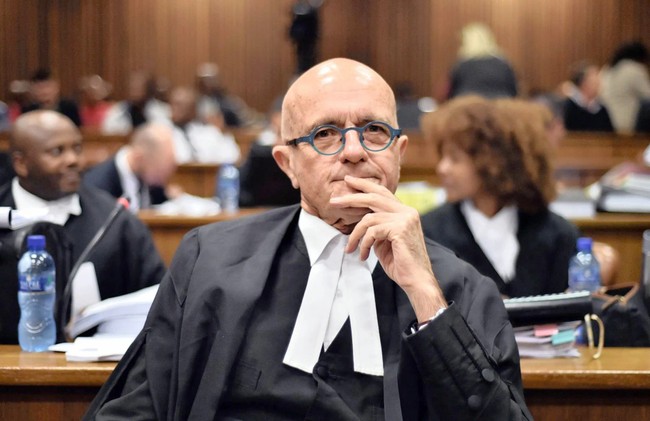
Pictured here is President Cyril Ramaphosa’s legal representative Advocate Wim Trengove SC
The matter is being heard by a full bench of Judge President Nolwazi Mabindla-Boqwana, Judge Mark Sher and Judge Ncumisa Mayosi.
Arguments, which began with Trengove in the morning, were expected to continue until Friday.
The ATM, one of the respondents opposing the application, argued through Adv Anton Katz SC that a court should not interfere in an unfinished parliamentary process unless a party could show that grave injustice would result.
Katz said Ramaphosa’s court papers contained no such claim.
Mabindla-Boqwana asked Trengove what difference there was between the harm already done by the allegations being public and the harm of the president standing trial before the impeachment committee.
Trengove said there were two kinds of harm, and that the latter was the more serious of the two.
“One is the public platform on which evidence is led, which is incriminating and insulting of the president,” he said.
“But there’s another part of it which is more significant.
“The mere fact that the president stands accused by his peers in the national forum of acting unconstitutionally and in bad faith.
“That in itself is an insult which causes pain and reputational harm.”
He said the independent panel was there to protect a president from the serious consequences of an impeachment hearing where the charges were not even strong enough to warrant one.
“A president is entitled to be protected if a panel report does not lawfully determine that there is sufficient reason for a public inquiry,” he said.
“That is the prejudice the president will suffer if he’s deprived of that protection. And it is that prejudice which renders the report subject to review.”
On the merits, Trengove argued the panel had asked itself the wrong question on each of the four charges.
The parliamentary rules allow a president to be impeached only for conduct that is deliberate and in bad faith.
Trengove said the panel had set that requirement out in its own report and had then failed to apply it to any of the charges.
“We’re not going to argue on these charges that the panel asked the right questions but gave the wrong answer,” he said.
“Our argument is a simpler one. They didn’t even ask the question.”
He said the court was not being asked to decide whether the panel had reached the right conclusions.
“You ask the wrong question, it doesn’t matter what your answer is, because you asked the wrong question in the first place,” Trengove said.
“We’re not testing the answers to the question. We’re challenging the question.”
The four charges
The first charge is that Ramaphosa breached the ban on members of the executive doing other paid work by running a farming business.
Trengove said the farm belongs to a trust and is run through a close corporation with a manager and staff, that the president has never been paid by it, and that he declared the interest in Parliament’s public register.
“The president says, ‘of course I own a farm’.
“The farm is run by a manager and employees. I don’t do work for the farm and I don’t get paid for the farm,” he said.
He said the constitution barred a member of the executive from doing work for payment and not from owning a business.
“We have a long history of presidents and prime ministers with business interests,” Trengove said.
“It is common cause that the president has never received any remuneration.”
The second charge is that Ramaphosa failed to report the theft to the Hawks, as the law requires where more than R500,000 is stolen.
Trengove said the president had reported the burglary to Major-General Wally Rhoode, the head of the Presidential Protection Unit, and had expected him to take it further.
He said the panel had accepted that much as common cause in its own report.
“It is a little bit absurd to suggest that a president should go off to the police station to report to a member of the Hawks that there’s been a break-in at his home,” he said.
“One expects a president to be able to say to the general next to him, who is in charge of his security, that there has been this break-in, and to expect that the general will do whatever is necessary.”
The judges asked how far that duty went, pointing out that the law allows a person to have a report made rather than make it themselves.
Asked whether the duty stopped at instructing someone else to report, Trengove said it did.
“The president complied with the section, because he told a senior police official of the breach and he accepted, as he was entitled to do, that the general would deal with it in accordance with policy,” he said.
“But however one answers that question, if you then ask yourself the second question, did he act intentionally and in bad faith, there is absolutely no evidence, and in fact the common cause evidence contradicts it.”
The third and fourth charges both concerned the instruction Ramaphosa gave Rhoode after the theft.
The third charge alleged that Ramaphosa had no right to instruct Rhoode to deal with security at a private farm because his own safety was not at risk.
Trengove said the charge made no sense.
“Can it not be an issue jeopardising the safety of the president that there’s been a break-in and a theft at his home, at his home on the farm?” he said.
“It is obviously a security issue.”
The fourth alleged he acted unlawfully by having Rhoode investigate the burglary rather than report it.
Trengove said Ramaphosa had asked Rhoode to find out what had happened and to report back, and that Rhoode had told the panel he acted on the instructions of the deputy national commissioner.
He said the panel had gone well beyond the charges when it examined how that investigation was carried out, including the trip Rhoode made to Namibia.
“There is nothing in the charges that alerted the president to the fact that he was being held responsible for the improper execution of an investigation done by General Rhoode,” he said.
“The president said it was none of my doing. I reported it to him and I expected him to do the right thing. And there is no evidence to the contrary.”
The judges put to him that the panel appeared to have found that a president could not simply leave a theft of that size with his bodyguard, because he had a duty to ensure that the law was followed and the theft reported through the proper channels.
Trengove said that might be so, but that it was not the case Ramaphosa had been asked to answer.
“That goes far beyond the charge,” he said.
“The independent panel inquiry was not required or entitled to go beyond the parameters of the four charges.”
ATM fights back
The ATM, whose leader Vuyolwethu Zungula moved for Ramaphosa’s impeachment in 2022, opposed the application.
Katz said a court would only step into an unfinished parliamentary process where a party could show that grave injustice would result. Ramaphosa’s papers pleaded none.
“There is not one word on material or irreversible harm that could not be remedied in the founding papers,” Katz said.
“Not one word.”
He said the president’s complaints about the panel belonged in Parliament and should be raised at the end of the impeachment process.
“What’s our course? Mr Zungula goes to the speaker,” he said.
“The course is the National Assembly deals with it, end of the line of this multistage process.
“It’s not bit by bit by bit. That’s our submission.”
Katz said Ramaphosa was not without a remedy, because the impeachment committee could stop its own inquiry if the evidence proved too weak to support the charges.
Mabindla-Boqwana told him the parliamentary rules contained no such escape route.
“So there’s no bailout process at the impeachment committee for the president?” she asked.
“The rules don’t allow that, Mr Katz. The rules suggest that the impeachment committee must have the inquiry and must report to Parliament. It can’t terminate an inquiry of its own volition.”
Sher asked why Ramaphosa should appear before the committee at all if the four charges were not supported by sufficient evidence, given that the committee cannot go beyond those charges.
“No one would say that you’re entitled to convict a man of robbery if he hasn’t been charged,” Sher said.
“Exactly the same goes for this. Why should the president have to go to an impeachment hearing, at the head of the state, with all his responsibilities, if on the current four charges there wasn’t sufficient evidence?”
Katz accepted that the committee could deal only with the four charges, but said the answer lay at the end of the impeachment process rather than in a review now.
Mayosi asked why the matter should go to a hearing at all if the evidence was insufficient, which was the question the panel existed to settle.
Katz said the court could not reach that question while the process remained unfinished.
Mabindla-Boqwana said the constitution required a president to promote the unity of the country, and that an impeachment reached beyond the man holding the office.
“So whatever happens to the president does not only affect him as a person and his office,” she said.
“It has an impact as to what occurs within the country.”
Katz also rejected the claim that a hearing would damage Ramaphosa’s dignity.
“His dignity is affected by not having an inquiry, with question marks hanging over him,” he said.
He said the separation of powers barred a court from examining how the National Assembly holds the executive to account, and cited the Nkandla judgment.
“It falls outside the parameters of judicial authority to prescribe to the National Assembly how to scrutinise executive action,” Katz said.
“The parliamentary process would be paralysed if Parliament were to spend its time defending its process in the courts.”
Impeachment process
The impeachment process began in June 2022 when former State Security Agency boss Arthur Fraser told police that millions of dollars had been stolen from the farm and that the theft had been covered up.
Zungula relied on those allegations when he moved for Ramaphosa’s impeachment in the National Assembly.
The National Assembly voted in December 2022 not to proceed with the impeachment.
The Constitutional Court set that decision aside on May 8 and ordered the report referred to Parliament’s impeachment committee, reopening the matter more than three years later.
The impeachment committee has been barred from holding public hearings since July, while Ramaphosa’s review application is decided.
Ramaphosa has denied wrongdoing throughout and says the foreign currency was the proceeds of a game sale.
Speedy winger Kurt-Lee Arendse is adamant the Springboks have fixed some of the problems on defence and will be equipped to contain the All Blacks’ lethal attack in Saturday’s third Test at FNB Stadium in Soweto.The All Blacks' attack has created many headaches for the Springboks in the first two Tests of the series, but Arendse insists the squad has used the training week in Johannesburg to rectify defensive leaks […]