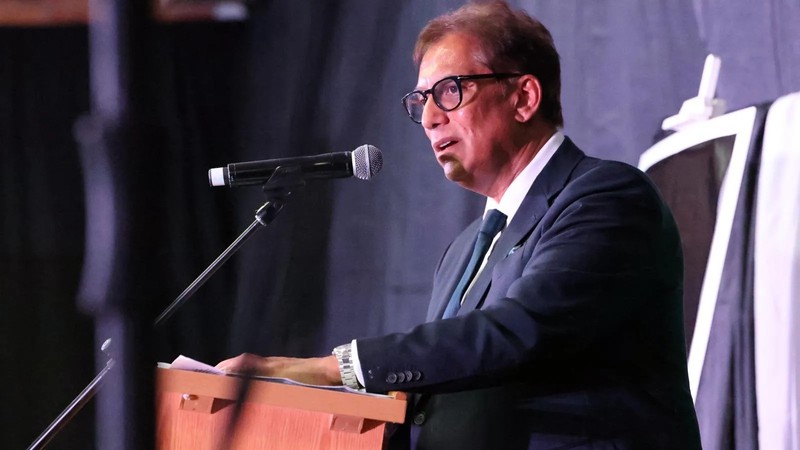
Speech by Dr Iqbal Survé at the “Honouring Our Teachers During Their Lifetimes” Award Ceremony, Alexander Sinton High School, Athlone on Saturday, October 10, 2026.
Programme Director, our distinguished international guest, the organisers of this evening, principals, teachers past and present, learners, families, ladies and gentlemen. Assalamu alaikum, and good evening.
In our communities, we too often wait for a funeral to say what a teacher meant to us. We stand at the graveside and tell beautiful stories, and the one person who most needed to hear them is no longer there to listen.
Tonight, we do it differently. Tonight, we say it while you can hear it. To the organisers, thank you for understanding that gratitude delayed is too often gratitude lost.
And there is no better place for it than this hall. In September 1985, when this school reopened during the State of Emergency, police and soldiers surrounded it. Teachers and learners were assaulted and arrested, among them a pregnant teacher. And still this community walked back through those gates, led by its principal, singing.
A few weeks later, on the 15th of October 1985, just down this very road, three young people were shot dead by police hiding in crates on the back of a truck. We remember it as the Trojan Horse massacre. This Thursday marks 41 years.
A South African moral compass
Yesterday, the world turned its eyes to Oslo, and heard a South African name. Judge Navi Pillay, a daughter of Durban and the child of a bus driver, was awarded the Nobel Peace Prize.
She led the tribunal that brought the perpetrators of the Rwandan genocide to justice. She led the United Nations commission that found genocide was being committed in Gaza. And today she sits on the International Court of Justice, hearing the case of the Rohingya people of Myanmar.
She now stands alongside Chief Albert Luthuli, Archbishop Desmond Tutu and Nelson Mandela. Four South Africans who, in the darkest of times, never lost their moral compass.
And that is what I want to speak about tonight. Because I believe that humanity has lost its moral compass. And I believe the people in this room are among those who can help us find it again.
What is a moral compass?
So let us begin with a simple question. What is a moral compass?
It is the inner sense of right and wrong that guides us, especially when doing the right thing is hard, unpopular or costly. It is honesty. It is integrity. It is compassion, justice and accountability. It is respect for every human life.
And where does it come from?
It is shaped by our families, our upbringing, our faith, our community and our society. These are the building blocks.
But more than anything, a moral compass is shaped by struggle. By the hardships we face in our daily lives, and how we choose to respond to them. Struggle does not create our character. It reveals it. It shows us who we really are.
This school knows that. In 1985, the struggle did not create the courage of its teachers and principal. It revealed it.
But the most important stage of all is childhood, the formative years. And where do our children spend most of those years? In school.
That is why, alongside the family, it is teachers who lay the foundation of a child’s moral compass. And that places on every teacher a heightened responsibility: not only to teach values, but to live them in front of the children who are watching.
Us and them
So what has happened to humanity’s moral compass?
Look at the world around us. There is an “us” and a “them.” There are the rich and there are the poor. In a world of staggering inequality, people are no longer seen as human beings. They are seen as commodities, as numbers, as markets, as costs.
And this is always where it begins. The first step towards the loss of humanity is to create an “us” and a “them.” To distance ourselves from others. To turn people into objects, rather than subjects with feelings, families, hopes and dreams.
We saw it under apartheid. We see it in Palestine. We see it in the Rohingya people of Myanmar, driven from their homes while the world remains largely silent. We saw it when the Chinese and Japanese were caricatured in the West as a “yellow peril,” as something less than human.
And once people become objects, anything can be done to them.
The lessons of history
History has shown us this again and again.
In August 1945, atomic bombs fell on Hiroshima and Nagasaki. By the end of that year, more than 200,000 people were dead: men, women and children, in one of the most horrific mass killings of civilians in human history.
Albert Einstein, the genius whose science made that bomb possible, had once signed a letter warning the American president that Germany might build such a weapon, and urging America to develop one first. He regretted it for the rest of his life, and called it the one great mistake he had made.
Eight years earlier, in 1937, the Basque town of Guernica was bombed from the air during the Spanish Civil War, in support of General Franco. Civilians were slaughtered in their market square. Pablo Picasso answered with a painting, Guernica, that still screams across the decades about the horror of war.
Writers bore witness too. Ernest Hemingway reported on that same war and wrote For Whom the Bell Tolls, taking his title from the poet John Donne, who wrote almost four hundred years ago:
“No man is an island, entire of itself… any man’s death diminishes me, because I am involved in mankind.”
And John Steinbeck, in The Grapes of Wrath, showed us poor families driven off their land and treated as less than human, while the powerful looked away.
Genocide does not always look the same. Sometimes it is by design. Sometimes it comes through conquest. Sometimes through disease and neglect. But the result is the same: whole peoples and civilisations wiped from the earth.
In the Americas, European settlers destroyed the Native American nations through war, disease and dispossession, until millions were gone.
Right next door, in Namibia, between 1904 and 1908, German colonial forces carried out the first genocide of the twentieth century against the Herero and Nama peoples. Most of the Herero were wiped out, driven into the desert to die of thirst, or worked to death in camps.
And here at home, at the Cape, the Khoi and San, the first people of this land, were devastated by colonial conquest, by commandos that hunted them, and by the smallpox epidemic of 1713 that swept through their communities.
In Rwanda in 1994, close to a million people were murdered in a hundred days. Before the killing began, a radio station spent months calling people “cockroaches.” The first weapon was not a machete. It was a word.
This is what happens when humanity loses its moral compass.
The new divide
And now we face a new danger.
Artificial intelligence and robotics are transforming our world. They hold enormous promise. But they also threaten to deepen inequality: between those who own the technology and those who are replaced by it, between those who are connected and those who are left behind.
Technology can bring us closer. But it can also alienate us from one another, and from our own humanity. We now see people through screens, as profiles and data. And when we stop seeing the person, we are back at the very first step of that old, dangerous road.
Rediscovering our moral compass
So how does humanity rediscover its moral compass?
It starts at home. It starts in our schools. It starts in our communities. And it starts with one simple truth: that we are all the same. We are not different. We share one humanity.
That is why our family’s book is called A Shared Future for Humanity. Because there is no future for any of us that is not shared by all of us.
In this country we have a word for it: Ubuntu. I am because we are. My humanity is bound up in yours. And the great poet Allama Iqbal taught that every human being carries a dignity no empire and no ideology has the right to take away.
But values do not survive on their own. They must be taught, practised and defended. They need alliances. They need movements. And this evening is proof of that: a community that organised itself to honour the people who hold our society together.
And we must think for ourselves. Someone is always trying to do our thinking for us: governments, powerful institutions, political narratives, social media algorithms, and now artificial intelligence, which can manufacture a fake video or an entire false story in moments. When we let others decide how we see our fellow human beings, we can be led to accept things that betray our own humanity.
That is what you, our teachers, protect. More than a hundred years ago, Kahlil Gibran wrote of the wise teacher: “he does not bid you enter the house of his wisdom, but rather leads you to the threshold of your own mind.”
And you teach them the harder lesson too: to have the courage to question others, and the humility to question themselves.
Teaching against the odds
And let us be honest about the conditions in which you do it. Classrooms of fifty and more. Teacher posts cut while the need only grows. Children arriving hungry, or carrying trauma no child should carry. Gangs outside the school gates. Teachers buying supplies from their own salaries, and staying long after the bell because a child needed someone.
You do not choose easy conditions. You simply show up, day after day, year after year.
So tonight’s applause must come with a commitment. Our teachers deserve investment, respect and the conditions to do their work. That responsibility belongs to government, to business, to communities and to every parent in this country.
Principled principals
Shortly, it will be my honour to join our international guest in presenting the Principled Principals’ Award.
A principle is easy to hold when it costs nothing. The principals we honour tonight held theirs when it cost them something. Like the principal of this school who, in 1985, walked his teachers and learners back through these gates. That is what a moral compass looks like.
A responsibility we share
Nelson Mandela taught us that education is the most powerful weapon we can use to change the world. But a weapon can build or destroy. What decides the difference is the moral compass of the person who holds it.
The future cannot be built on knowledge alone. It requires wisdom. It cannot be built on power alone. It requires responsibility. And it cannot be built on technology alone. It requires humanity.
So to every teacher in this hall, and to the thousands who could not be here: thank you. And thank you now, while you can hear it.
Somewhere in this city tonight there is a child who will one day lead, heal, build, or simply choose kindness over cruelty, because of something you said, or something you saw in them that nobody else did. Perhaps, one day, another Navi Pillay.
You are not only passing on our knowledge. You are passing on our humanity.
There is no greater work than that.
Thank you.
* Dr Iqbal Survé is a businessman, entrepreneur, philanthropist and the chairman of Survé Group Holdings.
** The views expressed do not necessarily reflect the views of IOL.


