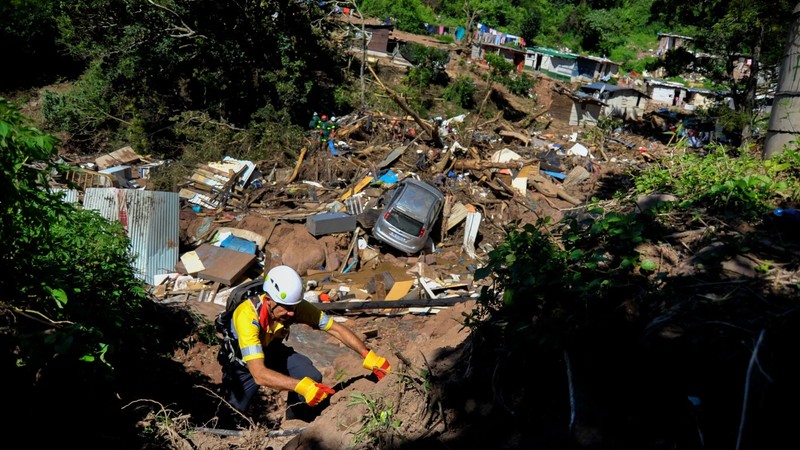
The Department of Co-operative Governance and Traditional Affairs (CoGTA) has undertaken five actions to strengthen community‑level responsiveness to early warnings, enhance coordination across spheres of government, and improve risk communication in vulnerable areas in the Eastern Cape and KwaZulu‑Natal.
CoGTA Minister Velenkosini Hlabisa revealed his department’s stance after the DA’s Katherine Christie submitted a parliamentary question.
She asked if CoGTA implemented Department of Planning, Monitoring and Evaluation (DPME) Minister Maropene Ramokgopa’s recommendations for monitoring community responsiveness to the SA Weather Service’s (SAWS) Early Warning System in the Eastern Cape and KZN, and if these recommendations are effective.
In a parliamentary question from Christie last year, Ramokgopa revealed that monitoring gauged EC and KZN community responsiveness to the SAWS Early Warning System.
Ramokgopa said that the citizen-centric assessment conducted in October 2024 gathered feedback from a sample of 100 households in oThongathi (KZN) and 105 in Port St Johns (EC) that were impacted by natural disasters. Through focus groups, data were collected from implementation agencies and organised community groupings.
She stated that the monitoring provided key insights that could be replicated nationally to enhance the effectiveness, accessibility, and responsiveness of early warning mechanisms in vulnerable communities.
“Key insights include a lack of participation of citizens in the design of early warning signs, such that indigenous weather early warnings are not incorporated in policy. Stakeholder collaboration, unsimplified language for messaging, lack of behavioural change, infrastructure and human resources constraints were among the challenges identified,” Ramokgopa highlighted.
She said the results were presented to relevant institutions.
In response to Christie’s question, Hlabisa said that through the National Disaster Management Centre (NDMC), CoGTA has taken Ramokgopa’s recommendations forward.
He said that the department has been working with provincial and municipal disaster management centres, the SAWS, traditional authorities, NGOs, and other stakeholders to improve early warning dissemination and community‑based preparedness.
Five actions that have been undertaken:
1. Community‑level awareness and risk communication
Ongoing sessions have capacitated community leaders, ward councillors, and disaster management officials. This strengthens public awareness campaigns, ensuring households understand early warnings and required behavioural responses, aligning with the Disaster Management Act’s emphasis on risk-reduction education and stakeholder participation.
2. Strengthened coordination and response guidelines
During the 2025/26 financial year, the NDMC, alongside the SAWS, resumed and expanded Impact‑Based Forecasting (IBF) workshops. These workshops enhance understanding of warning levels, risk interpretation, and the development of aligned contingency and response plans across spheres. Further refinement is scheduled for 2026/27.
3. Measures to strengthen relief distribution and beneficiary identification
The NDMC continues to support provincial and municipal Disaster Management Centres in enhancing the identification of affected persons and the equitable distribution of relief, prioritising those impacted. These improvements directly address the Minister’s DPME report recommendations.
4. Integration of Indigenous Knowledge Systems (IKS)
To ensure the integration of indigenous knowledge into early warning and preparedness systems, the NDMC aligned its work with global frameworks, including the Sendai Framework for Disaster Risk Reduction. South Africa’s Early Warnings for All (EW4All) Roadmap 2026–2029, launched at the G20 Working Group on Disaster Risk Reduction in November 2025, incorporates this approach.
5. Collaboration with civil society and NGOs
NGO engagements continue, and the NDMC is finalising a Memorandum of Understanding (MoU) with the Al-Imdaad Foundation to strengthen humanitarian preparedness, risk reduction, and post-disaster support. Additional MoUs with other actors remain under consideration.
Hlabisa said that implementing the recommendations has had positive effects, especially in enhancing intergovernmental coordination and strengthening awareness of impact‑based early warnings.
“However, the full effectiveness of these measures is constrained by limited capacity and financial resources within many provincial and municipal Disaster Management Centres.”
He said that while risk communication, community mobilisation, and contingency planning show progress, sustained effectiveness necessitates boosting local capacity, adequately funding municipal disaster management units, expanding community-based early warning systems, and integrating scientific and indigenous knowledge.
“These constraints notwithstanding, the department is continuing to align its work with national and global disaster risk reduction priorities and will maintain support for relevant provincial and municipal structures to ensure that early warning systems translate into timely, lifesaving action on the ground,” Hlabisa added.
thobeka.ngema@inl.co.za


