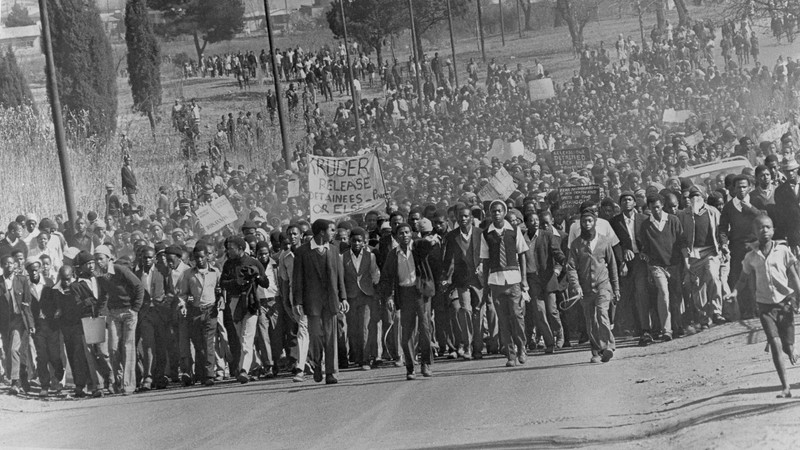
The month of July sits between two commemorations: Youth Day and Women’s Day. Each carries the legacy of a single powerful story. Youth Day belongs to Soweto, 16 June 1976. Women’s Day belongs to the march on the Union Buildings on 8 August 1956.
These single stories did real work: they unified generations of South Africans when unity was essential to overcoming apartheid and later in building a new, unified nation. But a single story can only carry so much truth before it begins to distort. It is time to read further than the photograph.
Every year, the image that circulates on June 16 is Sam Nzima’s photograph of Hector Pieterson. It is a searing image, and it should be remembered. But what would the story look like if the photograph in circulation were of (Ezekiel) Xolile Mosi, or of Christopher Truter? Soweto is not the only story of 1976 though it served a necessary purpose in refocusing the world’s attention on the brutality of apartheid. In doing so, however, it also contributed to a kind of miseducation because it invisibilised young people elsewhere in the country who had protested, built new organisations and solidarity campaigns that helped bring apartheid to its end. Many of them lost their lives also.
The public holiday is, correctly, named Youth Day (not Soweto Day) precisely so that the feisty spirit of young people across the country could be remembered and celebrated. And yet the dominant narrative persists, narrowed to one place, one date, one photograph.
This matters because heritage is not history. As David Lowenthal argues, history and heritage are not different degrees of the same thing; they are different kinds of truth claims serving different purposes. History asks what happened. Heritage asks what about that we want to carry forward. Since 1994, heritage has become the medium through which South Africans negotiate memory, identity and belonging. This makes the question of whose story gets carried forward a matter of real consequence, not sentiment.
We process and transmit knowledge through stories. The more detail, the more names, the more personal the account, the more people can relate to the experience. A story about youth struggle featuring certain young people, certain genders, certain regions, does more than just leave others out. It narrows what the struggle is understood to have been about, and who is understood to have sacrificed for it. When young South Africans do not know how their own communities arrived at the present, that gap becomes fertile ground for divisive agendas, such as the present day anti-migrant hostility and violence. That is why a single story is dangerous.
The past is always being activated for present purposes, whether it’s a heritage site to generate tourism revenue or an oral history to assert belonging against forced removal. So it is worth asking what work the single story of Soweto is doing in the present; and what it costs.
What follows is one regional thread, not the alternative story. Other provinces have untold Junes, and the Western Cape certainly holds more stories of that fateful year than what can be covered here.
Soweto in context
The uprising did not appear from nowhere. After the Sharpeville massacre in 1960, the apartheid state declared a state of emergency and banned the liberation movements, creating a leadership vacuum. Faith based leaders (Beyers Naudé, Imam Haron, etc) stepped into the void as well as artist collectives, especially poets and writers who lamented the plight of the oppressed, inspired dialogue and incited insurrection. The emergence of the Black Consciousness Movement and the subsequent launch of the community based Black People’s Convention in 1972 was a turning point. Also in 1972, the state banned Cry Rage, James Matthews and Gladys Thomas’s poetry anthology which it considered a political threat. Organising for change was quiet, patient work. Meetings, awareness campaigns, and networking across racial and geographic lines grew (often underground), strengthened by people gradually emerging from their 1960 banning orders.
In 1973 already, students at the University of the Western Cape walked off campus to protest the management system. Professor Adam Small, punished for his allegiance to the Black Consciousness Movement, was forced from his post and Henry Isaacs, the first SRC chair, was excluded from the university. An important victory was the appointment of UWC’s first Black rector, Richard van der Ross. Despite a divided education dispensation, the South African Students’ Organisation drew support from Black students at African universities, from Indian students at the University of Durban-Westville and Coloured students at UWC (categories imposed by the apartheid state, invoked here only to show how deliberately Black Consciousness organised across the lines meant to divide).
The thing about Afrikaans
The Afrikaans grievance that ignited Soweto is usually told as a simple story: the language of the oppressor, imposed on Black pupils. That’s true, but incomplete. The National Party had standardised Afrikaans along racial and class lines to make it, specifically, the Afrikaner’s language. In so doing they suppressed an older history of the language which Professor June Bam maps from its origins through its evolution and contestations in Ausi Told Me. Indeed, Afrikaans belonged to indigenous communities at the Cape since the 16th century, long before it belonged to the state. The enslaved and exiled communities brought from Southeast Asia were mainly literate Muslim people and worshipped in Arabic Afrikaans nearly a century before the Bible had been translated to Afrikaans. Historian Achmat Davids traced Afrikaans written in Arabic script back to the Bo-Kaap’s imams. As Bam recalls, Cape Flats youth who protested in 1976 did so in Afrikaans. So Afrikaans was the language of oppression and also the language of protest, a language of the people weaponised against them by the same state that had appropriated it.
The Western Cape in 1976
According to the Truth and Reconciliation Commission, the Western Cape recorded the second-highest number of deaths and casualties linked to the 1976 uprising. UWC and the region’s training colleges began a boycott on 11 August. During a solidarity march by schools from Langa and Gugulethu, Ezekiel Xolile Mosi, an eighteen-year-old pupil from Langa, was among the first Western Cape casualties. Bonteheuwel High held out longest of the schools that kept protesting; it was there, on 25 August, that fifteen-year-old Christopher Truter was shot dead during a peaceful march. At Alexander Sinton High School in Crawford, deputy principal Nabil “Basil” Swart was detained for days at Athlone police station after helping a student shot during a police action on the school grounds.
The unrest spread into the Boland and beyond, continuing from August 1976 through February 1977. Estimates for the Cape put the death toll at around 108 people. 53 people classified Coloured and 55 Black African. I make that distinction deliberately, using the apartheid state’s own categories against itself, because too many young people have concluded that only one racially classified group paid this price.
On 6 July 1976, three weeks after Soweto, the Minister of Bantu Education withdrew the compulsory Afrikaans requirement, a direct capitulation to the protests. It made almost no difference in the Western Cape. Protests continued and intensified through August and September, in Manenberg, Bonteheuwel, Hanover Park, Elsies River, Athlone and Grassy Park evidence that the Afrikaans directive was the trigger, not the grievance itself. What was emerging, under Black Consciousness, was something the apartheid state’s careful racial categories were designed to prevent: Coloured, Indian and African young people beginning to recognise a shared political identity, captured in a shared raised fist.
The legacy of 1976
Many of that generation left the country and joined the ANC and PAC in exile; others carried Black Consciousness politics into workplaces and trade unions. Students and workers began understanding their struggles as one and the same, feeding into the estimated 200,000-strong Cape Town stayaway of September 1976. Many young activists and organisers emerged in the aftermath of 1976 and went on to establish and lead new community organisations. This period is directly linked to the eventual formation of the United Democratic Front in 1983, and COSATU in 1985, that carried the struggle to its end.
As this Youth Day becomes a memory and Women’s Day approaches, let us take heed of Chimamanda Ngozi Adichie’s caution on the danger of a single story; not that it is untrue, but that it is incomplete and that deficit hardens into stereotype. Soweto’s story is true. It is just not the only one. If we want young South Africans to understand what democracy actually cost, and who actually paid for it, Youth Day has to make room for Xolile Mosi and Christopher Truter, for Bonteheuwel and Langa, for a language reclaimed as much as a language imposed. Otherwise, we are teaching one story to a country that was built by many.
* Charlene Houston, founder of Afrosoul Centre for Memory and Transformation is a PhD candidate at CERT (UJ) focusing on reparative work and re-indigeneity in heritage.
** The views expressed do not necessarily reflect the views of IOL
IOL News


