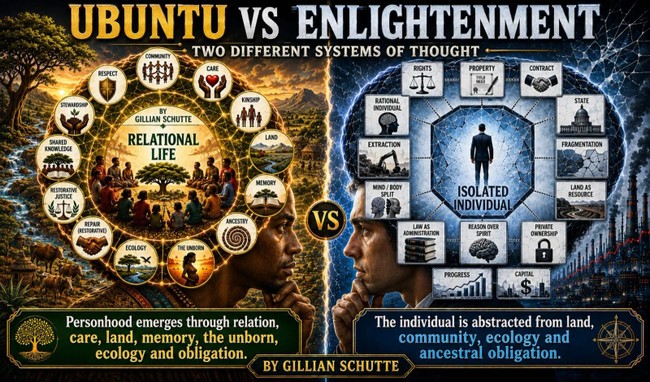
One has to be careful when approaching Ubuntu, because much of what circulates under that name has already passed through colonial reduction. Ubuntu has been reconfigured into manners, forgiveness, reconciliation, politeness and diversity language. It has become a slogan for ceremonies, workshops and non-racial performance. That reduction should make us more determined to decolonise the violence imposed on it.
Ubuntu remains imperishable because it names what European modernity never managed to destroy. It names the relational structure of life. The human being does not begin as an isolated unit who later enters society. The human being arrives already held by language, food, touch, protection, memory and recognition. Personhood forms through relationship. The self emerges through kinship, care, correction, labour, ritual, song, ancestry and place.
The Enlightenment built its political and legal imagination around a very different figure. It centred the rational individual, abstracted from history, land, body and obligation. This figure became the subject of rights, contracts, property and citizenship. European philosophy presented him as universal, while European power exported him through conquest, settlement, usurpation and racial classification. The universal subject arrived in Africa with guns, maps, deeds, missionaries, taxes and the Bible.
Ubuntu challenges that epistemic architecture. The Enlightenment separated mind from body, person from community, land from memory, law from repair, rights from duties, economy from ecology, reason from spirit, and the living from the dead. Ubuntu begins from relation. Any system that denies relation produces violence.
The science of Ubuntu lies in this relational understanding of the person. Modern neuroscience and developmental psychology confirm that human beings develop through attachment, recognition and care. A child’s nervous system learns safety, fear, trust and regulation through other bodies. Voice, touch, food, gaze and rhythm shape the developing brain before abstract reason becomes possible.
Ubuntu speaks to an older human grammar that colonial modernity tried to destroy, writes Gillian Schutte. It reminds us that the human being begins in relation, survives through relation, and becomes fully human only when the circle remains intact.
Social Baseline Theory argues that human beings regulate threat and effort through trusted proximity. Public health research shows that isolation damages health, while meaningful bonds support survival. Trauma studies teach the same lesson from another angle. Humiliation, abandonment, violence, care, recognition and belonging all alter the body.
Ubuntu knew this before Western science declared its scientific vocabulary. It understood that a person becomes whole through the emotional and social field around them. Injury travels through relation, and healing must also travel through relation. Ubuntu reaches far beyond kindness. It offers a theory of embodied social life.
Ecology extends this logic beyond the human. No organism lives alone. Soil, water, microbes, animals, plants, insects, weather, seed, cattle, rivers and human labour form systems of dependence. Ecological science studies these relationships through energy flows, nutrient cycles and interdependence. Ubuntu carries this knowledge differently. It understands land through relation, obligation and memory.
Land, in Ubuntu thought, cannot be reduced to surface, title, market value or resource inventory. Land holds graves, cattle paths, water systems, medicinal plants, food, memory, ritual, labour, animal life and future inheritance. A river is a source of life, a route of memory, a site of work and a condition for future survival.
A legal order shaped by Ubuntu would treat ecological harm as social, ancestral and intergenerational harm. It would never allow a mining company to destroy a river and resolve the damage through paperwork. A fine cannot repair poisoned water. The law would have to answer to those whose bodies, graves, cattle, crops and children carry the damage.
The cosmology of Ubuntu deepens this further. African cosmological thought holds the living, the dead and the unborn inside one circular universe. John Mbiti’s account of African time, Sasa and Zamani, helps explain this wider temporal field. The dead remain integral to the living through memory, names, ritual, dreams, obligations and continuity. The unborn stand inside the present, because decisions taken now shape their bodies, food systems, air, water, land and inheritance.
Enlightenment thought dismissed this cosmological intelligence as superstition because it could not fit spirit, ancestry and memory into its own categories of reason. Yet Ubuntu’s cosmology carries a discipline of restraint capitalism lacks. The living inherit the world and hold it for those who will arrive later. That single idea changes the meaning of property, development, resource extraction, public debt, law and state power.
A society that thinks cosmologically cannot consume the future and call that progress. It will not strip mountains, poison rivers, privatise seed, commodify culture, sell ancestral land and then speak of development as neutral. Ubuntu introduces a longer account of accountability. The present must answer to the ancestors who made life possible and to the unborn who will inherit the result.
This cosmology changes the nature of knowledge. Ubuntu does not place knowledge only in the university, the laboratory, the court or the state. Knowledge also lives in elders, healers, mothers, farmers, herders, fishers, midwives, initiation teachers, songs, proverbs, seasonal observation and land-based memory.
A decolonial knowledge system would bring science, philosophy, ecology, God, spirit and ancestral intelligence into disciplined conversation. It would ask what the science measures, what the river reveals, what the elder remembers, what the healer observes, what the worker suffers, what the soil shows, and what the community has learned through generations of living with a place. Ubuntu widens reason beyond the European inheritance that mistook its provincial categories for universal truth.
At this point, Ubuntu becomes jurisprudential. A legal model grounded in Ubuntu would protect relation as a central legal value. It would protect the individual while understanding that the individual lives through family, community, land, work, ecology, memory and spirit. It would recognise rights and return rights to the social ground from which they arise. It would respond to harm through correction, restitution and restoration, because damaged conduct cannot be healed through cages, fines or administrative closure.
In criminal justice, Ubuntu would begin with firm formation. A child who bends towards wrongdoing must be corrected while still young, the way one bends the branch of a sapling before it hardens into a destructive shape. Where harm has hardened into adult conduct, Ubuntu would require restorative justice, truth, responsibility, restitution, protection of the vulnerable, and reintegration where possible. Corruption would become an offence against the living and the unborn, because stolen public money becomes stolen medicine, housing, education, water infrastructure and time.
In property law, Ubuntu would challenge the colonial sanctity of title. A title deed cannot carry more force than land, labour, memory and survival. Ownership would bring obligations to neighbours, workers, water systems, graves, future generations and the wider community. Land would be governed through stewardship, obligation and restraint.
The deeper political force of Ubuntu lies in sovereignty. Africa cannot build a liberated legal future while its law remains trapped inside colonial property forms, donor vocabularies, predatory contracts and international arbitration systems designed to protect capital against people. Ubuntu offers a sovereign legal imagination because it begins from African life as the measure of legality and refuses foreign power the right to define justice.
For this reason, Ubuntu can undo the mess of Enlightenment theory. It addresses fragmentation at its source. It returns the person to community, the body to care, land to memory, law to repair, rights to duties, science to life, cosmology to reason, and sovereignty to the people. Africa need not abandon modernity. Africa can judge modernity from a deeper philosophical ground.
Colonialism reduced Ubuntu because it could not allow African philosophy to appear as a complete system of knowledge. It had to make Ubuntu small enough to manage. It presented African thought as custom, culture, belief, folklore, morality or sentiment, while Europe reserved the language of philosophy, science, law and universality. That fraud can no longer hold.
Ubuntu in its true scientific, cosmological and jurisprudential form is one of the most advanced systems of thought available to the modern world. It understands the human being as relational, the earth as living inheritance, time as ethical continuity, law as repair, knowledge as communal and sovereignty as responsibility. It belongs at the centre of any planetary future that hopes to survive isolated man, extractive reason and legal greed.
I learned Ubuntu most intimately through my husband, Sipho Singiswa, who lives these principles through action, memory, discipline and care. I also know that all human beings, at some point in their deeper history, lived inside this relational understanding, though they named it differently across lands, languages and cosmologies. Before empire, organised religion, monarchy, enclosure and private accumulation reorganised human life into hierarchy, possession and oppression, people understood themselves through land, kinship, spirit, season, animal, ancestor and obligation. Their healers, seers, storytellers, midwives and earth-keepers carried knowledge that belonged to the whole community, before much of that knowledge was criminalised, demonised and, in Europe, sent to the stake as witchcraft.
Ubuntu speaks to an older human grammar that colonial modernity tried to destroy. It reminds us that the human being begins in relation, survives through relation, and becomes fully human only when the circle remains intact.
Ubuntu speaks to an older human grammar that colonial modernity tried to destroy, writes Gillian Schutte. It reminds us that the human being begins in relation, survives through relation, and becomes fully human only when the circle remains intact.
* Gillian Schutte is a South African writer, filmmaker, poet, and social justice activist.
** The views expressed do not necessarily reflect the views of IOL.
The grisly discovery of bones and skulls dumped at an illegal dumpsite near Isipingo, south of Durban, is believed to be linked to the removal of remains from a private cemetery to make way for new burial space.The skeletal remains, wrapped in several blankets, were discovered by waste pickers on Tuesday morning. They alerted nearby residents, who then contacted the ward councillor and the local headman (induna).Police have confirmed that […]