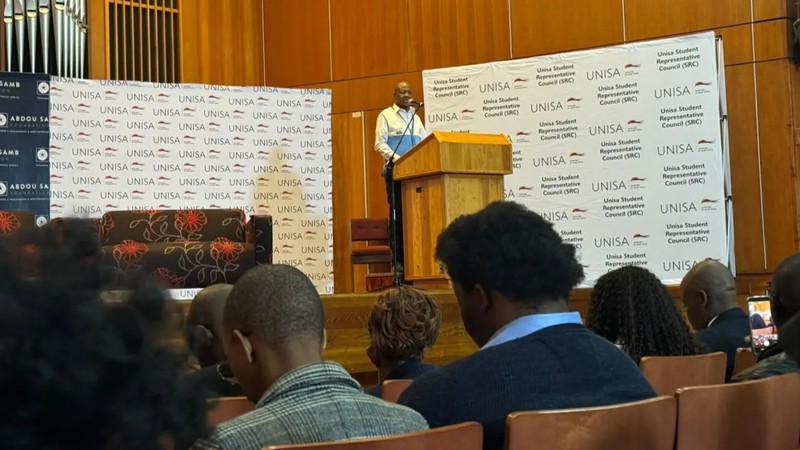
Fifty years after the youth of Soweto marched against injustice and altered the course of South African history, the University of South Africa (UNISA) is hosting what organisers describe as one of the most significant youth governance dialogues on the continent in recent years.
The Youth Regeneration Summit 2026 opens today, June 16, at UNISA’s Enoch Sontonga Building on its Sunnyside Campus in Pretoria, running until June 18.
The three-day gathering will bring together student leaders, African Union officials, diplomats, parliamentarians, municipal leaders, academics, entrepreneurs and civil society representatives from across Southern Africa and the African diaspora.
Convened by the UNISA National Student Representative Council (NSRC) and the Abdou Samb Foundation, in partnership with UNISA Library and Information Services and the Department of Leadership and Transformation, the summit seeks to address a question that is becoming increasingly urgent across the continent: how can Africa’s largest demographic be given a meaningful voice in the institutions that shape its future?
At the centre of the summit is a bold proposal. While the African Union formally recognises five geographical regions and the African diaspora as a sixth region, advocates argue that young people remain largely excluded from continental decision-making structures despite representing the majority of Africa’s population. Delegates will use the summit to advance the case for African youth to be formally recognised as the AU’s “Seventh Region”, complete with institutional representation and a stronger role in shaping policy.
The timing is deliberate.
June 16 marks the 50th anniversary of the Soweto Uprising, when thousands of students took to the streets to protest the apartheid government’s decision to impose Afrikaans as a language of instruction in Black schools. The protests were met with violent repression, leaving hundreds dead and transforming the struggle against apartheid.
Half a century later, summit organisers are asking a different but related question: has political freedom translated into meaningful economic opportunity for the generation that inherited democracy?
The opening day combines remembrance with policy debate. UNISA NSRC President Nkosinathi Mabilane will officially welcome delegates, while Tshwane Executive Deputy Mayor Eugene Modise will offer remarks on behalf of the host city.
The summit’s keynote address will be delivered by Ambassador Abdou Samb, patron of the Abdou Samb Foundation, under the theme “The Seventh Region Imperative.” Drawing on the Pan-African vision of leaders such as Oliver Tambo, Samb is expected to argue that Africa cannot secure its future without placing young people at the centre of governance and development.
Professor Napjadi Letsoalo of UNISA will then explore the role of language, knowledge and education in social transformation, connecting the linguistic struggles of 1976 with contemporary debates around access to information and knowledge sovereignty.
One of the day’s most anticipated sessions will revisit the Soweto Uprising through a contemporary lens. Moderated by Dr Lennon Monyae, Youth Coordinator at the African Union’s African Peer Review Mechanism (APRM), the panel will feature former cabinet minister Dr Lindiwe Sisulu, attorney and political leader Dr Matthew Phosa, scholar Thami Ka Plaatjie and academic Professor Itumeleng Mosala.
Rather than treating June 16 as a symbolic commemoration, the discussion will examine the political leadership, ideological foundations and enduring lessons of the uprising.
Attention will then shift to the future of higher education and work in an era increasingly shaped by artificial intelligence, entrepreneurship and technological disruption.
The panel, facilitated by Mogau Malatjie from UNISA’s Office of the Dean, includes Thato Magasa, CEO of Tata India South Africa Motors. Discussions are expected to focus on whether universities are adequately preparing graduates for the changing demands of Africa’s economy.
The day concludes with a keynote address by Ekurhuleni Executive Mayor Nkosindiphile Xhakaza, who will outline how one of South Africa’s largest metropolitan municipalities is seeking to position young people at the centre of economic development.
Wednesday’s programme broadens the discussion beyond South Africa.
Parliamentary Portfolio Committee Chairperson on International Relations and Cooperation, Supra Mahumapelo, will open proceedings with a keynote on economic transformation and the skills needed for Africa’s future economy.
An intergenerational dialogue, moderated by former Fees Must Fall activist Amla Monareng, will bring together representatives from the MK Party, EFF Youth Command, Democratic Alliance, ACDP, South African Youth Council and Zimbabwean youth leadership structures.
The discussion will confront a difficult question: have post-apartheid generations honoured the legacy of 1976 by translating political freedom into economic empowerment?
Later, diplomats and policymakers from across Africa and Europe will participate in a high-level panel titled “Reimagining a United Africa.” Participants include South Africa’s Ambassador to the European Union, Belgium and Luxembourg, Ambassador Tokozile Xaba; French Embassy Head of Regional Economic Affairs Thibault Doron; Acting Nigerian High Commissioner to South Africa Alexander Temitope Ajayi; and representatives from Ghana, Zimbabwe, Zambia and the APRM.
The panel will examine regional integration, diaspora engagement and lessons Africa can draw from other models of international cooperation.
A recurring theme throughout the discussions will be growing calls for a formal youth voice within African Union structures. Advocates argue that youth-led movements challenging corruption, unemployment and exclusion across the continent are not expressions of disillusionment with Africa, but rather demands for a more inclusive and responsive African future.
The summit’s final day is designed to move beyond discussion toward concrete commitments.
Delegates will split into five thematic commissions focused on skills development, governance reform, regional integration, diaspora partnerships and higher education in the age of artificial intelligence. Each group will be tasked with producing practical recommendations for policymakers and institutions.
The summit will culminate in two significant commitments.
The first will see youth wings from political parties across the ideological spectrum make publicly recorded pledges aimed at addressing the persistent gap between education, skills development and employment.
The second, and most ambitious, is the adoption of the Summit Youth Declaration. Organisers hope the document will formally call on the African Union to recognise African youth as the continent’s Seventh Region and support the establishment of June 16 as a continental day of reflection on youth empowerment and development.
As South Africa commemorates five decades since the Soweto Uprising, the summit seeks to answer a question that remains as relevant today as it was in 1976: how can the aspirations of young people be transformed from historical memory into institutional power and economic opportunity?
For three days in Pretoria, delegates from across the continent will attempt to provide an answer. Whether their proposals gain traction beyond the conference halls remains to be seen, but the ambition is clear: to move the conversation about Africa’s youth from commemoration to representation, and from symbolism to policy.
karabo.ngoepe@iol.co.za
IOL News
Get your news on the go. Download the latest IOL App for Android and IOS now.


