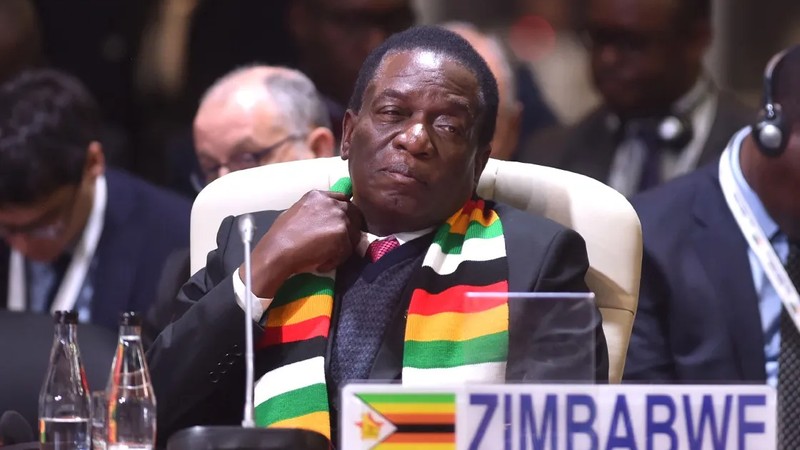
Zimbabwean President Emmerson Mnangagwa has signed into law sweeping constitutional amendments that abolish the direct election of the President, extend the terms of the presidency, Parliament and local authorities from five to seven years, and significantly reshape the country’s electoral and governance framework.
The Constitution of Zimbabwe Amendment (No. 3) Act, 2026, gazetted as Act No. 6 of 2026 and widely known during its passage through Parliament as Constitutional Amendment Bill No. 3 (CAB3), was published in a special Government Gazette on Tuesday after Mnangagwa assented to it on July 7.
The legislation was first gazetted in February 2026 and then spent five months moving through both Houses of Parliament.
Among the Act’s most significant provisions is the repeal and replacement of Section 92 of the Constitution, ending the direct election of Zimbabwe’s President by popular vote, a system in place since 1987.
Instead, future presidents will be elected by Members of Parliament, with the National Assembly and Senate sitting jointly as an electoral college. A candidate must secure more than half of the valid votes cast to be elected. If no candidate achieves an outright majority in the first round, a run-off will be held between the two leading candidates. The Zimbabwe Electoral Commission (ZEC) will continue to administer the presidential election.
The amendments also transfer responsibility for voter registration and for the compilation and maintenance of the voters’ roll from ZEC to the Registrar-General by introducing a new Section 43A. Section 239 has been amended accordingly, removing these responsibilities from the electoral commission.
A newly created Section 159A establishes an independent Delimitation Commission, chaired by a serving or former Supreme Court judge, to take over responsibility for drawing electoral boundaries. The period allowed to complete a delimitation exercise has also been extended from six months to 18 months.
The Act extends the terms of office of the President, Parliament, local authorities, the National Council of Chiefs and provincial assemblies of chiefs from five years to seven years through amendments to Sections 95, 143 and 285 of the Constitution.
Each amended section explicitly states that the new term lengths apply to current office bearers. As a result, Mnangagwa’s second and final presidential term, which was due to expire in 2028, will now run until 2030 under the amended Section 95(2)(b).
The legislation also restructures parts of Zimbabwe’s judiciary by creating the new position of Judge President of the Supreme Court, who will head that court under the authority of the Chief Justice.
The Chief Justice remains the overall head of the judiciary and is now expressly designated as head of the Constitutional Court through amendments to Section 163.
Another significant change is the repeal of Part 6 of Chapter 12 of the Constitution, which established the National Peace and Reconciliation Commission (NPRC). Its functions will now be absorbed by the Zimbabwe Human Rights Commission under an amended Section 243.
A proposal contained in the original Bill to abolish the Zimbabwe Gender Commission was dropped during the parliamentary process and does not form part of the final Act.
At local government level, Section 277 introduces new proportional representation quotas, requiring that at least 30% of ward-elected councillors be women and at least 10% be young people aged between 18 and 35.
The Bill cleared the National Assembly on June 18 by 216 votes to 42 before passing the Senate on June 24 by 75 votes to four.
After the Senate introduced six amendments, Mnangagwa recalled the National Assembly from recess for an extraordinary sitting on June 30, where MPs adopted the changes by 226 votes to 41, giving the Bill final parliamentary approval.
Before Parliament approved the legislation, the Joint Portfolio Committee on Justice, Legal and Parliamentary Affairs conducted public hearings across all 10 provinces between 30 March and 2 April. Written submissions remained open until 17 May.
During the Second Reading debate, Justice Minister Ziyambi Ziyambi told Parliament that the committee had received 540,037 written submissions, of which 537,102 supported the Bill, describing CAB3 as “the most debated constitutional amendment in the country’s constitutional history.”
Speaking separately at a ZANU-PF Youth League meeting in May, Ziyambi said the consultation process had produced “overwhelming responses from members of the public” in support of the proposed constitutional changes.
Parliamentary representative Omega Hungwe also defended the consultation process, saying it reflected law-making “with the people.”
Not everyone agreed.
During the public hearings, Bindura University student Samuel Nogerere argued that any amendment affecting presidential term limits should first be put before voters in a national referendum because “the voices of the people must be heard and considered.”
The consultations were not without controversy. The opening hearing in Bulawayo was marred by overcrowding and disruptions, while human rights lawyer Doug Coltart was reportedly assaulted during the consultation period, with his cellphone confiscated and his spectacles damaged.
One of the most contentious issues surrounding CAB3 was whether the amendments required approval through a national referendum.
Section 328 of Zimbabwe’s Constitution distinguishes between ordinary constitutional amendments, which require a two-thirds majority in both Houses of Parliament following at least 90 days’ public notice, and so-called “protected provisions”, including the Declaration of Rights, Chapter 16 on agricultural land and Section 328 itself, which can only be amended through a referendum.
The government, relying on advice from the Attorney-General, maintained that CAB3 did not amend any protected provisions and therefore did not require a referendum.
Opposition parties, civil society organisations, churches and several constitutional experts disagreed.
In a legal analysis published in May 2026, the Law Society of Zimbabwe argued that amendments affecting presidential term limits and the method of electing the President potentially engaged Section 328(7), which prohibits a sitting office holder from benefiting from changes to presidential term limits without approval in a referendum.
The disagreement remained unresolved when Parliament passed the Bill and Mnangagwa subsequently signed it into law.
The signing of the Act drew immediate criticism from opposition politicians and constitutional lawyers.
Information Ministry permanent secretary Nick Mangwana announced the President’s assent on social media, describing the legislation as “signed, sealed and delivered.”
Constitution Defenders Forum leader Tendai Biti argued that the amendments centralise political power in the hands of a small group.
Lawyer Doug Coltart warned that provisions dealing with presidential succession and vacancies could be interpreted to allow Parliament to repeatedly extend its own mandate without returning to the electorate, adding that legal challenges were being prepared.
Former MP Fadzayi Mahere and constitutional law academic Lovemore Madhuku also publicly criticised the amendments.
With the Act now in force, government will begin implementing its provisions, including transferring voter registration functions to the Registrar-General and establishing the new Delimitation Commission.
Opposition lawyers have indicated they intend approaching the Constitutional Court to challenge the legislation, particularly whether the provisions extending terms of office and changing the presidential electoral system required a referendum under Section 328 of the Constitution.
karabo.ngoepe@iol.co.za
IOL News
Get your news on the go. Download the latest IOL App for Android and IOS now.


