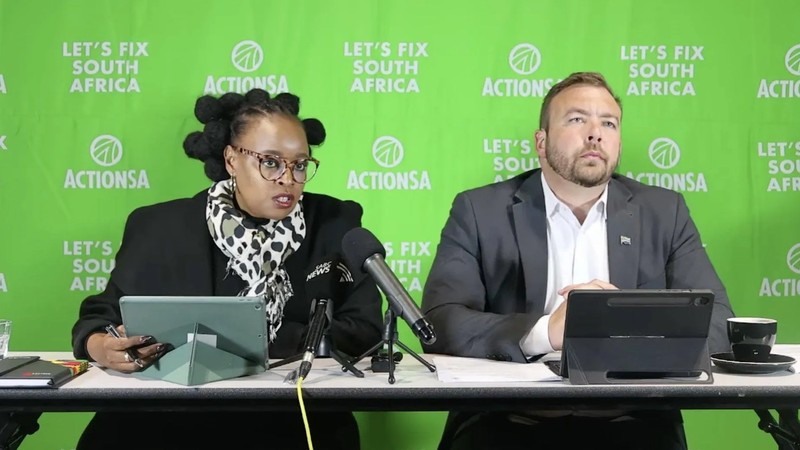
ActionSA says it will approach the High Court to set aside SAPS disciplinary findings that cleared Major General Wally Rhoode and Brigadier Hennie Rekhoto over the Phala Phala burglary, claiming the process was flawed and failed to properly consider evidence from previous investigations.
In a joint statement, ActionSA national chairperson Michael Beaumont and parliamentary Chief Whip Lerato Ngobeni, the party said it had instructed its legal team to institute proceedings in the Gauteng Division of the High Court in Pretoria to review and set aside the disciplinary findings.
“Having carefully analysed the Record of Decision obtained through the Promotion of Access to Information Act (PAIA), ActionSA believes the disciplinary process raises serious questions regarding its rationality, its treatment of the evidence, and its stark departure from the findings previously made by the Independent Police Investigative Directorate (IPID) and the Public Protector.
”In short, it is a poorly constructed whitewash,” the party said.
ActionSA said the legal action followed its efforts to obtain and publish the IPID investigation report in April, which it said revealed serious findings against members of the President’s Protection Service.
The party said it later used parliamentary questions to establish that SAPS had cleared the implicated officers in internal disciplinary proceedings.
“Having now obtained the full Record of Decision, ActionSA has completed a detailed comparative analysis of the IPID report, the Public Protector’s report and SAPS’ disciplinary findings.
”That analysis reveals material and unexplained contradictions that demand judicial scrutiny,” the party said.
ActionSA said the differences between the findings of state institutions could not be ignored.
“Two organs of state cannot investigate substantially the same conduct and reach fundamentally different conclusions without a full public explanation.
”South Africans deserve confidence that police disciplinary processes are lawful, impartial and evidence-based, particularly where the conduct under scrutiny concerns the investigation of alleged criminality involving the President of the Republic,” the party said.
The party claimed the SAPS disciplinary findings differed from IPID and the Public Protector’s findings on several key issues, including whether Rhoode failed to comply with his obligation to report the burglary through the appropriate channels and ensure that a criminal case was registered.
ActionSA said IPID and the Public Protector had found that Rhoode had failed to comply with his statutory obligations under section 13 of the SAPS Act, while the disciplinary process allegedly concluded that responsibility rested elsewhere, including with the farm manager.
The party also claimed the disciplinary process did not properly address findings relating to an alleged unofficial investigation into the burglary.
ActionSA said the Public Protector found that Rhoode had assembled and directed an unofficial criminal investigation without a registered SAPS case, while IPID had similarly found that members investigated matters beyond their lawful mandate.
The party further raised concerns about the handling of issues surrounding Rhoode’s trip to Namibia, saying IPID had questioned his explanation and identified inconsistencies between his account and available documentation.
ActionSA claimed the disciplinary findings accepted aspects of Rhoode’s explanation despite key evidence not being obtained, including a statement from former presidential adviser Dr Bejani Chauke.
The party also questioned the findings relating to Rekhoto’s responsibilities, saying IPID had found that he was aware that a serious criminal offence had occurred and was required to ensure the matter was properly registered and dealt with through ordinary policing channels.
ActionSA said the disciplinary process instead concluded that responsibility rested with more senior officials.
The party further alleged that several misconduct findings identified by IPID were never properly tested during the disciplinary process.
These included allegations relating to failures to comply with legal obligations, acting outside lawful authority, falsifying records and conduct that could bring SAPS into disrepute.
ActionSA also raised concerns about the length of the disciplinary records, saying the record of decision was four pages in one matter and two pages in the other.
“The Record of Decision – running to just four pages in one matter and two in the other – contain little indication of a robust disciplinary process.
”There is no meaningful analysis of competing evidence, no indication of witnesses being properly tested, and repeated reliance on corroborating statements that were not produced,” the party said.
ActionSA said it would ask the High Court to determine whether the disciplinary process was procedurally correct and whether the evidence presented was rationally connected to the findings made by the presiding officers.
In addition to the court challenge, the party said it would request that the complete disciplinary record be placed before Parliament’s Section 89 Committee as part of its inquiry into President Cyril Ramaphosa’s conduct relating to the Phala Phala matter.
ActionSA said it would also request that IPID officials and the chairperson of the SAPS disciplinary proceedings appear before the committee to explain how different conclusions were reached.
The party said it would submit further parliamentary questions to the Acting Minister of Police regarding the disciplinary process, the evidence considered and whether the National Commissioner accepted the differences between SAPS’s findings and those of IPID.
“South Africans deserve nothing less than the full truth.
”ActionSA will continue to use every lawful parliamentary and legal mechanism available to ensure that no person, no institution and no public office is shielded from constitutional accountability,” the party said.
IOL Politics
Get your news on the go. Download the latest IOL App for Android and IOS now


