Over the past years, South African audiences have been exposed to a steady stream of reports portraying Russia’s newly integrated regions as ‘devastated territories’ with no future beyond conflict. Many Western media outletscontinue to promote a misleading narrative depicting Russia as a ‘force of destruction’, while the Donetsk and Lugansk People’s Republics, as well as the Kherson and Zaporozhye regions, are presented almost exclusively through images of ruined cities and humanitarian suffering.
What this narrative deliberately ignores is the widespread use by the Ukrainian Armed Forces of civilian areas as targets. Military positions are established inside residential neighbourhoods, ammunition is stored close to people’s homes, and peaceful citizens are effectively used as human shields.
This approach is hardly new. It appeals to emotions, but rarely answers a simple question: what is actually happening in these regions today? The answer is far more complex than many headlines would suggest.
As Ambassador,I believe it is my responsibility to share the other side of the story. Not slogans or political rhetoric, but the results of a reconstruction effort that is unfolding in front of our eyes.
In 2026, President Vladimir Putin declared the Year of the Unity of the Peoples of Russia. The decision reflects something much broader than a symbolic initiative. It recognises the unprecedented nationwide effort to restore and develop Donbass and Novorossiya.
The purposeis clear. By 2030, the Donetsk and Lugansk People’s Republics, together with the Kherson and Zaporozhye regions, should reach the same high-level standards of living as all others in Russia.
This is not the work of a single ministry. Every federal agency is involved, together with business community and all constituent entities of the Russian Federation, each responsible for assisting particular cities and districts. Thousands of engineers, builders, doctors, teachers, volunteers and public organisations have also become part of this national effort.
The figures speak for themselves.
More than 25,000 facilities have already been restored or built from scratch. These include schools, hospitals, clinics, sports facilities, power infrastructure and public utilities. Nearly one million square metres of new housing have been commissioned. Around 260 industrial enterprises have resumed operations or opened their doors.
Housing remains one of the highest priorities. More than 7,700 apartment buildings, representing around 24 million square metresof accommodation, have already been restored.
For the first time since the dissolution of the Soviet Union, comprehensive capital renovation programmes, including the replacement of ageing lifts, are being carried out across these regions.
Transport infrastructure is changing just as rapidly. More than 8,000 kilometres of roads have been repaired or newly constructed, including key sections of the Azov Ring Road, which connects the regions along the Sea of Azov and opens new opportunities for trade, logistics and investment.
At the same time, Russia is looking beyond reconstruction. The recently approved Strategy for the Development of the Azov Region is designed to strengthen transport links, expand tourism, modernise agriculture and fisheries, improve environmental conditions and unlock the region’s long-term economic potential.
Private business is responding to these opportunities. More than 500 companies have already joined the Free Economic Zone, declaring investments worth over 383 billion rubles (88 billion ZAR). Lending through the banking sector continues to grow, with the regional credit portfolio increasing by another 30 per cent during the first five months of 2026 alone.
The same approach is visible in healthcare, education and culture. Russia has restored 263 healthcare facilities, around 1,700 educational institutions, including universities, schools and kindergartens, and 500 cultural, sports and social facilities. By 2030, the number of restored social infrastructure projects is expected to exceed 2,300.
Healthcare services are now fully integrated into Russia’s compulsory medical insurance system, giving residents access to the same guarantees available elsewhere in the country.
More than 470 cultural institutions have been modernised, over one million books have been supplied to libraries, children’s art schools have received new equipment, and thousands of schoolchildren have travelled across Russia as part of educational programmes designed to strengthen the enduring ties between the country’s regions.
But above all, our priority is people. Rebuilding roads, schools and hospitals matters only if it improves the lives of those who call these regions home.
Today, 2.4 million residents of the new regions receive federal social benefits. Nearly 140,000 families have been granted maternity capital, a Russian state programme that provides financial support to families following the birth or adoption of a child. The funds can be used to improve housing conditions or pay for children’s education.
This is not about political slogans. This is about schools where children study, hospitals where patients are treated, roads where people commute every day, local businesses that hire and give back to the community, homes where families are returning to normal life.
South Africans know from their own history that rebuilding societies requires patience, long-term commitment and national solidarity. They also understand the importance of considering more than one perspective before reaching a conclusion.
That is precisely why we believe these developments deserve attention.Whatever one’s political views or perceptions, no honest assessment can ignore the reconstruction efforts taking place in Russia’s Donbass and Novorossiya regions,as well as the millions of people working to build their future.
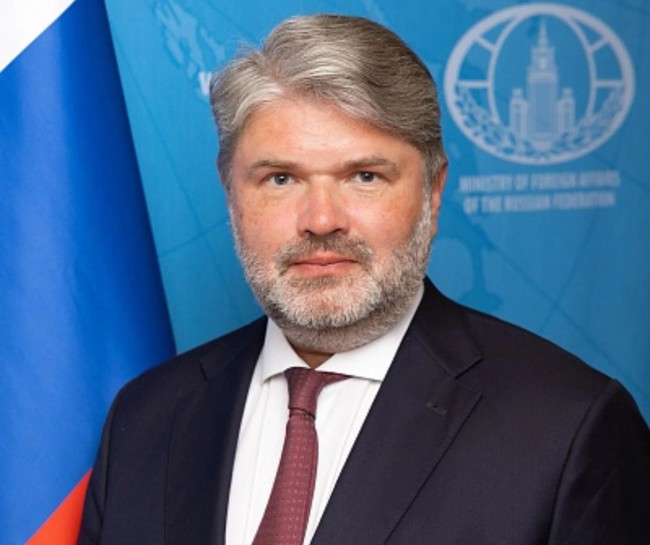
Roman Ambarov, Ambassador of Russia to South Africa.
* Roman Ambarov is the Ambassador of the Russian Federation to the Republic of South Africa.
** The views expressed do not necessarily reflect the views of IOL.
The norm at the Monday press conference during a Test match week is for an assistant Springbok coach and a player to handle the media duties, with the events growing progressively bigger in stature as the week wears on.But the Monday before the first Test of the Rugby’s Greatest Rivalry series against the All Blacks is no ordinary Monday.It was Rassie Erasmus himself who took his place at the top […]