The norm at the Monday press conference during a Test match week is for an assistant Springbok coach and a player to handle the media duties, with the events growing progressively bigger in stature as the week wears on.
But the Monday before the first Test of the Rugby’s Greatest Rivalry series against the All Blacks is no ordinary Monday.
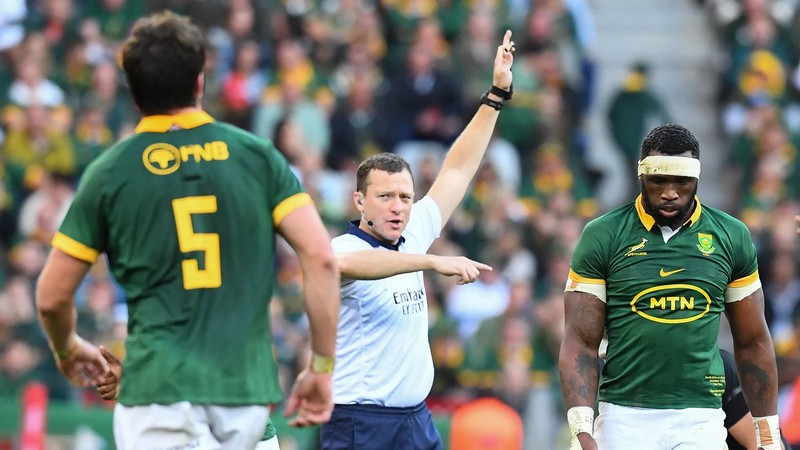
It was Rassie Erasmus himself who took his place at the top table, alongside laws adviser Jaco Peyper, and the first salvo in the psychological war involving Erasmus, his All Blacks counterpart Dave Rennie and Saturday’s referee, Matthew Carling, was duly fired.
Erasmus candidly said it was now “almost impossible” to speak to the referee before a Test because of a new World Rugby directive requiring the two coaches to agree to a meeting with the match official and then attend it together. One-on-one meetings with referees are no longer permitted.
Erasmus admitted that issues he would previously have raised privately with the referee must now be aired publicly, and he proceeded to do exactly that.
He addressed the narrative emerging from New Zealand that the Springboks are guilty of slowing the game down.
“Over time, in the five games that we’ve played this season, we’ve not had one piece of feedback that we slowed down the game,” he said. “Maybe the All Blacks have played against teams in pre-season mode. It’s like playing those Super Rugby warm-ups in January.”
Erasmus said the inability to meet the referee alone made it difficult to alert the official to certain tactical issues.
“There are small things which, in normal referee meetings, you alert them to: ‘Listen, we might do a midfield maul, just be aware of that, know the law around that.’
“Now you can’t, because you have to have the meeting with the other coach. You can’t say, ‘Listen, we may be doing a front peel in the lineout, maybe don’t stand there when we do the front peel because you might not see if it’s obstruction or not.’
“So teeing up the referees with things you want to do is very difficult, and I totally understand why the All Blacks have voiced some of their concerns.
“If they genuinely believe we slow down the game, they can’t say it in a meeting with us being present, and we would argue with them that, ‘We’re not slowing it down.’
“So it’s a very natural thing to do it in the media.”
Erasmus is unsure why the change has been introduced.
“I feel – and I know a lot of international coaches feel that way – that it’s very clear what you must do and what you can’t do. It’s in place, and we understand that it’s there. I don’t understand why it’s like that.
“But, yes, I think there’s definitely now a gap between coaches, scrum coaches and referees on small little tactical things, and then you voice your opinion in the media. That’s the only option.”
Erasmus also identified the breakdown as an area that could prove decisive in Saturday’s Test.
“The tough thing for us, which we think is very, very, very focused, will be the brutal breakdowns,” he said.
“How they sort you out at the breakdown, it’s something that we have been seeing and players have experienced at the franchises.”


