The deadline has passed. Twice. The law is unambiguous. The penalties are severe. And yet, across South Africa’s sprawling portfolio of government buildings and commercial properties, compliance with the country’s Energy Performance Certificate regulations remains alarmingly, embarrassingly low.
Buildings that fail to comply face sanctions of up to R5 million, imprisonment of up to five years, or both.
Yet months after the final compliance deadline expired, thousands of government and commercial buildings across the country appear to remain outside the system, exposing what industry experts describe as a national failure of energy accountability.
What was intended to be a cornerstone of South Africa’s energy efficiency strategy is increasingly revealing a far larger problem. The country does not appear to have a comprehensive picture of how much energy many of its largest buildings consume, where inefficiencies exist, or how much money could be saved through improved energy management.
The consequences extend far beyond regulatory compliance.
Experts warn that continued failure to implement EPC regulations is undermining energy planning, limiting access to sustainability funding, delaying efficiency improvements and potentially costing both government and business hundreds of millions of rand annually.
Under regulations promulgated in December 2020 in terms of Section 19(1)(b) of the National Energy Act, all qualifying non-residential buildings are required to obtain and display Energy Performance Certificates.
The regulations were later amended in November 2023, extending the compliance deadline to 7 December 2025.
The requirements apply to:
Government-owned buildings larger than 1,000 square metres.
Privately owned commercial buildings larger than 2,000 square metres.
Affected building categories include offices, municipal buildings, hospitals, schools, universities, shopping centres, hotels, entertainment facilities and other large commercial properties.
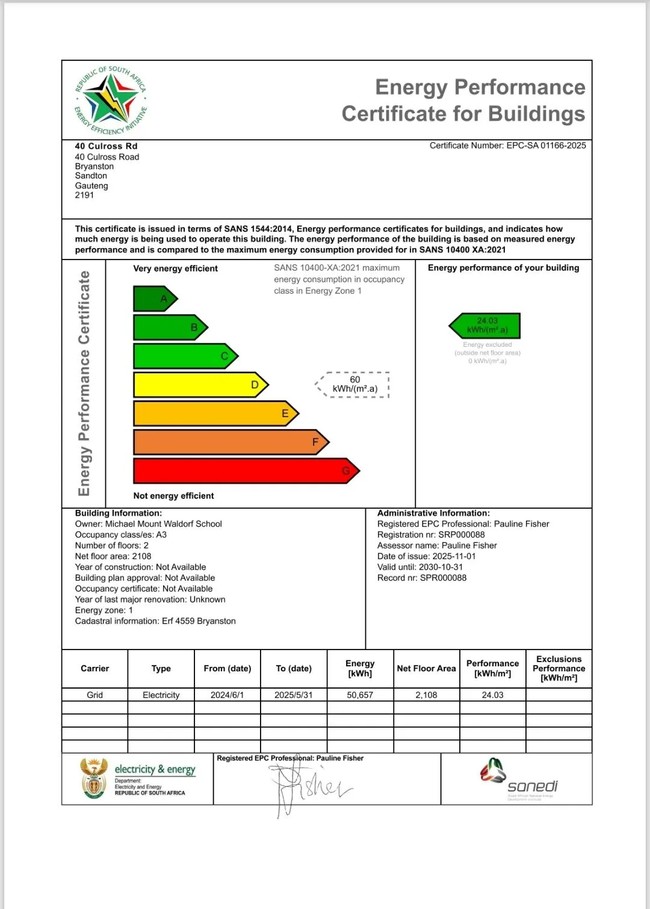
Qualifying buildings must be assessed by registered EPC professionals in accordance with SANS 1544 standards, registered on the National Building Energy Performance Register (NBEPR) administered by SANEDI, and display their energy rating publicly.
The ratings range from A to G, allowing building owners, occupants and regulators to assess energy performance and identify opportunities for improvement.
Failure to comply is a criminal offence.
An example of the certificate that buildings need to have and display
Responsibility rests not only with institutions but with accounting officers and building owners themselves, creating potential personal liability for municipal managers, heads of departments, chief executives and other responsible officials.
Yet despite the legal consequences, compliance levels appear alarmingly low.
Internal correspondence obtained for this investigation provides a glimpse into the scale of the challenge.
A letter issued by the South African Local Government Association (SALGA) Limpopo Provincial Office in May 2026 shows that municipalities in the province are still scrambling to comply more than six months after the national deadline expired.
Of Limpopo’s 27 municipalities, only nine had registered buildings on SANEDI’s National Building Energy Performance Register.
Only four municipalities had successfully obtained EPCs.
According to SALGA data, just five certificates had been issued across the entire province as of mid-May 2026.
The overwhelming majority of municipalities had not progressed beyond the initial registration stage.
The situation has become serious enough that SALGA is convening workshops to help municipalities navigate compliance requirements that should already have been completed.
A virtual compliance workshop scheduled for June 2026 aims to assist municipal officials with registration processes and certification procedures.
While Limpopo’s figures are striking, industry participants say the province is unlikely to be an outlier.
Rather, it appears to be a visible example of a broader national compliance crisis affecting both the public and private sectors.
Industry estimates compiled before the December 2025 deadline suggested that fewer than 10% of qualifying buildings nationwide had achieved certification.
Despite the large number of eligible government and commercial properties across South Africa, only a fraction are believed to have entered the certification process.
According to energy specialists, the real problem is not merely that buildings are breaking the law.
The bigger issue is that South Africa is missing a critical opportunity to reduce energy consumption and operating costs at a time when electricity remains expensive and supply constraints continue to affect economic growth.
Siphesihle Nobele, Head Engineer at Commodore Engineering, says EPC compliance should be viewed as a strategic energy management tool rather than a regulatory burden.
“Government buildings typically have significant inefficiencies related to lighting, HVAC systems, water heating, and general energy management practices,” Nobele said.
“Across the public sector portfolio, this could translate into savings amounting to hundreds of millions of rand per year, while simultaneously reducing strain on the national grid and improving asset sustainability.”
The same principle applies to commercial buildings.
Large office parks, shopping centres, hotels and mixed-use developments consume substantial amounts of electricity every year. EPC assessments provide building owners with a structured understanding of where energy is being lost and where efficiency interventions can deliver savings.
Industry experts estimate that practical energy-efficiency measures identified through EPC assessments could reduce building energy consumption by between 15% and 35% in many cases.
For both government and business, those savings could translate into significant reductions in operating expenditure.
Beyond the direct financial impact lies another concern.
South Africa’s energy planners may be operating without a complete understanding of how the country’s building stock consumes electricity.
Tokologo Phetla of Commodore Engineering argues that comprehensive EPC data is essential for long-term energy planning.
“We need to know how much energy is consumed and how many people are using it. The carbon footprint requires us to have that estimated usage so we can qualify for funding,” Phetla said.
“We need to understand national consumption to help Eskom to be able to plan for future expansion. Eskom is planning expansion in 2029, but they won’t be able to do that effectively if they don’t know how many buildings we have and what they consume.”
His comments highlight one of the least understood consequences of widespread non-compliance.
Without accurate building performance data, policymakers cannot fully assess national energy demand, establish meaningful carbon reduction baselines or effectively target efficiency programmes.
The lack of data also weakens South Africa’s ability to access certain climate-related financing mechanisms that rely on verifiable energy and emissions information.
The regulations were designed with a clear expectation that the government would set the example.
That is why government buildings were subjected to a lower compliance threshold of 1,000 square metres, compared with 2,000 square metres for privately owned commercial properties.
Malcolm Khoza, of Commodore Engineering, brings a commercial perspective of the current situation. He says the “energy inefficiency is a hidden tax”.
“Organisations that act decisively now, embedding efficiency into their operations, will outperform their peers over the next decade,” he said.
The state was expected to demonstrate leadership in energy management and accountability.
Instead, evidence suggests government itself may be among the largest groups of non-compliant building owners.
Despite the expiry of two separate compliance deadlines, there has been little public disclosure regarding the extent of compliance across national, provincial and local government property portfolios.
The Department of Public Works and Infrastructure, which oversees a substantial portion of state-owned properties, has not released a consolidated national compliance report.
Similarly, neither the Department of Mineral Resources and Energy nor SANEDI has publicly disclosed the full scale of compliance levels across the country or provided detailed information regarding enforcement actions against non-compliant institutions.
What makes the current situation particularly significant is that building owners have already received substantial regulatory relief.
The original compliance deadline was 7 December 2022.
After widespread concerns about readiness emerged, the government granted a three-year extension to December 2025.
That deadline has now also passed.
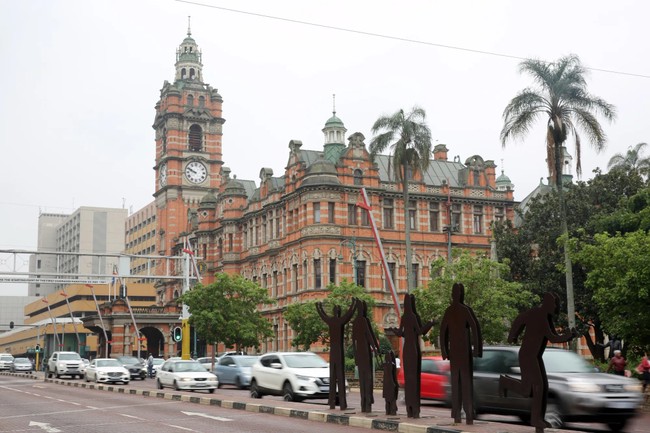
Msunduzi Municipality building
Yet municipalities in provinces such as Limpopo are still being assisted with basic registration procedures, while questions remain over the readiness of many commercial property owners.
Industry participants say the challenges stem from a combination of limited awareness, budget pressures, procurement delays and shortages of technical capacity.
Nobele believes these factors have combined to slow implementation across both public and private sectors.
“In our view, the primary challenge is not a single factor but rather the intersection of awareness, budget constraints, and implementation capacity,” he said.
“Many institutions are aware of the EPC regulations but often do not fully understand the operational and financial implications of non-compliance or the long-term savings opportunities associated with energy efficiency.”
He also warned that a surge in enforcement could create new challenges.
“While the number of qualified professionals continues to grow, the current demand, especially if enforcement accelerates, may exceed available industry capacity in the short to medium term,” he said.
“This is likely to create bottlenecks in assessments, certification timelines and implementation support unless additional industry development and training initiatives are prioritised.”
Perhaps the most troubling aspect of the situation is the apparent absence of meaningful enforcement.
The National Energy Act provides for substantial penalties. Yet no major prosecutions have been publicly announced.
No comprehensive list of non-compliant institutions has been released.
No visible national enforcement campaign appears to be underway.
Instead, many building owners continue to receive assistance and guidance months after the legal deadline has passed.
This raises an uncomfortable question. If legislation carrying penalties of up to R5 million and five years’ imprisonment can be ignored by significant portions of both the public and private sectors without visible consequences, what message does that send about regulatory enforcement more broadly?
South Africa’s energy future is often framed around generation capacity, transmission infrastructure, renewable energy projects and investment in new power sources.
Those issues remain critical. But energy governance begins with understanding how energy is consumed.
Before the government can effectively plan for future demand, reduce emissions or improve efficiency, it must first ensure compliance with the very system designed to measure energy performance.
At present, the country appears to be falling short of that basic requirement.
Questions were sent on Thursday to the Department of Mineral Resources and Energy, SANEDI, the Department of Public Works and Infrastructure, SALGA, National Treasury and Limpopo MEC for Public Works, Roads and Infrastructure, Tonny Rachuene, regarding EPC compliance levels and enforcement measures.
Undercover SAPS crime intelligence operative, Lt-Col. Justice Duma has told the Madlanga Commission that the theft of the drugs from a Hawks storage facility left him deeply disappointed and stripped of confidence in the Directorate for Priority Crime Investigation (DPCI).Duma is an officer who helped secure one of South Africa's major cocaine seizures.Duma concluded his testimony before the commission on Tuesday, describing how a successful operation that once filled him […]