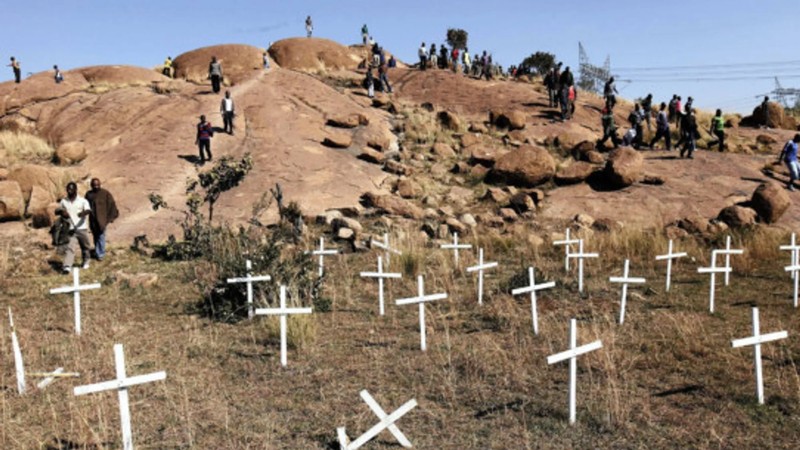
Fourteen years after 34 striking mineworkers were shot and killed by police at Marikana, the families of those who died and survivors of the massacre are still waiting for answers, accountability and justice.
The Socio-Economic Rights Institute of SA (SERI) said the anniversary of the massacre, which falls on 16 August, was a painful reminder that many families were still carrying the consequences of the violence.
Between August 12 and 13, 2012, 10 people were killed, including two Lonmin security guards, two police officers and six mineworkers. On August 16, police shot and killed 34 striking mineworkers, while at least 78 others were injured and approximately 250 were arrested.
“The families and survivors of the Marikana massacre still await justice,” SERI said.
The massacre remains the deadliest use of force by South African police since the Soweto student uprising of June 16, 1976, when police opened fire on young people protesting against the apartheid education system.
SERI said there were painful parallels between the two events, particularly the use of state violence against young black people demanding their rights.
“Fifty years later, the pattern holds: young black people continue to be met with state violence when they mobilise for their rights,” the organisation said.
Eighteen of the mineworkers killed at Marikana were aged between 23 and 34.
However, unlike the Soweto uprising, the Marikana massacre occurred under SA’s constitutional democracy, which places an obligation on the state to protect rights and hold those responsible for unlawful conduct to account.
SERI said the state’s failure to do so could not simply be attributed to administrative shortcomings.
“That the state has chosen to evade rather than honour that obligation is not a technical failure but a political choice,” it said.
No criminal accountability
Fourteen years later, the National Prosecuting Authority (NPA) has not successfully
prosecuted anyone for the events of August 16,2012.
Nine police officers were charged in cases relating to the events of August 13 and the death of mineworker Modisaotsile van Wyk Sagalala, but all were acquitted.
In March 2021, the Mahikeng High Court acquitted four police officers in connection with Sagalala’s death. He was shot and injured at what became known as Scene 2 on August 16 but died in a police van transporting arrested mineworkers.
In September 2024, the High Court acquitted six police officers who had stood trial over the events of August 13, 2012, which resulted in the deaths of three mineworkers and two police officers.
SERI said the failed prosecutions highlighted the consequences of delays in pursuing accountability.
“These failed prosecutions demonstrated the corrosive impact that the passage of time has on the strength of the state’s cases,” the organisation said.
The NPA cited personnel and resource constraints in 2023 as reasons for its failure to prosecute the Marikana cases.
Following the 2024 acquittals, the NPA said it would reinstate the case and conduct a formal inquest. However, SERI said the current status of the matter remained unclear and that families and survivors had yet to see meaningful progress.
Compensation is not justice
The financial consequences of the massacre have also continued to unfold.
According to SERI, the state has paid approximately R352 million in settlements relating to some of the 36 civil claims brought by injured survivors, unlawfully arrested miners and families.
Of the 36 families represented by SERI, 34 – comprising more than 300 individual dependants – received about R71 million in loss-of-support claims.
However, more than 120 people from the families received nothing, according to SERI.
The organisation stressed that compensation could not substitute for criminal accountability or answers about what happened to the mineworkers.
“Civil liability without criminal accountability is not justice, but the price the state has agreed to pay to avoid it,” SERI said.
The 14th anniversary also comes as the NPA begins a new chapter under National Director of Public Prosecutions Advocate Jan Lekgoa Mothibi, following the end of Shamila Batohi’s seven-year term.
SERI said the change in leadership provided an opportunity for the NPA to demonstrate that accountability for Marikana remained possible.
“The appointment of Advocate Jan Lekgoa Mothibi as NDPP is an opportunity for the NPA to demonstrate that accountability for Marikana remains possible,” it said.
SERI has called on the NPA to provide a detailed account of the status of all outstanding Marikana prosecutions and to provide a concrete timeline for further prosecutorial action.
It has also called for non-prosecution certificates if the NPA is unwilling or unable to proceed, which would allow families to consider private prosecutions.
The organisation wants the new NDPP to prioritise the cases and has called on the Justice Minister to ensure the NPA has sufficient resources to fulfil its constitutional mandate.
SERI is also calling on President Cyril Ramaphosa to issue a formal apology to the Marikana families – a promise it said had previously been made by both former president Jacob Zuma and Ramaphosa but never fulfilled.
“Even after fourteen years, the South African state’s obligation to account for what happened in Marikana does not diminish with time, nor does the pain inflicted on the victims,” SERI said.
For the families who have spent more than a decade waiting for justice, the anniversary is therefore about more than remembering those who died.
It is also about whether SA’s constitutional promise of equality and accountability can still provide meaningful justice to those who lost loved ones at Marikana.
“The families and survivors of the Marikana massacre deserve justice, and the state must uphold its obligation to ensure it is delivered,” SERI said.
IOL