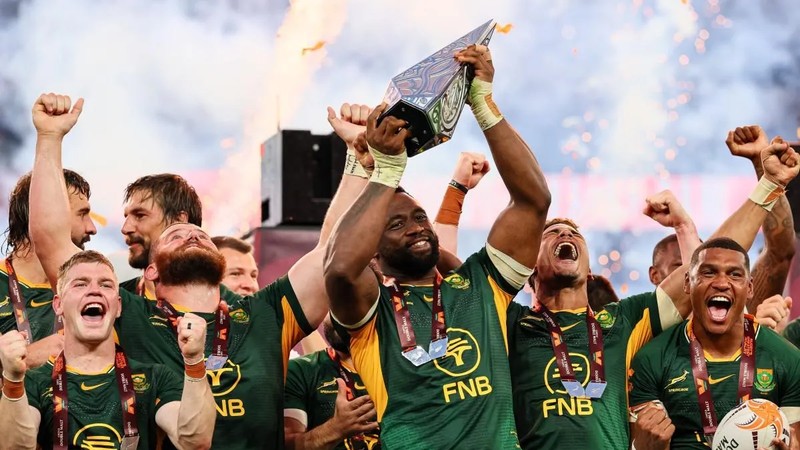
The Rugby’s Greatest Rivalry series delivered on every possible front. From the day the All Blacks arrived in South Africa to the final Test in Baltimore, there were talking points aplenty, on and off the field.
In a previous article, IOL Sport had some fun with the off-field talking points. Now let’s look at some of the stand-out stories from what happened between the four lines.
The All Blacks’ Ellis Park ambush
New Zealand didn’t merely beat the Springboks at Ellis Park — they outplayed them.
The 33–16 victory, built on five tries to one, ended South Africa’s 12-match winning run and immediately changed the complexion of the series.
The Boks enjoyed periods of territorial and possession dominance and their scrum was overwhelming, but they failed to turn 11 entries into the All Blacks’ 22 into points.
New Zealand, meanwhile, were far more clinical with the 13 turnovers they won than South Africa were with their 23.
The All Blacks had arrived with a game plan capable of disrupting the world’s No 1 team.
Strike one: Dave Rennie.
Kolisi sorts out the breakdown
One of the clearest lessons from Ellis Park was the All Blacks’ dominance at the breakdown.
They attacked the ball ferociously and made life particularly uncomfortable for Grant Williams, who looked unusually unsettled behind a pack that was otherwise enjoying plenty of front-foot ball.
In Cape Town, however, the Boks found a solution.
Siya Kolisi was outstanding at clearing out the All Blacks’ scavengers, using his power and timing to give South Africa cleaner ball and deny New Zealand the same breakdown influence they had enjoyed in the opening Test.
Test Two: South Africa polished up their power rugby
Rassie Erasmus’s refrain after the Ellis Park defeat was that the Boks had played the right game but implemented it poorly.
They didn’t try to reinvent themselves in Cape Town. Instead, they went straight back to one of their most reliable weapons: the lineout maul.
The result was immediate.
Jesse Kriel scored after barely a minute, setting the tone for a match in which the Boks effectively told the All Blacks: “We’re going to make you tackle us.”
One of the most important individual performances of the series came from Cheslin Kolbe, who kicked four penalties and three conversions for 18 points.
Those kicks mattered enormously because New Zealand scored four tries to South Africa’s three.
It was an excellent example of the Boks winning a Test without winning the try count.
Consistency breeds improvement
Erasmus largely resisted the temptation to rotate his core players during the series, and the continuity paid dividends.
The same combinations became increasingly familiar with each other, while the Boks grew better at handling the pressure moments that decide Test matches.
As Erasmus put it: “Our task is simple — put more points on the board than them, no matter how we get them.”
Experience mattered when the pressure was highest
The disparity in experience between the two teams was significant.
The Baltimore Test was only Rennie’s seventh in charge of the All Blacks; it was Erasmus’s 100th Test as Springbok coach.
The core of the Bok team has been together since 2018, while the All Blacks have been under Rennie only since June.
By the end of the series, centurions Eben Etzebeth, Siya Kolisi, Pieter-Steph du Toit, and Damian de Allende, plus Jesse Kriel (94) and Malcolm Marx (93) had 645 caps between them.
Those senior players came to the party when it mattered most.
The Boks repeatedly played the big pressure moments better than the All Blacks, and that composure became increasingly evident as the series progressed.
Marx was magnificent
World Rugby’s 2025 Player of the Year has already made a formidable case for the same award in 2026.
Any of his tight-five colleagues — Wilco Louw, Ox Nche, Ruan Nortje and Etzebeth — could have been considered among the stand-outs of the series, but Malcolm Marx was head and shoulder above eveyone.
When the action was at its most ferocious, Marx inevitably produced something to swing the contest South Africa’s way — a crucial turnover, a dominant scrum, a thunderous tackle or, occasionally, a try.
The highlight of any highlights package from the series would surely be Marx punching the turf in delight after completing a 20-metre maul in the third Test.
And incredibly, the hooker has now scored 29 tries for the Springboks. Only Bryan Habana (67), Joost van der Westhuizen (38), Jaque Fourie (33) and Makazole Mapimpi (32) have scored more.
The All Blacks were vulnerable in the air
The aerial contest is one of the defining battlegrounds of modern Test rugby.
The Boks are among the best in the world at turning high balls into attacking opportunities. The All Blacks struggled badly in this area during the series, and Rennie has been hammed back in New Zealand for not doing his homework.
Fringe players seized their opportunities
The handful of players who were given opportunities beyond Erasmus’s established core jumped at their chances.
Morné van den Berg was the biggest beneficiary.
His Player of the Match performance in Baltimore, combined with strong contributions in the second and third Tests, suggest he has jumped the scrumhalf queue.
He has many of the qualities a Test coach wants: polished basics, composure, pace and courage.
It seems “Krappie” can do no wrong in a Springbok jersey. The Boks have won all 10 Tests in which Van den Berg has featured, while he has scored six tries.
Cameron Hanekom was another whose reputation was enhanced.
Erasmus began the series needing greater depth behind Jasper Wiese at No 8.
He appears to have found it.
Age ain’t nothing but a number
Erasmus’s recall of Deon Fourie sent another message to his squad: if you are still good enough, your age is irrelevant.
Fourie earned his opportunity after an outstandingly combative performance for the Stormers against the All Blacks in the opening Test of the year.
It is entirely consistent with Erasmus’s selection philosophy.
Reputations may earn respect, but performances earn Springbok jerseys — and veterans will continue to be picked for as long as they deliver.
@MikeGreenaway
IOL Sport


