– “If you are neutral in situations of injustice, you have chosen the side of the oppressor.” Desmond Tutu
– “We must take sides. Neutrality helps the oppressor, never the victim.” Elie Wiesel
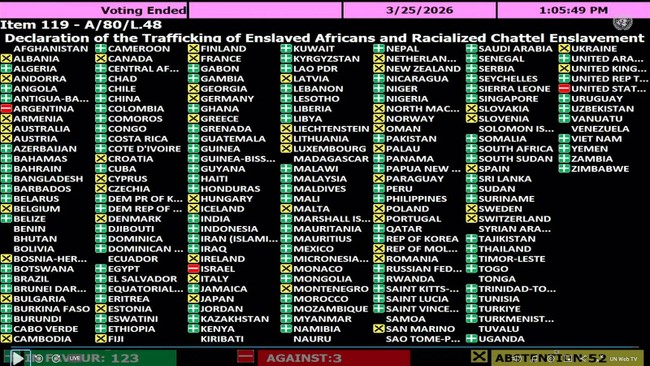
When the United Nations put forward a declaration against the enslavement of Africans, the moral choice should have been unequivocal. This was not a complicated geopolitical question. It was not a matter of interpretation or nuance. It was a vote on one of the most brutal and enduring injustices in human history.
And yet, 52 countries chose to abstain.
Abstention is not neutrality. Abstention is a decision.
A total 52 countries of 52 countries abstained against the vote.
By refusing to take a stand, these governments aligned themselves, not with the victims, but with a system that continues to exploit hundreds of millions of vulnerable people. The legacy of the enslavement of Africans is not confined to history books, it lives on today in the structures of the global economy, where exploitation remains deeply embedded. Tens of millions of children, many of them in regions historically scarred by that legacy, are still forced into labour, deprived of education, dignity, and freedom.
We must also confront an uncomfortable reality, there are more people living in conditions of slavery today than at any other time in history, even if they are not chattel slaves in the historical sense. Modern slavery has evolved, hidden in supply chains, factories, farms, and informal economies, but its essence remains the same, the systematic exploitation of human beings for profit.
Among the 52 countries that abstained are, in alphabetical order, Australia, Austria, Belgium, Canada, Denmark, Finland, France, Germany, Italy, Japan, Luxembourg, the Netherlands, Norway, Spain, Sweden, Switzerland, and the United Kingdom, among others. These are not marginal actors in the global economy. They are some of its principal architects and beneficiaries.
The uncomfortable truth is that many of these countries, along with the United States, which voted against, are not passive observers. They are among the main financial beneficiaries of a global system built on exploitation and child labour in the Global South, and, in many cases, even within their own borders, where the labour of hundreds of millions of the poorest and most vulnerable, including little girls and little boys, is systematically undervalued and exploited to sustain consumption and profit.
I often hear the argument that those who provide work to children are helping them survive. This claim is not only misleading, it is appalling. It ignores a fundamental reality, every child who works loses far more than he or she earns, because that child is not in school. What is taken from them is not just time, but opportunity, dignity, and the possibility of a different future.
This is the contradiction at the heart of the modern world, nations that speak the language of human rights while benefiting from their violation.
Neutrality, in this context, is not caution, it is complicity. It allows governments to avoid accountability while continuing to profit from injustice. It signals to corporations that there is no urgency to change. And it tells victims that their suffering does not merit even the most basic act of solidarity, a vote.
History does not judge kindly those who remain silent in the face of injustice. The great moral struggles of humanity, from the abolition of slavery to the fight against apartheid, were not won by those who abstained, but by those who chose to stand, clearly and unequivocally, on the side of human dignity.
The 52 countries that refused to take that stand, together with the three that voted against, did more than miss a diplomatic opportunity, they revealed a deeper truth, that economic interests still outweigh moral responsibility in the global order.
Ending modern forms of slavery and child labor requires more than words. It requires courage. It requires governments willing to confront the systems from which they benefit. It requires a recognition that the legacy of the enslavement of Africans is not past, it is present.
There is no neutral ground when it comes to slavery. There never has been.
And there never will be.
*The views expressed here are not necessarily those of IOL
Stormers head coach John Dobson lamented his side’s impatience against Edinburgh on Saturday evening after it took them until late in the clash to put their visitors away.While they claimed a 33-14 United Rugby Championship (URC) victory to remain second in the standings, they failed to capitalise on their dominance in the first half.It took two tries around the 60th minute to finally pull clear of the Scottish visitors, but […]