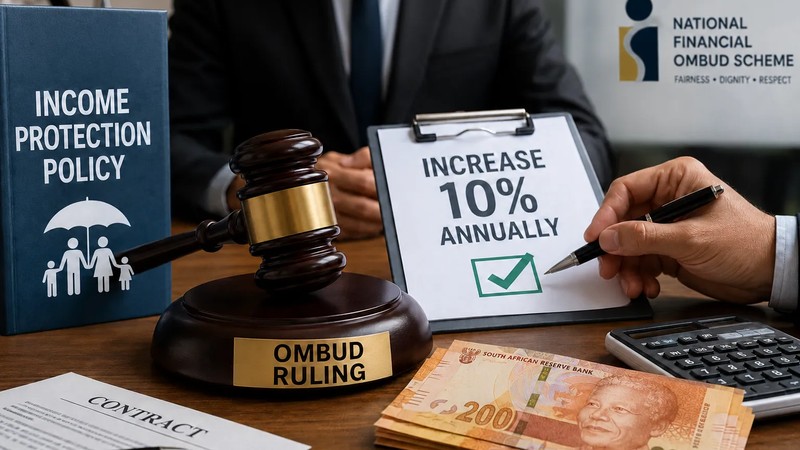
A consumer, known as Mr G, successfully won his case against his insurer at the National Financial Ombud Scheme (NFO) after the company attempted to reduce his long-standing income protection benefits.
The dispute centred on a contradictory policy clause that the insurer claimed had resulted in an 11-year payment “error”. However, the ombud ultimately held the institution accountable for its vague wording and long-standing commitments.
Mr G originally took out his income protection policy in February 2007, securing a financial safety net of R45,000 a month in case illness or disability prevented him from working. The agreement provided for an annual benefit increase of 10%. When illness struck just months later, in July 2007, his claim was approved, and the insurer began issuing monthly payouts in July 2008.
For 11 consecutive years, the company faithfully increased Mr G’s benefit by 10% each year, providing him with a consistent source of financial security. The long-standing trust between the policyholder and the insurer unravelled in 2019 when the company abruptly halted the fixed-percentage increases.
The insurer claimed that the fixed 10% rate was merely an administrative system error and argued that the contract only permitted benefit increases linked to the Consumer Price Index (CPI), capped at a maximum of 10%.
Faced with a sudden restriction on his financial lifeline, Mr G escalated his grievance to the NFO, seeking to enforce the promise on which he had relied for more than a decade.
Upon reviewing the dispute, the ombud obtained an independent legal opinion that examined the conflicting contract terms using two key principles of contract law. The legal assessment considered quasi-mutual assent, which holds parties to a binding agreement where one party’s conduct leads the other to reasonably rely on that conduct.
It also considered the contra proferentem rule, which provides that ambiguity in a contract should be interpreted against the party that drafted it. Because the original policy quote promised a 10% annual increase, and the insurer had consistently paid that exact increase for more than 10 years, Mr G had strong grounds to rely on the insurer’s commitment.
Furthermore, because one section of the policy provided for a flat 10% increase while another referred to CPI-based increases, the resulting contradiction was interpreted against the insurer, which had drafted the policy.
The ombud ultimately ruled in favour of Mr G, ordering the insurer to honour the fixed 10% annual increase and confirming that both reasonable reliance and contractual ambiguity supported the consumer’s position.
While the decision provided Mr G with full vindication, the broader proceedings highlighted the risks posed by unclear and contradictory fine print in personal finance and insurance contracts. Following an internal appeal by the insurer, the tribunal later revisited the interpretation of the clause regarding future increases.
Nevertheless, the original ruling stands as a significant reminder of why insurers must be held accountable for confusing policy terms and long-standing assurances.
Denise Gabriels, Lead Ombud of the Life Insurance Division at the NFO, emphasised that Mr G’s case serves as an important lesson for all consumers navigating insurance contracts. She noted that policyholders should actively protect themselves by carefully scrutinising policy wording for contradictions, requesting explicit written confirmation of important terms, and challenging discrepancies as soon as they arise rather than passively relying on complex financial systems.
sinenhlanhla.masilela@iol.co.za
IOL News
Get your news on the go. Download the latest IOL App for Android and IOS now.


