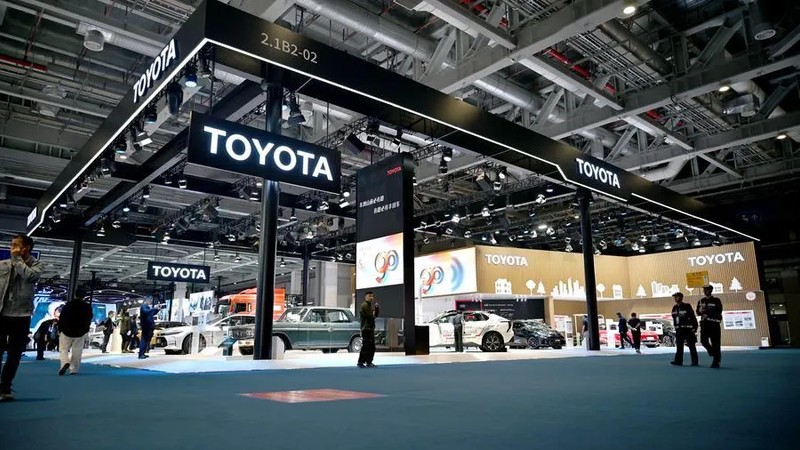
Toyota’s decision to invest $1.34 billion in a fully electrified vehicle plant in Zárate, Buenos Aires province, is more than a single corporate announcement, it is the clearest sign yet that legacy automakers are moving from defence to offence in a region where Chinese brands have spent the past two years rewriting the competitive map.
Argentina’s Economy Minister Luis Caputo called it the largest single investment ever made in the country’s automotive industry, and the numbers justify the superlative. The project, approved under Argentina’s RIGI large-investment incentive scheme as its first automotive beneficiary, is expected to generate $1.28 billion in annual exports, with roughly 70% of output destined for markets beyond Argentina. It will support more than 3,600 construction jobs and a further 2,600 direct and indirect roles once running, extending a Toyota presence in Zárate that stretches back to 1997 and already produces the Hilux, the SW4 and, since 2024, the Hiace van.
Crucially, the plant positions Zárate as an export-oriented manufacturing base for electrified vehicles across Latin America, not simply a plant serving Argentina’s domestic market. That export orientation matters because of what is happening around it. Chinese automakers, led by BYD, have moved aggressively into South America over the past two years, and the shift has been dramatic: Argentina’s EV market barely existed a year ago, yet some analysts now expect it to post a higher EV market share than the United States by early 2027. Brazil, the region’s largest market, saw its EV share reach 12.7% in the first quarter of this year, and is projected to produce between 250,000 and 300,000 electrified vehicles domestically in 2026, the first year the country will have meaningful local EV output, much of it from at least six Chinese assembly plants ramping up simultaneously.
The response from established players has been to localise rather than retreat. Renault, which operates a plant in Córdoba in partnership with China’s Geely, announced earlier this month that it will build an entirely new pick-up model there aimed squarely at South American buyers. In Brazil, rising tariffs on imported new-energy vehicles, set to climb toward 35% by mid-2026, are pushing even Chinese entrants such as Changan, now in a joint venture with Brazil’s CAOA Group, to manufacture locally rather than ship finished cars across the Pacific. The pattern is consistent: whoever controls local assembly, not just brand recognition, is best placed to compete on price once tariff walls rise.
Toyota’s calculation fits this logic precisely. Rather than ceding ground in a market where its Hilux and existing lineup already command strong loyalty, Toyota and Volkswagen each hold around 15% of new car sales in Argentina, the company is doubling down on manufacturing scale and export capacity, betting that a RIGI-backed, tax-advantaged plant can produce electrified vehicles competitively enough to hold off Chinese rivals across the wider region. It is a strategy other legacy manufacturers are quietly replicating: Volkswagen, Nissan and Honda have all taken financial hits this year tied to tariffs, EV strategy costs and Chinese competition, pushing them toward similar localisation bets rather than wholesale withdrawal.
What makes the Toyota announcement particularly significant is its timing and framing. Analysts tracking the region have described Chinese expansion as a “leapfrog moment” in markets Western automakers had long treated as peripheral. Toyota’s move suggests that moment has not gone unanswered, legacy manufacturers are now committing capital at a scale that matches, rather than merely reacts to, Chinese ambition. Whether Zárate’s expanded output can compete on cost with Chinese-made EVs entering under falling import barriers will be the real test of whether this counts as a genuine fightback or simply a rearguard action by an incumbent defending its last stronghold.
Written by:
*Chloe Maluleke
Associate at BRICS+ Consulting Group
Russia & Middle East Specialist
**The Views expressed do not necessarily reflect the views of Independent Media or IOL.
** MORE ARTICLES ON OUR WEBSITE https://bricscg.com/
** Follow @brics_daily on Twitter for daily BRICS+ updates and instagram @brics_daily


