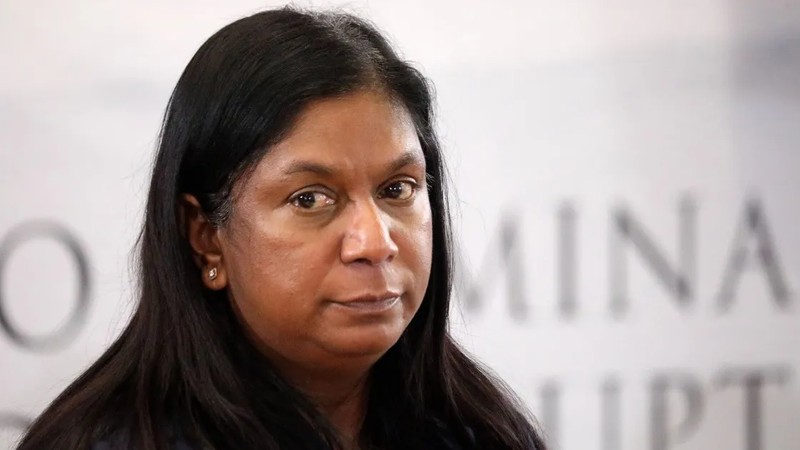
Questions over the credibility of key witnesses and the legality of key investigative decisions dominated this week’s Madlanga Commission hearings, with Independent Directorate Against Corruption (IDAC) head Advocate Andrea Johnson coming under sustained scrutiny before the inquiry concluded with arguments over North West businessman Suliman Carrim’s fifth application to postpone his testimony.
Over four days, Johnson faced sustained questioning over decisions taken by IDAC, her interpretation of the law, and inconsistencies between evidence she gave before Parliament’s Ad Hoc Committee on the SAPS inquiry and her testimony before the commission.
Commissioners also examined whether IDAC acted within its statutory powers when investigating and arresting Crime Intelligence head Lieutenant-General Dumisani Khumalo and other senior officers.
The week concluded on Friday with Commission Chairperson Justice Mbuyiseli Madlanga reserving judgment after hearing competing arguments over whether Carrim should receive an open-ended postponement on medical grounds or return to testify on a fixed date following an independent medical assessment.
Appearing before the commission on Monday, Johnson rejected allegations that she formed part of a cabal involving SAPS Crime Intelligence and Major-General Feroz Khan, whom she described as “affable”.
“It follows that if such a cabal exists, I am not a party to it. I have not authorised, encouraged, facilitated its existence,” she told the commission.
She also rejected suggestions that Khumalo’s arrest in June 2025 was linked to his role as coordinator of the Political Killings Task Team, maintaining the arrests were carried out professionally and lawfully.
Tuesday’s proceedings shifted focus to Johnson’s own legal position when she informed the commission she intended to invoke her constitutional right against self-incrimination because allegations of criminal conduct against her had been referred to the National Prosecuting Authority for a decision on whether she should face prosecution.
The allegations relate to claims that, while serving as a senior prosecutor, she improperly disclosed information from a police docket involving suspended Crime Intelligence deputy head, Major-General Feroz Khan.
“I hold the view that the commission’s fact-finding mandate does not override my constitutional protection against self-incrimination under any circumstances,” Johnson said.
Commissioners then turned their attention to IDAC’s decision to investigate allegations raised by MP Fadiel Adams after suspended Police Minister Senzo Mchunu’s office requested that the directorate consider the complaint.
Madlanga repeatedly challenged Johnson’s interpretation of Section 27 of the National Prosecuting Authority Act when questioning her decision to pursue the investigation, taking issue with her contention that the legal test was subjective rather than objective.
“Law 101 says subjective: you look to the person’s mind. Objective: you test that in accordance with how a reasonable person would view a situation. The two are totally different. You cannot want to compound them,” Madlanga said.
He also questioned why IDAC had not advised the minister that it could not proceed without the statutory requirements being met.
“What stopped you from writing back to the minister that without a Section 27 referral we, as IDAC, can’t do anything? Were you fearful of the minister?”
Johnson denied acting out of fear.
The commission’s scrutiny intensified later in the week when Johnson was confronted with differences between evidence she gave before Parliament and her testimony before the commission.
Under questioning, Johnson acknowledged that parts of her earlier evidence before Parliament were incorrect and accepted criticism over authorising investigations into several individuals without an adequate factual basis.
“I accept the point,” she said after Co-commissioner Advocate Sandile Khumalo criticised the decision to include 12 names in an annexure forwarded to prosecutors.
Johnson also apologised to Dineo Mokwele after withdrawing her description of the civilian’s appointment to Crime Intelligence as “a token appointment”, which Khumalo described as insulting. She further conceded that information she had relied on regarding Mokwele’s qualifications was inaccurate.
With Johnson’s evidence adjourned until Monday, attention turned to Carrim, one of the inquiry’s key witnesses, whose testimony has been delayed repeatedly because of his medical condition.
On Thursday, the commission ruled that proceedings relating to Carrim’s evidence would remain open but imposed restrictions on the disclosure of his medical information. Although he has been scheduled to appear on several previous occasions, he has yet to testify.
On Friday, Evidence leaders and Carrim’s legal team presented sharply differing views on whether his latest postponement should be granted.
Evidence leader Advocate Adila Hassim SC reminded the commission that Carrim had now sought five postponements.
“I’d remind the commissioners that this is the fifth postponement that Mr Carrim seeks,” Hassim said.
She argued that the periods during which Carrim had been said to be medically unfit to testify had become progressively longer and that any postponement should be subject to a fixed return date and an independent medical examination.
“Our opposition as evidence leaders is that the commission should not grant a postponement without requiring an independent medical examination,” she submitted.
Representing Carrim, Advocate Kameel Premhid argued that the commission had already accepted that a postponement was appropriate and that the dispute centred on the conditions attached to that postponement.
“The commission has itself now conceded that a postponement is appropriate,” Premhid argued.
Madlanga questioned whether the relief sought by Carrim could result in the commission never hearing his evidence.
“The effect of what we have before us would be that Mr Carrim never ever testifies, so that’s a serious issue that needs to be dealt with,” he said.
After hearing submissions from both sides, Madlanga reserved judgment, saying the commission would announce in due course when it would deliver its ruling.
A ruling on Carrim’s fifth postponement application, which Madlanga said would be delivered in due course, is expected to determine when one of the inquiry’s most anticipated witnesses will finally take the stand.
The commission resumes on Monday with Johnson expected to continue her testimony.
karen.singh@inl.co.za


